
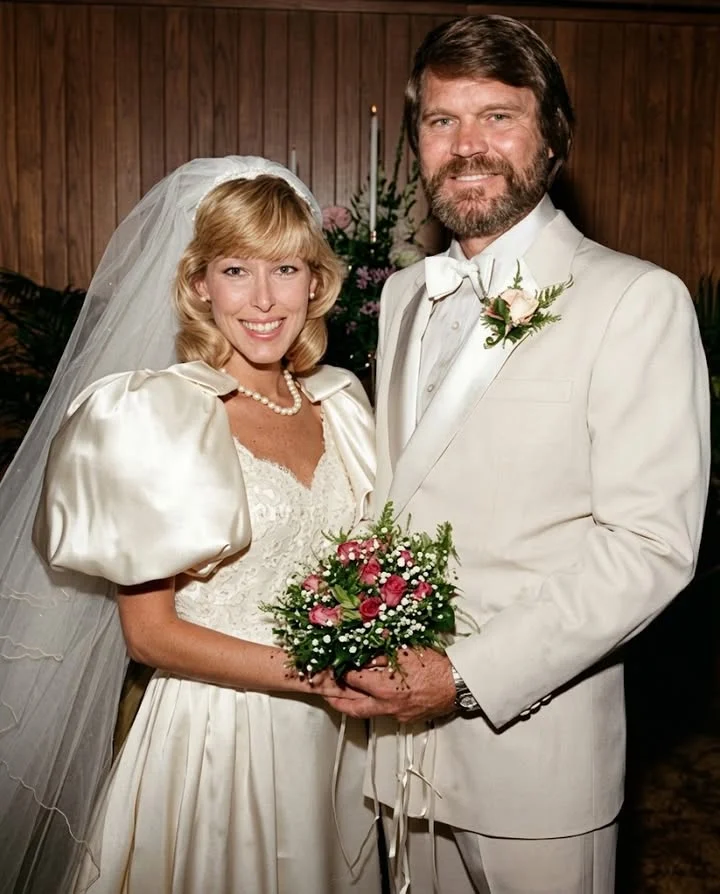
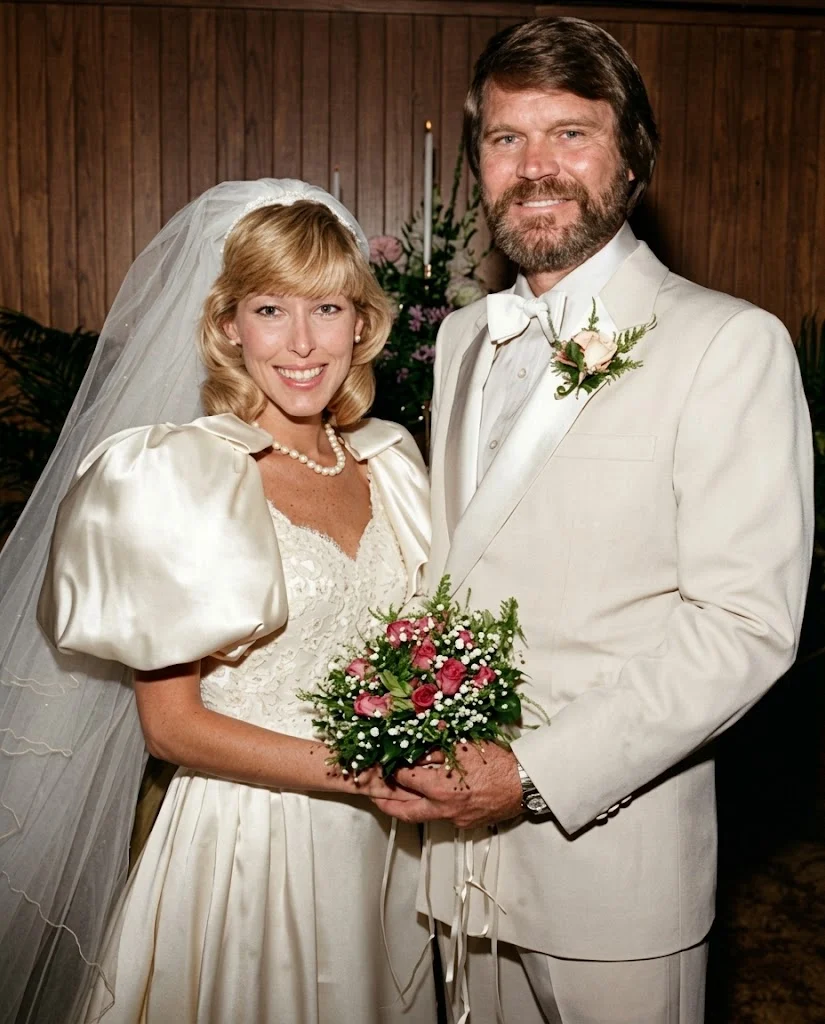
Three weeks after Sarah Barg gave birth to their son Dillon, she walked out of Glen Campbell’s life with the newborn in her arms. The divorce in 1980 closed a marriage that had begun as one of Nashville’s most public scandals and ended as a private warning about how fame can feed addiction.
The romance first shocked the country music establishment. Barg was married to Mac Davis, a successful country singer and one of Campbell’s friends. When Campbell and Barg chose to leave their previous lives for each other, the press recorded every step and turned their relationship into a public spectacle before the wedding even took place.
Campbell was already far more than a country singer. He was a global television star and a crossover phenomenon riding the success of his mid-seventies hits. He and Barg married in 1976 and entered a life under constant scrutiny. To the public they looked like a glamorous and defiant couple standing firm against industry judgment.
Behind closed doors the story was darker. The pressure of Campbell’s skyrocketing career and the stress of their public origin pushed him deeper into severe alcohol and substance abuse. He was becoming one of the biggest entertainers in the world while quietly losing his grip on his own life.
Barg stayed through the heaviest periods of his addiction. She tried to anchor a marriage that was fracturing under the weight of his habits and his erratic behavior. The cameras rarely captured that daily battle. It mirrored the darkest corners of a classic country heartbreak record.
The breaking point came in 1980. Just three weeks after Barg gave birth to Dillon, the couple finalized their divorce. The relationship that had defied the music industry ended because love could not cure a severe addiction.
She walked away with their newborn son, leaving Campbell to face the lowest point of his personal life.
He was alone in an empty house and forced to confront the wreckage his choices had caused. The man who had charmed millions with effortless guitar picking and smooth vocals was now fighting for his own survival.
That empty house could have been the final tragic chapter. Instead it became the catalyst for his redemption. The turning point arrived in 1981 when a blind date was arranged with a dancer at Radio City Music Hall named Kim Woollen.
Kim knew little about his music and even less about his turbulent industry reputation. What she saw was a man who desperately needed a lifeline. When they married in 1982, Kim became his fourth wife and took on the monumental task of helping him rebuild a shattered foundation.
With her steady presence and a renewed grounding in faith, Campbell finally broke the cycle of substance abuse that had haunted him for decades. Kim stood by him through the grueling process of recovery and provided the quiet stability he had spent his career searching for.
As his personal life stabilized, his relationship with his own catalog shifted. Songs of solitary wandering, missed connections, and weary travelers took on a heavier weight. In later years he no longer sang them from active turmoil but from the perspective of a man who had navigated the storm and survived.
The contrast between his 1980 rock bottom and his decades-long marriage to Kim became his greatest victory. He did not just survive his fame. He outlived his own demons. Their union lasted thirty-five years and guided him through his final public battle with Alzheimer’s disease.
His legacy was built on massive stages and television screens across the world. His actual triumph was finding a way out of the dark and finally building a home that did not crumble under the spotlight.