
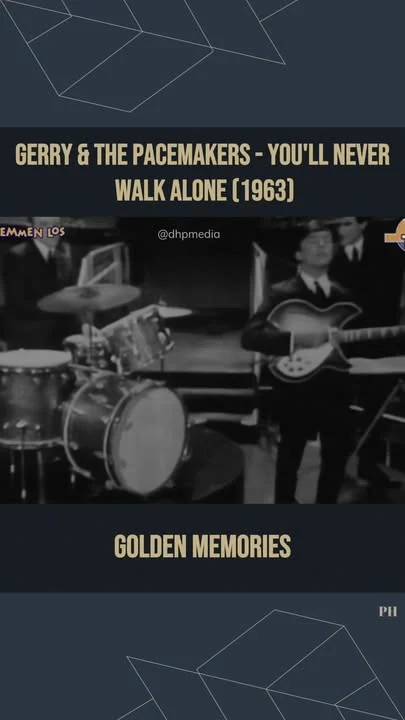
The first time the song truly landed was in a hospital corridor. A nurse, exhausted beyond measure, walked past a small cart with a speaker playing something soft. She mouthed the words without thinking. It wasn’t a performance. It was a reflex learned long ago, retrieved when the body needed it most. That is the quiet power of “You’ll Never Walk Alone” by Gerry & The Pacemakers — a recording that refuses to shout, yet manages to fill stadiums, hospital wards, and late-night taxis with the same steady warmth.
The story of this song begins not in a pop studio but on a theatre stage. Rodgers and Hammerstein wrote it for their 1945 musical Carousel, a benediction sung in the face of tragedy. Nearly two decades later, a Liverpool band reshaped it for a new era. Produced by George Martin, Gerry & The Pacemakers released their version in 1963. It climbed straight to number one in the United Kingdom, becoming a bridge between the theatre aisle and the football terrace. The single also made history: the group became the first act to have its first three singles all reach UK number one.
But a chart entry tells only half the story. The track found its real home on the band’s debut album How Do You Like It?, released the same year. Surrounded by Merseybeat stompers and rhythm-and-blues covers, the stately arrangement stood apart. The sequencing made it a point of stillness in a room full of motion. You hear the logic: speed, swing, swagger, and then this solemn procession through the centre of the record.
The arrangement itself is a masterclass in restraint. The rhythm section sits back — more heartbeat than backbeat. The strings swell like weather moving in, first a breeze, then a gathering front, then a clearing. Gerry Marsden sings with a plainspoken vibrato, shaping phrases so that vowels carry the emotion. The guitar glints rather than jangles, with small arpeggios that keep the song’s spine straight. When the piano appears, it doubles the harmony with such unobtrusive grace that you almost miss it — but the song would feel hollow without it.
The performance builds without manipulation. The modulation, if there is one, moves like a camera dolly, not a jump cut. The dynamics remain human: verses felt in a small chamber, the chorus in a nave. The reverb tail lingers like a thought you are not ready to lose. The tempo is the crucial choice. A notch slower and the song tips into sentimentality. A notch quicker and courage becomes a pep talk. Here, the pulse matches the walk in the title: steady, unhurried, shoulders squared.
Restraint turns into radiance not by adding more sound, but by letting the same notes stand up straighter.
By any cold metric, the record worked. It topped the UK singles chart and found success in Australia, Ireland and New Zealand. But the more significant afterlife began a few miles from the band’s home turf. At Anfield, the home of Liverpool Football Club, the song became a ritual. Sung before kick off, in sorrow after disaster, in joy after improbable comebacks. The club even etched its promise into its official motto. Culture critics sometimes overstate such transformations, but not here. The record’s success and its local authorship created a feedback loop between vinyl and voices that few songs ever achieve.
What fascinates is how the show tune’s architecture survived intact. Rodgers and Hammerstein wrote a melody built to hold grief and resolve simultaneously. It climbs while looking back. Gerry & The Pacemakers did not mask that theatre spine. They respected it, allowing orchestration to support, not recast, the geometry. That is why the pathos lands without melodrama. You hear the consonance between stage and street: the theatre teaches projection; the terrace teaches response.
One small craft detail: the breath between walk on and with hope in your heart. Many singers rush that intake to stretch the next phrase. Marsden lets the air complete the thought. The song acknowledges the human body — lungs, ribs, diaphragm — as part of the instrument. The phrasing reminds you that courage is not abstract. It is breath managed under pressure.
Listen to the mix. Vocals are forward but not isolated. You perceive a halo of room. The strings lean closer to church than cinema, bow hair not sheen. The drums surface with brushes, an undercurrent rather than a command. On headphones you notice how the sustained strings knit with the voice on long vowels. The kind of low level detail that transforms a familiar track back into a living performance.
It would be easy to reduce the song to football. Yet its reach has always been wider. During the pandemic, communities across Europe repurposed it as a salute to essential workers and a balm for isolation. The lyric, call it secular gospel, speaks to any public moment when fear comes into view and we decide to face it together. The Pacemakers’ version works because it frames courage as a collective act without ever shouting.
In the band’s career, this moment was a culmination. Their early singles had already set records. Under the guidance of manager Brian Epstein and producer George Martin, Gerry & The Pacemakers staked out a lane adjacent to The Beatles: less irony, more earnestness. The single might be a cover, but it crystallized the band’s own face — sincerity as signature.
The Liverpool connection is more than trivia. Some stories tell of Gerry Marsden sharing an advance copy with manager Bill Shankly in the summer of 1963. Shankly was immediately taken. Soon the Anfield DJ’s habit of spinning the week’s chart opened a new tradition. The crowd sang the number one, then kept singing when it left the charts. Longevity by communal fiat.
What about the song’s body, that tactile thing we experience through speakers? On the final chorus, the strings rise first like a hand on a shoulder. The voice follows, not louder, but with a little more grain. The arrangement widens then tightens. When the last chord resolves, the release feels earned. The record does not manufacture catharsis. It allows it.
The arrangement keeps faith with the lyric’s verbs: walk, blow, sky, storm. The textures conjure weather and motion. The band resists any breakbeat or dramatic drum fill that would force a climax. Instead, they let the harmony make the horizon appear. A second guitar line might have modernized the record in 1963, but the choice not to crowd the midrange is why it feels timeless now.
Two small stories stay vivid. A late night taxi ride through a city I barely knew, rain on the windshield like Morse code. The driver hummed along to a local radio segment of songs you grew up with. He turned it up, said nothing, and the silence between us felt like understanding. And that hospital corridor: a nurse, exhausted, mouthing along as she walked. Nothing performative. Just a line learned young, retrieved when needed.
And yes, back to Anfield. A match watched on television, the camera cutting to faces in the stand as the chorus rolled out. What struck me was not spectacle. It was the ordinary faces — parents, kids, people in heavy coats — each using the melody for something personal while making one sound together.
It is instructive to compare versions. Patti LaBelle & The Bluebelles give it spectral force. Elvis Presley lets his gospel choir carry the burden. Later pop arrangements drape the tune in contemporary sheen. Gerry & The Pacemakers found the exact point where pop meets prayer. That is why the recording outlasts fashion. Its studio craft is midcentury, but its sensibility is sturdy, almost folk-like. A melody to be borrowed and given back.
For listeners coming to the song fresh: try it once on modest speakers in a small room. Then again on a system with more air around the treble. You do not need premium gear to get the message, but on a decent home audio setup the strings bloom and the vocal sits in space the way it would in a hall. You begin to hear the arrangement as architecture, not just ornament.
A few final particulars for context. The single was issued in 1963, hit UK number one, appears on the debut album How Do You Like It? George Martin’s production during this era is part of the reason the record rings with clarity and humility rather than bombast. And while label credits fascinate discographers, what matters for most of us is that the track endures not only as a chart entry but as a shared rite.
We sometimes call songs anthems too easily. An anthem, properly, is sung by many for a reason beyond entertainment. This recording made that leap. It teaches courage not as a solo performance but as something we borrow from each other. That is the genius: a pop single that knows when to step aside and let the crowd sing.
As the last chord fades, I am left with the simplest measure of a classic. It does not require the moment to be grand to feel grand. It makes room for whatever you are carrying and walks beside you until you can carry it yourself.
Listening Recommendations
The Beatles – The Long and Winding Road. Similar orchestral ballast and late era tenderness. A string-laden slow build that treats vulnerability as strength.
The Hollies – He Ain’t Heavy, He’s My Brother. Another communal leaning ballad where restrained vocal delivery meets resolute moral centre.
The Righteous Brothers – Unchained Melody. Dramatic but disciplined, with soaring vocal phrasing that turns personal longing into public catharsis.
Elvis Presley – You’ll Never Walk Alone (1967). A gospel-framed rendition showing how choir and lead can refract the same melody into devotion.
Gerry & The Pacemakers – Ferry Cross the Mersey. The band’s own elegiac pop, Liverpool again as place and metaphor, strings used as supportive weather.
Roy Orbison – Crying. A lesson in emotional architecture. Voice as cathedral, arrangement as scaffolding for release.
Notes and sources: The single’s UK chart-topping status and label are documented by the Official Charts Company. The song’s Rodgers and Hammerstein origin and 1963 success are summarised in standard references. Liverpool’s adoption and the track’s presence on How Do You Like It? are widely reported and supported by reliable discographies. (For clarity: 1963 UK number one single on Columbia/EMI. Appears on the 1963 album How Do You Like It? Early recordings produced under George Martin’s direction. Later civic life intertwined with Liverpool F.C.)