
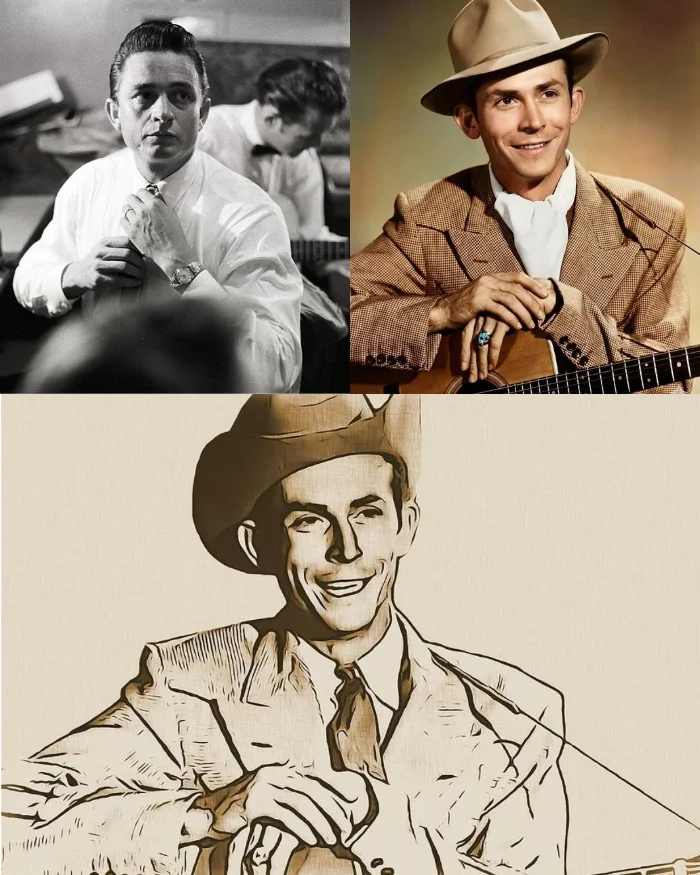
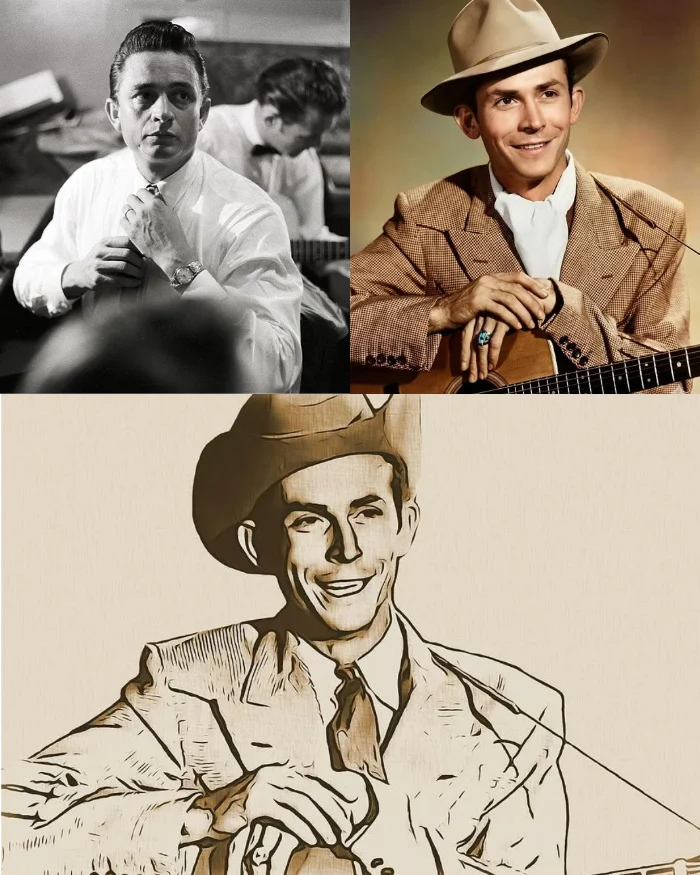
The torch did not pass with a speech or a record contract. It passed in a crowded room in 1950, when an unknown teenager from the Arkansas cotton fields watched a frail star pour raw truth into a microphone and felt something permanent shift inside him.
That teenager was J.R. Cash, just eighteen and preparing to leave the flood-prone soil of Dyess, Arkansas. He had no band, no professional career, and no clear road to a studio. He was simply a kid about to enlist in the United States Air Force. Before he left, he stood in the audience as Hank Williams performed live.
Williams was at the height of his commercial power, yet his body was betraying him. Tall and painfully thin, he carried the agony of a spinal condition and the visible weight of a hard-lived life onto the stage. When he reached the microphone, he did not offer the polished theatrical entertainment of the era’s pop stars. He offered a cracking, unguarded vulnerability.
He sang with a broken, honest authority that captured thousands without ever raising his voice to a shout.
The young Cash stood mesmerized. He saw a performer who refused to hide his flaws or dress up his heartbreak. Williams put his struggles directly under the stage lights. In that room, Cash heard echoes of rural poverty, deep loneliness, and the constant internal war between Saturday night sins and Sunday morning redemption. Williams was proving that an audience did not merely want to be entertained. They wanted to be understood.
That realization became the blueprint Cash would build his life upon. It shaped the way he approached a microphone when he returned from military service and walked into Sun Records in Memphis four years later.
By 1955, when Cash stood before producer Sam Phillips, he did not try to copy the smooth, heavily orchestrated Nashville sound. He relied on the unvarnished truth he had witnessed in the crowd. Cash stripped the music to its core. Backed by the steady, chugging rhythm of two acoustic guitars playing a relentless freight-train beat, he delivered stories of inmates, heartbreak, and spiritual trouble with a flat, unapologetic baritone.
The rebellion of those early Sun sessions was not only in the rockabilly tempo that defined the Memphis label. It was in the total refusal to compromise reality. Cash had learned from Williams that a singer did not need a massive band to command attention.
A single man with a guitar could hold a room captive simply by standing his ground and telling the truth, however dark it happened to be.
Williams was burning through the final turbulent years of his life, entirely unaware that he had lit the fuse for the next half century of country music. He died on New Year’s Day in 1953, long before the teenager from Arkansas signed his own first record deal.
A decade later, in 1960, Cash released a full-length tribute album to the man who gave him his artistic compass. But his true homage was never confined to a record cover or a brief dedication.
The frail singer from Alabama showed a cotton-field teenager that darkness, failure, and pain could be brought into the open. The Man in Black took that lesson, picked up his guitar, and walked it the rest of the way.