
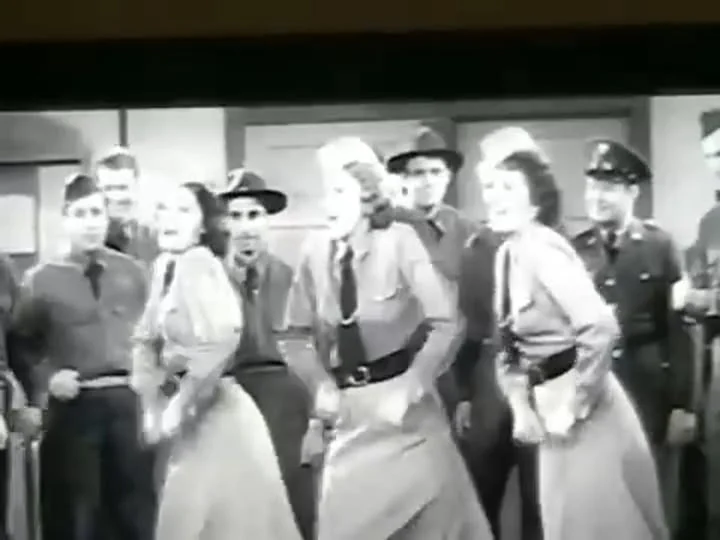
There is something magical about the moment a record begins to play. For fans of the Swing Era, few moments rival the crackle that precedes “Boogie Woogie Bugle Boy” as performed by The Andrews Sisters. The song itself seems to pulse with a life of its own from the very first note. It debuted in the 1941 Abbott and Costello film Buck Privates and instantly captured the spirit of a nation on the brink of war. What appears to be a simple story about a gifted horn player drafted into the army band is actually a masterwork of vocal arrangement, big-band orchestration, and production that defined an entire generation of popular music.
Most listeners today discover this track not as a single but within album contexts. Whether on reissues of the Buck Privates soundtrack or anthologies like The Best of the Andrews Sisters, the song stands as a pivotal moment. It highlights the trio’s razor-sharp close harmony while anchoring a narrative that connects their pre-war novelties to later, more sophisticated hits. Hearing it in the arc of their career reveals both its cleverness and its enduring hold on cultural memory.
Their voices lock into a single luminous sound. That is the core of the magic.
The blend of Patty, Maxene, and LaVerne Andrews is rooted in close harmony. They sing in tight intervals, creating one unified instrument. The track showcases their virtuosity as they toggle between unison bursts and three-part counterlines. Patty carries the melody while Maxene and LaVerne weave responsive figures. Their diction, attack, and vowel shapes are meticulously aligned, which is why lines like “He was a boogie-woogie bugle boy of Company B” land with such rhythmic precision.
Behind the sisters, Vic Schoen and His Orchestra elevate the song from a clever ditty to a swing juggernaut. A bristling trumpet line simulates the bugle’s reveille call. The rhythm section shifts into boogie-woogie drive. The piano lays down rolling eighth-note patterns and a left-hand pulse that nods to barrelhouse style. Walking upright bass pushes each bar forward. The drums provide crisp insistent ride patterns and snare accents full of bounce. Saxophones add warmth with call-and-response riffs while trombones slide and smear like swing-era punctuation marks. The palette is classic: trumpets sing on top, reeds chatter in the middle, trombones anchor the harmony.
The arrangement is remarkably economical. It opens with a bugle-like motif that teases the story, then enters the verse and chorus with buoyant major-key optimism. The harmony leans on blues-tinged I-IV-V movement but never sits still. Turnarounds keep motion, brassy hits frame transitions with zing. Sixteen-bar packets keep the ear hooked. The band mirrors the syllabic shape of the lyrics almost like a comic strip. Every “blow” and “boogie” feels etched by the horns. Every cadence is sealed by the rhythm section.
Production values from 1941 shape the song’s personality. Microphone placement emphasizes the vocal blend at center stage while the band sits slightly behind. There is just enough room reverb to keep text audible but not enough to blur consonants. The result is a dance record that still works as a narrative performance. That balance between swing and story is why it carries such staying power.
As a wartime artifact, the song occupies unusual cultural terrain. It is not propaganda exactly but camaraderie. The lyric humanizes the soldier-musician as a working artist drafted into a new ensemble. That touch of romance mirrors a broader cultural shift as America prepared for conflict. Swing’s energy became a morale booster, and The Andrews Sisters were its most charismatic ambassadors. The song’s appearance in Buck Privates cemented both the trio’s Hollywood footprint and the melody’s ubiquity.
Listeners often fixate on the trumpet because the story centers on a horn player. But the record’s heartbeat is the rhythm section. The boogie-woogie piano sketching chord tones, the bass walking four-to-the-bar, the drummer’s cymbal time and snare pops. The reeds deserve flowers too. Saxophones cushion midrange harmony, clarinets peek through to add sparkle, and ensemble figures tuck under the vocals like a well-tailored suit lining. Brass writing favors compact statements over extended solos, reinforcing pop concision.
Vocal texture becomes another instrument. The sisters use syllabic scatting such as ba-das and doo-doos as rhythmic ornaments stitching sections together. Their precision gives the band license to punch harder. In rare moments where a single voice steps forward, the blend never dissolves. This is ensemble work that rewards repeat listening.
The song has rippled through history. Bette Midler’s 1970s cover revived it for a new generation and went Top Ten, proving the arrangement’s structural resilience. Transpose it, modernize the recording chain, polish the backbeat, and the motor still purrs. Yet The Andrews Sisters’ original remains definitive because the vocal blend and big-band chart capture swing’s social DNA. Music built for dancing, for parties, for movie houses, for evenings clustered around the radio.
Album context matters for today’s listener. When “Boogie Woogie Bugle Boy” is sequenced among other Buck Privates numbers or in a chronological compilation, you hear it framed by the era’s stylistic diversity. Fox trots, novelty tunes, romantic ballads. Each colored by changing instrumentation and studio techniques. In a compilation, the song appears near rhythm-forward hits, making its boogie pulse pop even more vividly. Albums teach the ear to recognize lineage, situating “Bugle Boy” alongside “Don’t Sit Under the Apple Tree” or “Rum and Coca-Cola”.
Why does the track feel evergreen? Its blend of specificity and universality. The lyric tells a story about one gifted horn player in Company B, but the emotional theme is broader: how artistry finds its outlet even in institutional settings. The bandstand becomes a place of community. Musicians pushing and pulling in time, trading riffs, laughing, locking in. Anyone who has played in a school jazz ensemble, a church group, or a military band will recognize the thrill of a section hitting a figure in perfect sync. The breath before the downbeat, the shimmer of the cymbal, the glint of brass under lights.
For listeners and players, the song is a superb primer on swing-era arranging. Study how the band comments on the lyric, answering phrases, setting up punchlines, cueing transitions. Notice the rhythm section always forward, never dragging. The chart breathes, swelling under choruses, paring back for clarity when the lyric gets dense, surging again for climactic tags. For vocal groups it is a masterclass in blend, vowel unification, and breath control. For horn players it showcases short-form phrasing where tone and articulation do the heavy lifting.
In our streaming age it is easy to treat a three-minute classic as sonic wallpaper. But giving “Boogie Woogie Bugle Boy” an attentive spin on a full compilation pays dividends. Streaming services often group the song within thematic albums such as wartime songs or big-band anthologies. That context changes how you hear it. A romantic ballad before it makes the boogie feel brighter. A novelty tune after it amplifies the trio’s comic timing. Hearing it in album context recreates a bit of the 78-rpm experience when artists and labels thought carefully about sequence and mood across a stack of sides.
Because the song has become universal shorthand for 1940s swing, it retains commercial appeal. Vintage-styled ads, film montages, brand campaigns rediscover it each decade. You will hear conversations about music licensing when “Bugle Boy” resurfaces in pop culture. Cleared uses of catalog standards can bring a vintage vibe with instant recognizability, especially when the arrangement’s cadence lines up well to quick-cut editing.
The recording also invites conversation about how pop evolves. The trio’s blend, honed on radio and vaudeville stages, prefigures the girl-group sound of the 1960s. The band’s writing foreshadows horn-driven soul arrangements of later decades. There is an unbroken thread from the jump blues of “Bugle Boy” to the punchy brass hooks in Motown to the horn stabs of modern funk and pop. When you hear how orchestra and voices dance together, you trace a lineage straight to contemporary charts even when the instrumentation has shifted to synths and drum machines.
For readers exploring this classic, the tune is remarkably flexible across ensembles. While the original features brass and reeds, it adapts beautifully to small-group jazz, vocal jazz ensembles with SATB and rhythm section, and guitar-centric swing groups. The harmonic vocabulary is approachable. The rhythmic feel is unmistakable. The call-and-response structure practically begs for arrangement experiments.
Listening Recommendations: For similar vibes and historical context, consider “Don’t Sit Under the Apple Tree” by The Andrews Sisters, another wartime earworm with exemplary close harmony. “Bei Mir Bist Du Schoen” showcases their tone and humor. “In the Mood” by Glenn Miller is the canonical big-band groove. “Chattanooga Choo Choo” by Glenn Miller with The Modernaires shares narrative charm and rhythmic buoyancy. “Tuxedo Junction” by Erskine Hawkins or Glenn Miller demonstrates slow-burn swing. “Shoo-Shoo Baby” by The Andrews Sisters captures their knack for tone color. “Rum and Coca-Cola” reveals their stylistic range post-war.
One final note on format: because the song migrated from film to singles to countless anthologies, mastering and transfers vary. When curating a library, choose editions that retain the transient snap of drums and gleam of trumpets without over-brightening the vocal. Some reissues aim for vintage warmth. Others emphasize detail. Try a few album presentations and trust your ear. For learners and nostalgic listeners alike, context enhances the joy.
What keeps “Boogie Woogie Bugle Boy” evergreen is not just its wartime charm or cinematic origin but the alchemy of voices and instruments serving a perfect little story. The trumpet says reveille. The piano rolls its boogie pattern. The bass strolls in quarter notes. The drums lay down dancing time. The reeds and brass chatter with wit. And three voices fuse into a single irreplaceable instrument. That sound, compact, spirited, and utterly alive, is why the record continues to animate dance floors, playlists, and movie scenes eighty-plus years on. If you are exploring swing anew or revisiting old favorites, make room for this track. It is a lesson in arrangement, a testament to ensemble craft, and a reminder that some records do not age. They glow.
For those discovering or revisiting this classic through modern streaming services, consider pairing it with a curated swing playlist to appreciate how its rhythms and riffs dialogue with the era’s broader sound world. For curators or filmmakers eyeing vintage cues, thoughtful music licensing of the right master can lend the precise sepia sparkle you are after.