
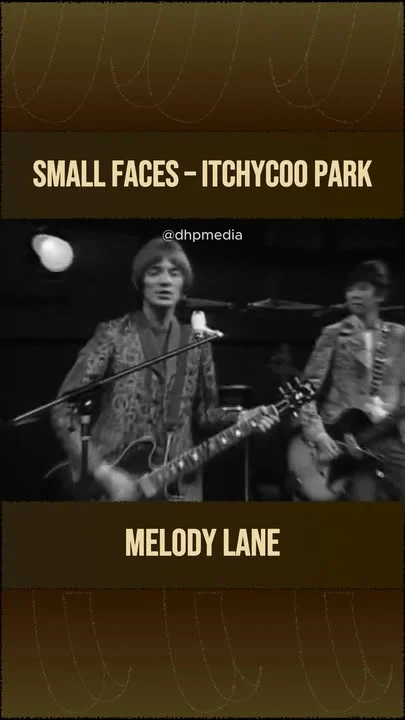
There are songs that feel like a season captured in a jar, ready to release its warmth whenever you twist the lid. Itchycoo Park by The Small Faces is one of those records. Decades after 1967, it still smells of dry grass after sun, of water shimmering through leaves, of time softening at the edges when you stare into the light. The track opens with a gentle percussion shuffle, then that voice—bright, boyish, slightly raspy—floats above the music like a kite in a friendly breeze. You are immediately somewhere else.
Steve Marriott and Ronnie Lane wrote this stand‑alone single for Immediate Records in 1967, at a moment when the band was leaving behind gritty mod stompers for a more melodic, adventurous sound. In the United Kingdom, it climbed into the Top 5. Across the Atlantic, it reached the U.S. Top 20 the following year. Those chart positions tell a neat story of a record that was both perfectly of its time and strikingly exportable.
The engineering trick that defines the song—the whoosh of phasing across the drums—has been described endlessly. But what matters is how that technique serves emotion. The drums do not simply swoosh. They breathe. They turn the space inside the recording into a living thing, as if the park itself were sighing along with the melody.
Phasing turns the air into an instrument, a musical weather system that passes right through you.
Listen to how the arrangement constructs its small world. The rhythm section moves with a limber, lightly syncopated gait—steady enough for a sing‑along, loose enough to feel like an afternoon nap tilted toward mischief. A warm keyboard bed glows behind the voice, occasionally flaring at phrase endings with a churchy squeeze. Over that, a tidy chiming guitar sketches the fence posts of harmony, ensuring the track never drifts too far from home. The vocals are stacked close, companionable, almost hand‑on‑shoulder intimate, with enough air around them to suggest a window left open in the control room.
Marriott delivers with a conversational ease that flirts with mischief. When he asks “what did you do there?” it is not an interrogation but an invitation to share a conspiratorial grin. He shades syllables with quick vibrato, holds a vowel a fraction too long, turning simple notes into moments of shared delight. His phrasing feels like a friend who cannot wait to show you a secret.
Then the famous flanging swells arrive. The track swims, and you are briefly underwater. This is not psychedelia as excess or shock. It is psychedelia as a gentle refocusing of the lens, deployed with restraint. Plenty of 1967 records were gaudier or more chemically overdetermined. Itchycoo Park uses its studio alchemy like a well‑timed wink, guiding your breathing in and out with the music.
The song never tries to be an orchestral spectacular. Instead, the band plays like a tight circle on a lawn, passing hooks around like a thermos of lemonade. The keyboard glows and recedes. The bass nudges without nagging. The snare has a crisp little snap, softened by the phase swoop when needed. The track has headroom—literal space into which your imagination can step. That is why it holds up in any listening environment. It tolerates being small because it already sounds like a miniature landscape.
One pleasure of this recording is its sense of scale. It understands childhood and young adulthood at the same time. There is wonder, but there is craft. There is play, but there is engineering. The close‑mic intimacy on the vocal makes you feel like you are crouched near the singer, whispering back lines between takes.
The lyric works because it withholds specifics. Many have argued about which London park inspired the title and which plants made it “itchy,” but the record is more interested in the feeling of getting away than in the GPS coordinates. The universal floats over the particular. Half a world away and decades later, you can drive a county road at dusk and feel like the trees you pass belong to the same republic of escape described here.
I often test a track by playing it in three places: a kitchen with windows open, a car with road noise underneath, and a modest home audio setup when the house is quiet. Itchycoo Park thrives in all three. In the kitchen, the phased cymbals seem to dance with the clink of plates. In the car, the buoyant beat matches the rhythm of signage sliding by, turning traffic into a chorus line. At night in a quiet room, the background vocals feel like friendly ghosts in the doorway, delighted you came back.
The band’s journey makes this single even sweeter. Before Immediate, they had been hitting hard on Decca with sparkling mod stompers. The move coincided with a fresh burst of autonomy. The writing partnership of Marriott and Lane was at a peak, and the group had grown confident enough to experiment without losing their pop instincts. If the later pastoral shimmer of Ogden’s Nut Gone Flake would show them building full fantasy worlds, Itchycoo Park is the carefree field trip that proves they can leave the city limits and still be themselves.
For all its lightness, the record is not disposable. Its central trick—the feel of the air being made musical—has been imitated endlessly. The lesson modern producers sometimes miss is proportion. The effect here serves the story. When the drums blur, your memory blurs with them. When the guitars regain their chime, you sense a smile returning to someone’s face only inches from the mic. The production is the text, not just decoration.
Three quick vignettes, because this song keeps making new rooms:
A student in a late dorm night, exam notes scattered like confetti, puts it on to feel a simpler sky. The first chorus lifts the shoulders from their crouch. The second makes the paper mess look oddly beautiful. The song does not erase stress. It reframes it as cloud cover, temporary by definition.
A parent drives a kid to practice, and a sunbeam flickers between rowhouses as the chorus arrives. The kid half‑sings, half‑mocks the words, and for a moment the car is both London in 1967 and a neighborhood that simply wants some fresh air.
A person who has never been to England sits on a bench after a complicated day. Earbuds in. Birds negotiating tree politics above. The phased drum wash and the friendly chords do not explain life, but they make room for it.
The rhythm section’s low‑profile intelligence deserves admiration. Bass lines walk with just enough step, never turning the meadow into a sidewalk. The snare places accents like a friend patting your arm at the right moments. Nothing feels overdressed. That restraint is a kind of glamour too—the kind that does not break a sweat.
You could call this the record where Small Faces proved the page could be turned without tearing it. The earlier punch remains. It is simply softened by a dreamier lens. And because the lens is clean, the picture is timeless. What sounded new in 1967 now sounds fresh, which is rarer. Newness expires. Freshness renews itself whenever sunlight hits it.
There is also the way the vocal blend embodies camaraderie. The harmonies do not grandstand. They fold in like friends chiming agreement during a good story. It creates an intimacy that suits the theme of escape. You go to the park with someone you trust. This single invites you to bring that person, even if they are a memory you are still making up.
One last note about how the band uses negative space. The arrangement leaves little pockets of quiet—tiny valleys between peaks—so that when the phase swell returns, it feels like a tide rolling back. That ebb‑and‑flow dynamic is the heartbeat of the track. It is also the source of its replayability. Your ear keeps leaning forward to catch the next inhalation.
In discussions of 1967 pop, the loudest artifacts often crowd the conversation: maximalist arrangements, studio fireworks, and headlines attached to famous names. Itchycoo Park humbly makes its argument in three minutes, with light in its pocket and freedom on its breath. It loses nothing by being a compact single. If anything, the brevity is part of its charm. Consider this your reminder that not every milestone needs to be a monument. Some are a sunny afternoon, perfectly mixed, that you can carry around forever.
And yes, when the chorus asks the obvious question about where someone has been, it answers with the only destination that matters: away. That remains the most adult kind of innocence pop can offer.
If you have not sat with it in a while, return to it with curiosity. Let the drums blur the edges of your day, and let the keys glow like a window you forgot was there. This is not nostalgia as retreat. It is craft as escape route, built by a band who knew how to keep wonder in tune.
For any reader wanting to follow its chord shapes or vocal blend more closely, it is the rare single that rewards careful listening and casual humming alike. Study it, sing it, or simply drift with it. The record holds.
Somewhere between a lazy Sunday and a bus ride to nowhere, Itchycoo Park is waiting, still sunlit, still smiling.
Listening Recommendations
- The Kinks – Waterloo Sunset – London tenderness with shimmering guitars and a river’s‑eye calm, cut in the same bright year.
- Pink Floyd – See Emily Play – Playful, compact psychedelia where studio trickery serves a candy‑coated melody.
- The Move – Flowers in the Rain – Breezy, percussive pop with late‑’60s English whimsy and a crisp, windblown hook.
- Traffic – Paper Sun – Sitar‑tinged swirl and rhythmic lightness that feel like another path through the same summer.
- The Beatles – Dear Prudence – A later, gentler trance with circular guitar figures and an invitation to open the shutters.
If you want to catch the record’s phantom details—the swell, the smear, the hushed harmonies—try one close listen on studio headphones, then one in your favorite room. And if you are curious about how it translates to a living space, a straightforward home audio setup will let the track breathe the way it was meant to.