
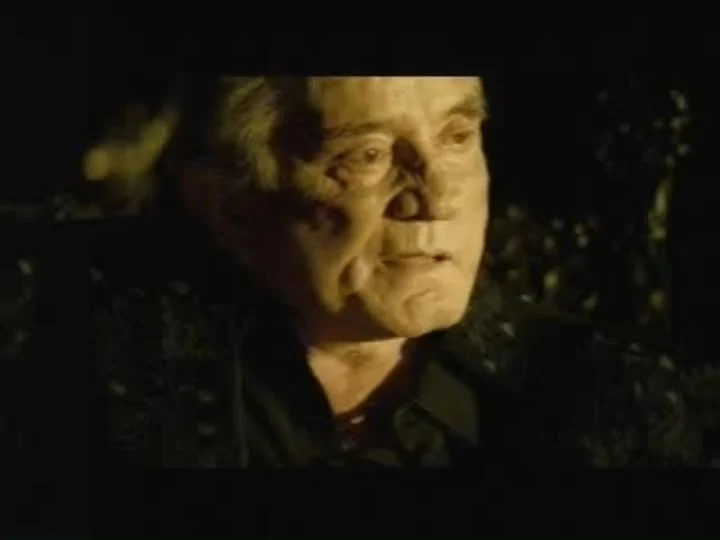
Johnny Cash once sang about an empire of dirt. In the final years of his life, that empire was made of memories, old photographs, and the quiet dust of a museum in Tennessee. There, in front of cameras he had known for decades, the Man in Black let his guard fall completely. He poured a glass of wine, his hands shaking, and the red liquid spilled across the table like a life that could not be held in one place. That moment from the music video for Hurt has become as famous as the song itself.
The song was written by Trent Reznor of Nine Inch Nails. It was a stark and bruising meditation on pain and addiction. Cash first heard it through producer Rick Rubin, who had persuaded the country legend to return to the studio in his final years. Rubin believed the song would speak to Cash, even though Cash did not usually record outside his own genre. At seventy years old, Cash took the risk. What happened next changed the way the world heard the song.
Cash’s voice was rough and weighted by time. He did not soften the words. He leaned into them, letting each line carry the memory of a hard-lived life. There had been substance abuse and heartbreak in his past, along with moments of grace and faith. Hurt gave him a way to say all of it without hiding. Reznor himself understood the transformation better than anyone.
“It wasn’t mine anymore.”
The lyrics move from self-harm to self-questioning. The narrator asks what he has become and admits that everyone he knows goes away in the end. Those words could have been written by someone young and lost, but in Cash’s mouth they sounded like the conclusion of a long autobiography. Every regret, every broken promise, and every moment of weakness seemed to live in his delivery. He did not offer a tidy answer. He simply stood there and let the truth be heard.
Mark Romanek directed the video with a delicate and unflinching eye. He shot it inside Cash’s own museum, a place where the glory of a legendary career had faded into peeling paint and forgotten corners. Old footage of a young and vigorous Cash was placed beside the frail present-day performer. The contrast was heartbreaking. The piano keys were heavy under his fingers. The wine would not stay in the glass. The images made the song feel less like a performance and more like a farewell.
Audiences recognized the significance immediately. The single became a major milestone in Cash’s late career and introduced his music to listeners who had never explored country or rockabilly. When it arrived on streaming platforms, a new generation found it. YouTube, Spotify, and Apple Music all helped carry the song to millions of people who were drawn to its honesty. Even today, the comment sections under the video are filled with stories of people who listen when they feel lost.
Part of that power comes from the song’s refusal to turn away from pain. In a culture that often wants quick fixes and easy inspiration, Cash’s performance offers something different. It acknowledges that some scars never fully heal. It also suggests that being honest about those scars is a form of courage. That message resonates more deeply now than ever, especially as conversations about mental health become more open and more urgent.
Cash did not live long after the release of Hurt. He died in 2003, leaving behind a remarkable body of work. But this particular song remains one of the most beloved entries in his catalog. It is often described as a cover, though that word feels too small. Cash took a song about personal destruction and turned it into a universal reflection on mortality and hope. There is no attempt to erase the past. There is only the raw and graceful admission that life is complicated.
Perhaps the most moving moment comes near the end when Cash sings about starting again a million miles away. The words are not a promise. They are a dream, a fleeting thought from a man who knows that the road behind him cannot be changed. He carried his mistakes into the studio and turned them into art. That is why Hurt is more than a song. It is a parting gift and a lasting proof that truth in music never goes out of style.