
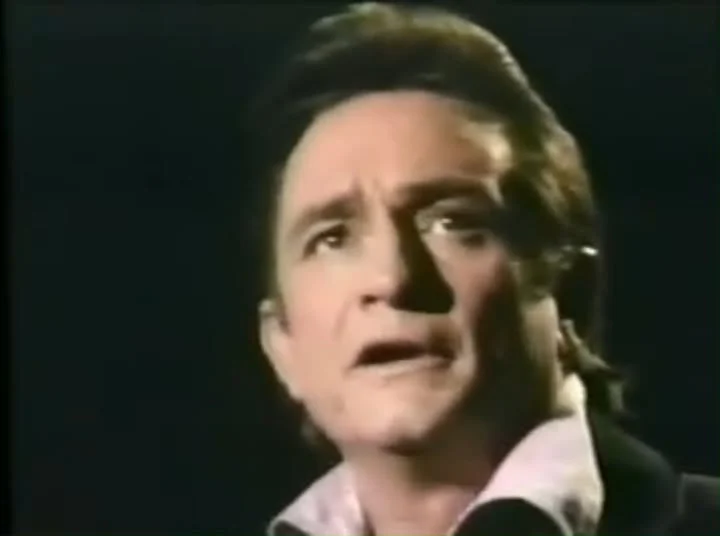
The needle drops, the tape rolls, and a voice like gravel and grace cuts through the Memphis humidity. It was 1955, and a young man with a troubled past and a singular vision was about to change American music forever. This is not just the story of a song, my friends. This is the story of a beginning—the spark that ignited the legend of Johnny Cash.
While the world would eventually know him for the black attire, the prison concerts, and the defiant anthem “I Walk the Line,” his journey first found its footing with a deceptively simple, raw rhythm track called “Cry! Cry! Cry!” It might not be his most famous ballad, but this debut single is the cornerstone of a legacy, the blueprint of a soul laid bare in under two minutes. For those seeking the roots of country music or the genesis of a cultural icon, this song offers a crucial glimpse into the early days of an artist who would redefine the industry’s very landscape.
The Memphis Gamble
Long before the stadiums and the myth, Cash was a young man with a passion that bordered on obsession. The story of “Cry! Cry! Cry!” begins with a leap of faith. Fresh off his ambitions to record gospel music, Cash found himself face-to-face with Sam Phillips, the visionary founder of Sun Records. Phillips, a man with an ear for the zeitgeist, famously heard something more commercial in Cash’s raw potential. He prompted the aspiring star to go back and find a sound that could sell. Cash returned with a song that fused heartbreak with a hypnotic, upbeat rhythm, a subtle blend of blues and country designed perfectly for the airwaves of the mid-1950s. It was a gamble that paid off in spades.
The Authentic Voice
What makes the track so profoundly timeless isn’t just its rhythm, but its relatability. “Cry! Cry! Cry!” dives headfirst into the murky waters of unrequited love, exploring the stinging betrayal and the ache of longing with a brutal, poetic honesty. In its concise, powerful runtime, Cash distills the essence of heartache into something both raw and universal. His ability to render complex emotion through straightforward language became his greatest superpower, allowing listeners to see themselves in his stories rather than just listening to them.
The narrative is one of karmic justice. The protagonist, wronged by a lover, predicts a future loneliness for her that will ultimately match his own. It is a message of righteous balance that deeply tapped into the audience’s sense of fairness. Cash’s lyrics became prophetic:
“You’ll cry, cry, cry and you’ll cry alone / When everyone’s forgotten and you’re left on your own.”
This wasn’t just a prediction of personal heartbreak; it was a thematic seed that would blossom throughout his career. He became the songwriter of the downtrodden, the soundtrack for the left-behind and the misunderstood, convinced that the scales of consequence always tip eventually.
A Sonic Earthquake
Sonically, the single was a true departure. It boasted a fresh hybrid of country, blues, and the raw energy of rockabilly that caught listeners completely off guard. With that unmistakable “boom-chicka-boom” train-like rhythm he made famous, Cash introduced a gritty groove that separated him wildly from his contemporaries in Nashville. The song’s mix of sustained intensity, concise storytelling, and emotional charge made it accessible to a broad demographic, transcending genres.
The music industry was in a transitional phase, and Cash was at the vanguard of its transformation. While Elvis Presley, Jerry Lee Lewis, and Carl Perkins defined the wild, rebellious image of Sun Records, Cash crafted a different archetype. He was the “Man in Black”—not a rebel, but a pillar of resilience, integrity, and authentic grit. Phillips recognized this unique chemistry, offering the creative freedom that allowed Cash to find the perfect balance between commercial viability and soul-baring expression. The result was a top-15 hit on the Billboard Country Singles chart, establishing him as a vital new voice.
The Lasting Echo
While “Folsom Prison Blues” and “Ring of Fire” would eventually become the towering giants of his catalog, “Cry! Cry! Cry!” remains the essential folkloric foundation upon which they stand. For music historians, it is the pivotal starting point, the moment the world heard a voice for the broken-hearted. The song’s minimal instrumentation puts Cash’s baritone front and center, a voice that needed no autotune or overproduction to convey an ocean of feeling.
The cultural relevance of this record has not faded with the digital age. In fact, in our modern, production-heavy world, the organic simplicity of “Cry! Cry! Cry!” feels profoundly refreshing. It serves as a reminder that music is, at its core, about storytelling and catharsis. Many artists across folk, rock, and punk have cited Cash as their essential muse, drawing from the well of early recordings like this one.
Modern country music has evolved with pop and hip-hop sensibilities, yet the DNA of Cash’s early honesty can still be traced. His emphasis on authenticity and emotional depth remains the gold standard, inspiring musicians to seek truth over trend. “Cry! Cry! Cry!” is not just a piece of history; it is a living, breathing lesson in resilience, beautiful in its simplicity and devastating in its honesty.
A Journey into the Soul
For anyone new to the legacy of the Man in Black, this debut is the perfect entry point. It is a direct line to the profound truth of his artistry. To listen to “Cry! Cry! Cry!” is to witness a story of creation—a man giving a voice to the voiceless, building a sonic bridge between the pain of the past and the hope of the future. It deserves more than a spot in the archives; it deserves a place in every music lover’s heart.
So, press play. Let the needle drop on the legacy. Hear the sound of a legend taking his first, mighty step.