
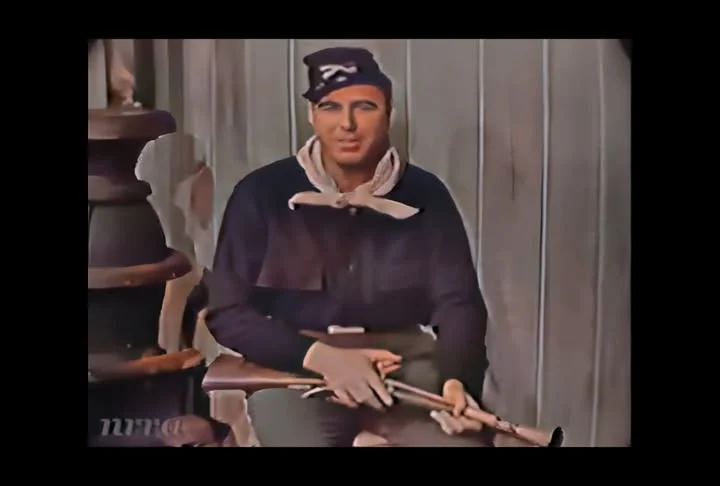
There are recordings that slip into a time capsule, encapsulating the exact heartbeat of an era. Then there are those that burst out of the capsule, grabbing you by the collar and demanding you join the parade. In the spring of 1959, Johnny Horton unleashed a musical wildfire with “The Battle of New Orleans” a song that felt less like a studio artifact and more like a living, breathing charge of pure adrenaline. It did not simply find its way onto turntables. It took them by storm.
I can still picture that scorching East Texas afternoon when a crackling AM radio in a dusty garage spat out the opening drum rolls and a banjo that seemed to fire like a squad of sharpshooters. The air was thick with sun-baked dirt and the scent of pine needles, yet the song cut through everything with a crisp, military cadence. It was not just a melody. It was a high-energy, slyly comedic retelling of a historic skirmish, delivered with a wink and a foot-stomping beat that refused to sit still.
The track was released in April of that year and later appeared on the album The Spectacular Johnny Horton. It did not merely edge onto the charts. It blasted to the number one spot on the Billboard Hot 100 and also topped the Country Singles list, an extraordinary crossover feat that few country artists of that time could replicate. In a decade still shaken by the electric jolt of rock and roll, Horton offered a different kind of charge. He gave listeners a slice of American legend wrapped in a rollicking, folk-infused rhythm that could make anyone tap a foot, regardless of age or background.
Behind the scenes, Horton was already a seasoned performer with gritty honky-tonk hits like “Honky Tonk Man” and “I’m a One-Woman Man” under his belt. He was a staple of the Louisiana Hayride, bridging the raw country sound of the early fifties with the budding spirit of rockabilly. Under the guidance of producer Don Law at Columbia Records, his career took a dramatic turn toward what became known as “saga songs” historical narratives set to rousing, folk-driven arrangements. This became his signature style and the vein that produced his greatest triumphs.
What makes the recording so irresistible is its deceptive simplicity. The arrangement hinges on an insistent, marching drum pattern that never breaks its stride. That rhythmic backbone gives the tune a parade-ground precision, perfectly framing the story of Andrew Jackson’s ragtag militia. The acoustic guitar churns with a skiffle-like frenzy, providing a breathless heartbeat beneath the narrative. Over that, a bright banjo delivers quick, melodic rolls that inject a frontier spirit and a playful, almost cartoonish quality into the lyrics. The fiddle and mandolin add lively, scratchy responses, creating a call-and-answer texture that keeps the ear engaged.
Horton’s vocal delivery is the glue that binds it all together. He sings Jimmy Driftwood’s witty, larger-than-life verses with a straight face and undeniable momentum. The lyrics place the listener in the boots of a “country boy” soldier who claims to have filled an alligator’s head with cannonballs. It is history as a campfire tale, passed down with each telling more embellished than the last. The song turns a complex battle from the War of 1812 into a three-minute adventure film that never loses its punch.
“The recording is a perfect machine of narrative propulsion, fueled by the folk spirit and the disciplined pulse of a crack session band.”
The sonic quality of the original Columbia recording, preserved across countless CD compilations and high-fidelity pressings, captures the immediacy of that Nashville session. The close-miked drums and dry acoustic textures make it feel as though you are standing just behind the band, right in the middle of the action. It is an intimate, almost tactile sound that has aged remarkably well.
Once the song conquered the pop charts, it sparked a brief but influential trend. Other artists rushed to ride the wave of historical sagas, recognizing that American audiences were hungry for tales of grit and derring-do delivered with a country slant. Horton and Don Law had successfully packaged traditional folk history into a mass-marketable product that dominated the radio. The success proved that an authentic, narrative-driven tune, even without the shrill scream of rock and roll, could hold its own in the mainstream.
For students of American roots music, “The Battle of New Orleans” serves as a masterclass in economy. It demonstrates that occasionally, stripping away excess and leaning on a strong central idea can produce something electric. The fiddle and banjo take the place of a piano as the percussive anchor, showing the versatility of the Nashville sound at the time. The result is a track that is both historically grounded and entirely timeless in its appeal.
Tragically, Horton’s promising career was cut short barely a year after the song’s release when a fatal car accident claimed his life in June 1960. He left behind a legacy defined by his ability to inject rockabilly energy and honky-tonk soul into the great American narrative ballad. This song remains the definitive example of that talent. It earned him a Grammy and cemented his place in music history as a pioneer who made the past feel irresistibly alive.
The song does not simply ask you to listen. It dares you to join the march. Even now, decades later, it still has the power to make strangers smile and tap their feet in unison. It is a shared memory, no matter how mythologized, that cuts across every demographic line. A single riff can transport a crowded bar back to that summer of 1959, when a banjo and a drumbeat turned a forgotten battle into an anthem for the ages.
For those looking to explore similar corners of this musical landscape, several tracks echo Horton’s approach. Tex Ritter‘s “High Noon (Do Not Forsake Me)” from 1952 shares that same clear-eyed narrative focus on a decisive American moment. Marty Robbins‘ “Big Iron” from 1959 delivers a taut, dramatic story with a compelling rhythm. Lonnie Donegan‘s “Does Your Chewing Gum Lose Its Flavor” captures a similarly energetic, tongue-in-cheek folk-pop spirit. Jimmy Dean‘s “Big Bad John” continues the saga-song tradition with its dramatic spoken-word style. The Kingston Trio‘s “Tom Dooley” shows the pop viability of acoustic instrumentation and dark historical themes. And Johnny Cash‘s “Don’t Take Your Guns to Town” offers a stark, compelling narrative driven by simple guitar and rhythm. Together, these recordings form a rich tapestry of storytelling through music, a genre that Horton helped redefine.
In the end, “The Battle of New Orleans” stands as a milestone in American musical history. It is a three-minute miracle that combines learning, laughter, and a beat that refuses to fade. Horton may have left the stage early, but his voice still echoes from every speaker that dares to play that opening riff. The song remains a testament to the enduring power of a good story, well told, with a banjo in hand.