
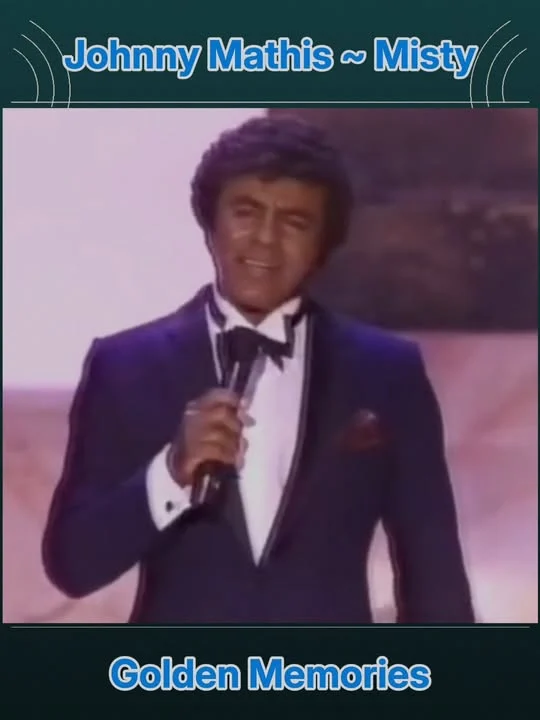
There is a moment in the first few bars of the recording where the room seems to hold its breath. It happens just before the strings enter, a brief pocket of silence that feels less like an absence of sound and more like a collective agreement to listen. That is the genius of Johnny Mathis and his 1959 version of Misty. It does not announce itself; it invites you in. And once inside, you are not the same.
Consider the scene of its creation. The year was 1959, and Mathis was at Columbia Records famed 30th Street Studio in New York, a converted church known for its cathedral-like acoustics. The space itself was a collaborator, its natural reverb wrapping the voice in a soft, pearly light. Here, with producers Mitch Miller and Al Ham, and arranger Glenn Osser, Mathis began to shape a song that would become his signature.
The tune itself arrived by a winding path. Composer Erroll Garner had written it as a piano instrumental in 1954; later, lyricist Johnny Burke added words that transformed a floating nocturne into a confession of sweet disorientation. Mathis had heard and loved Garner’s original as a teenager, and when the lyrics finally existed, he felt a deep, personal pull to sing them. On the sessions for his album Heavenly, he stepped toward the microphone, and the rest is history.
What makes this performance so enduring is its quiet architecture. Ossers chart unfolds like a slow curtain: murmuring strings, woodwinds rising in a hush, a rhythm section that keeps time as if worried the clock might wake someone. The piano answers Mathis in soft phrases, never flashy, always present. There is space around every syllable, the kind of air that only a room like Columbias 30th Street could capture. You can hear a long, pearly decay wrapping his consonants, a reverb tail that seems to settle on your shoulder rather than bounce off the back wall.
Mathis approaches the melody as a map, not a leash. He rides the long notes with a vibrato that never wobbles from sentiment into syrup. Notice how he handles the upward leaps: he does not attack; he glides, placing the pitch with a confidence that lets the orchestra bloom underneath. When he returns to the refrain, he slightly relaxes the time, letting the lyric inhale. It is a lesson in restraint.
Great singers don’t merely hit the note, they change the temperature of the room while theyre holding it.
The arrangement balances glamour and modesty with a particular delight. The strings shimmer like city lights in rain, but the rhythm section is almost domestic, warm, contained. A brushed cymbal here, a bass slide there, and an occasional ornamental arpeggio on piano to pull your ear back to the room. Even when the orchestra swells, the dynamic stays conversational. He is confiding, not declaring.
If you grew up hearing Misty as cocktail-hour wallpaper, it is easy to miss how precise it is as a piece of music. Mathis centers the lyrics uncertainty, being misty as a kind of blessed disorientation, by keeping the vowels forward and the consonants soft. He is not describing confusion; he is embodying surrender. And Ossers woodwinds underline that: a sighing clarinet here, a flute line that feels like breath exhaled onto glass. The overall timbre is silvery but never brittle, thanks to the orchestras midrange cushion.
The origin matters. By 1959, several singers had already claimed it, including Sarah Vaughan, whose version helped draw attention to the song. Mathis did not try to out-jazz Vaughan; he changed the stakes entirely. He turned Misty into a cinema shot in shallow focus, where the foreground, the voice, remains crisp while the background blooms. That is the Mathis trick: the song becomes an interior landscape.
It arrived at a pivotal point in his career arc. Heavenly marked Mathis ongoing consolidation of a sound: lush orchestration, refined dynamics, a poised vocal line that floated over carefully managed arrangements. Under producers Miller and Al Ham, he became a standard-bearer for the sophisticated adult pop of the late 50s and early 60s, a bridge between Tin Pan Alley tradition and the living room hi-fi. Misty is central to that identity, the single that codified Mathis as the romantic balladeer whose restraint could make even a crowded room feel like a library.
Think of the songs cultural life. It was the lodestar for Clint Eastwoods 1971 thriller Play Misty for Me, enshrining the tune in a new context and reintroducing its melody to another generation. But the Mathis cut remains the default in everyday imaginations, the one you hum cooking dinner, the one you recognize from a department store in December, the one you reach for when you want the air to feel a little lighter.
Three short vignettes tell you why Misty still matters today. First: a late-night radio show. The DJ speaks in a whisper, the city is damp from an evening storm, and before the weather report he cues Mathis. The first bar acts like a dimmer switch on your nerves. You stop scrolling. You breathe deeper. Whatever you were about to say to yourself can wait three minutes and change.
Second: a rented apartment, winter sunlight on a Sunday. A beginner taps out the melody from sheet music on a secondhand upright, slowing for the leaps, listening to how the left hand wants to cradle the right. The record becomes a teacher by osmosis, demonstrating that the trick is not more notes, it is better breath.
Third: a long drive after a complicated dinner, two people who do not agree about much at the moment. They hit play. In the hush between chorus and outro, both look forward and say nothing because the record is doing the talking, a reminder that tenderness is an option even when certainty is not.
If you are returning to Misty after years, consider how you listen. Good studio headphones let you hear the halo of the room and the tiny dynamic swells that casual speakers flatten. Follow the bass line through the second verse; notice how it gently walks without ever insisting on being noticed. Track the woodwinds in the outro; they descend like a curtain falling in half-light.
As a canonical piece of music, Misty is deceptively simple to cover and very hard to inhabit. Many great singers have recorded it, from Vaughan to Ella, each bringing a legitimate claim. Mathis claim is different: he weds clarity to haze, confidence to wonder. Even now, the performance sounds less like a museum piece and more like a living ritual, three minutes that keep re-teaching us how to ask softly for what we want.
The songs durability also speaks to Mathis place in American pop. He is a specialist in the slow reveal, and Misty is his calling card for that art. The performance proves you can make intensity out of patience, that understatement is not the absence of emotion but a different way of shaping it. In a world where ballads often chase the crest of their own choruses, Mathis chooses to carry the tune like a glass of water across a polished floor.
If you are tempted to analyze the harmonic turns on staff paper, by all means enjoy the architecture; the tunes chromatic slips make it a rewarding study. But the records essential message is textural, not technical: intimacy has a sound, and it is quieter than you think. Heavenly is full of lovely moments, yet Misty is the one that makes time behave. As the final cadence arrives, you feel placed, not dazzled, not lectured, just placed where the heart can recognize itself.
Video
Lyrics
Look at me,
I’m as helpless as a kitten up a tree
And I feel like I’m clinging to a cloud
I can’t understand,
I get misty just holding your hand.Walk my way,
And a thousand violins begin to play
Or it might be the sound of your hello
That music I hear,
I get misty the moment you’re near.You can say that you’re leading me on
But it’s just what I want you to do
Don’t you notice how hopelessly I’m lost
That’s why I’m following you.On my own,
Would I wander through this wonderland alone?
Never knowing my right foot from my left,
My hat from my glove,
I’m too misty, and too much in love.On my own,
Would I wander through this wonderland alone?
Never knowing my right foot from my left,
My hat from my glove,
I’m too misty, and too much in love.
Look at me…