
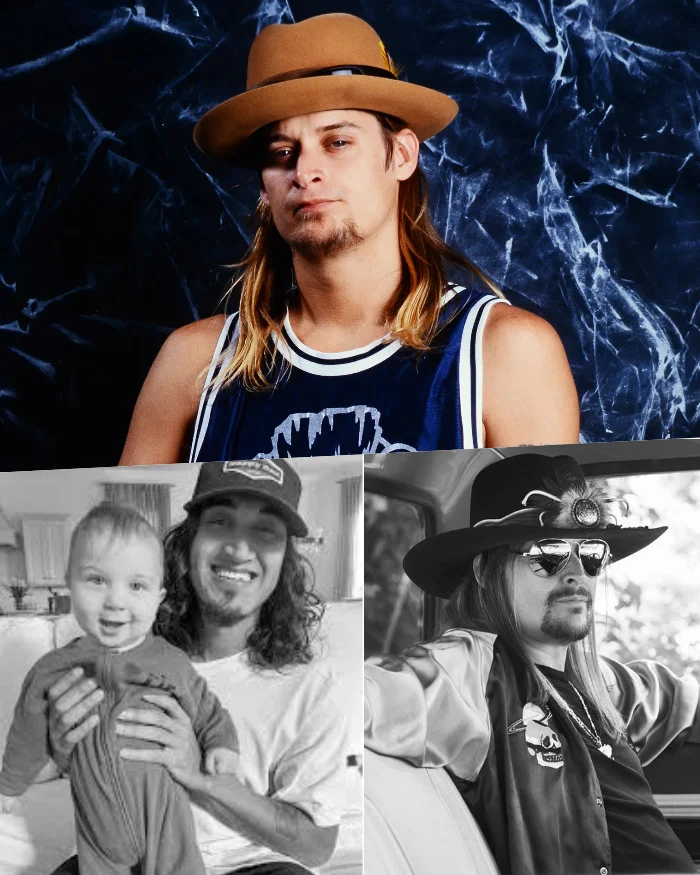

The loudest rocker in Detroit did not begin in a major studio. He began in a quiet basement, warming bottles through the night while his infant son slept nearby.
Long before his 1998 record Devil Without a Cause sold more than eleven million copies and turned him into a global television fixture, Kid Rock was simply Robert Ritchie, a broke musician dropped by the industry and facing the most intimidating chapter of his life. In the mid-1990s, rather than chasing industry parties or moving to Los Angeles to secure another record deal, he fought a grueling court battle to win full legal custody of his son, Robert James Ritchie Jr. For an unemployed and unsigned artist with a wild public reputation, the outcome was rare. The courts granted him full custody, and he became a single father with a toddler, no label support, and no steady income.
The legal victory forced his world to shrink to the property lines of his Michigan home. Knowing he could no longer jump in a van and take low-paying, out-of-state club tours required to build a grassroots audience, he chose to stay anchored. He took odd jobs, worked for a cleaning service, and scraped together minimum wage to afford diapers, groceries, and winter heating bills. The aggressive, larger-than-life rock persona the world would eventually see was quietly built between preschool drop-offs and late-night feedings.
That basement became both a recording studio and a nursery, and every late-night session carried the weight of fatherhood.
To keep his music alive without abandoning his son, he turned his basement into a makeshift recording compound. Driven by absolute necessity, he mastered independent engineering techniques that would ultimately define his raw Detroit sound. He pieced together affordable digital tape machines, routing cheap microphones and mixing consoles next to laundry baskets and baby gear. Because he could not afford to hire studio musicians or professional producers, he learned to program his own beats, track his own turntables, and layer the heavy guitars himself. Without a major label budget, he financed those grueling late-night sessions entirely out of pocket.
He pressed his own discs under his self-funded Top Dog Records imprint and acted as his own distributor by placing those basement-engineered albums on consignment at local record stores and selling them directly from the trunk of his car. It was that independent grind that laid the groundwork for his diamond-certified breakthrough. The gritty, uncompromising sound he engineered in that basement caught the ear of Atlantic Records. When they offered him a contract in 1997, they were not buying a manufactured artist. They were investing in a fully formed producer who had already figured out how to write, record, and sell his own music while carrying the weight of a family on his shoulders.
The contrast remains one of the most striking in modern music history. On the independent tapes he was selling from his trunk, he portrayed a loud, untouchable, rebellious figure. Off stage, he was navigating parenthood without a financial or emotional safety net. Today, Robert Jr. is a Belmont University graduate who recently made his father a grandfather. The exact engineering techniques and independent financing that turned those early basement sessions into a diamond-certified album form a lasting chapter of Detroit music history.