
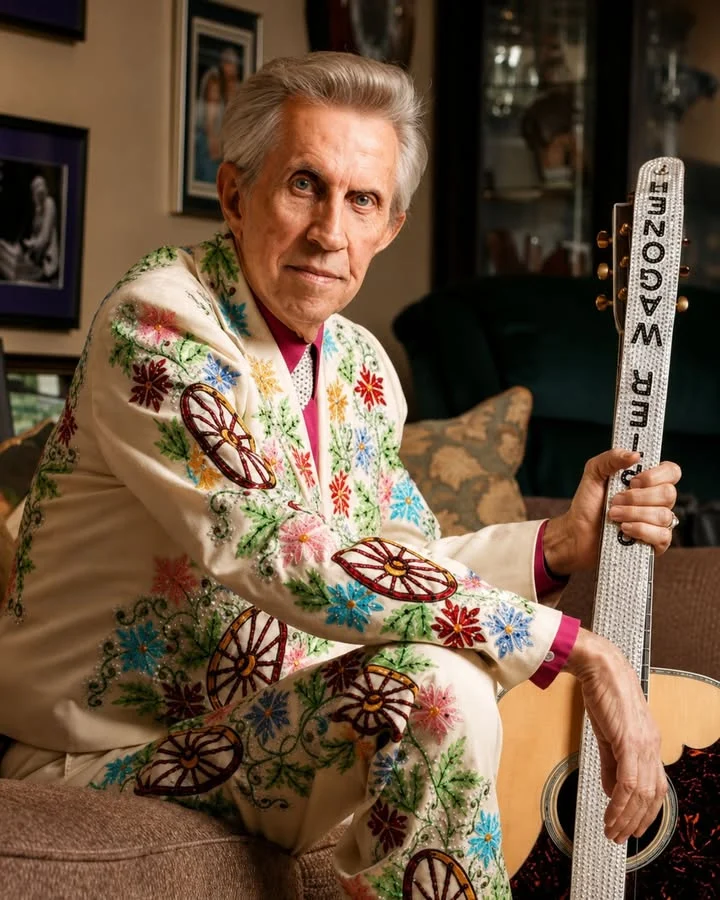
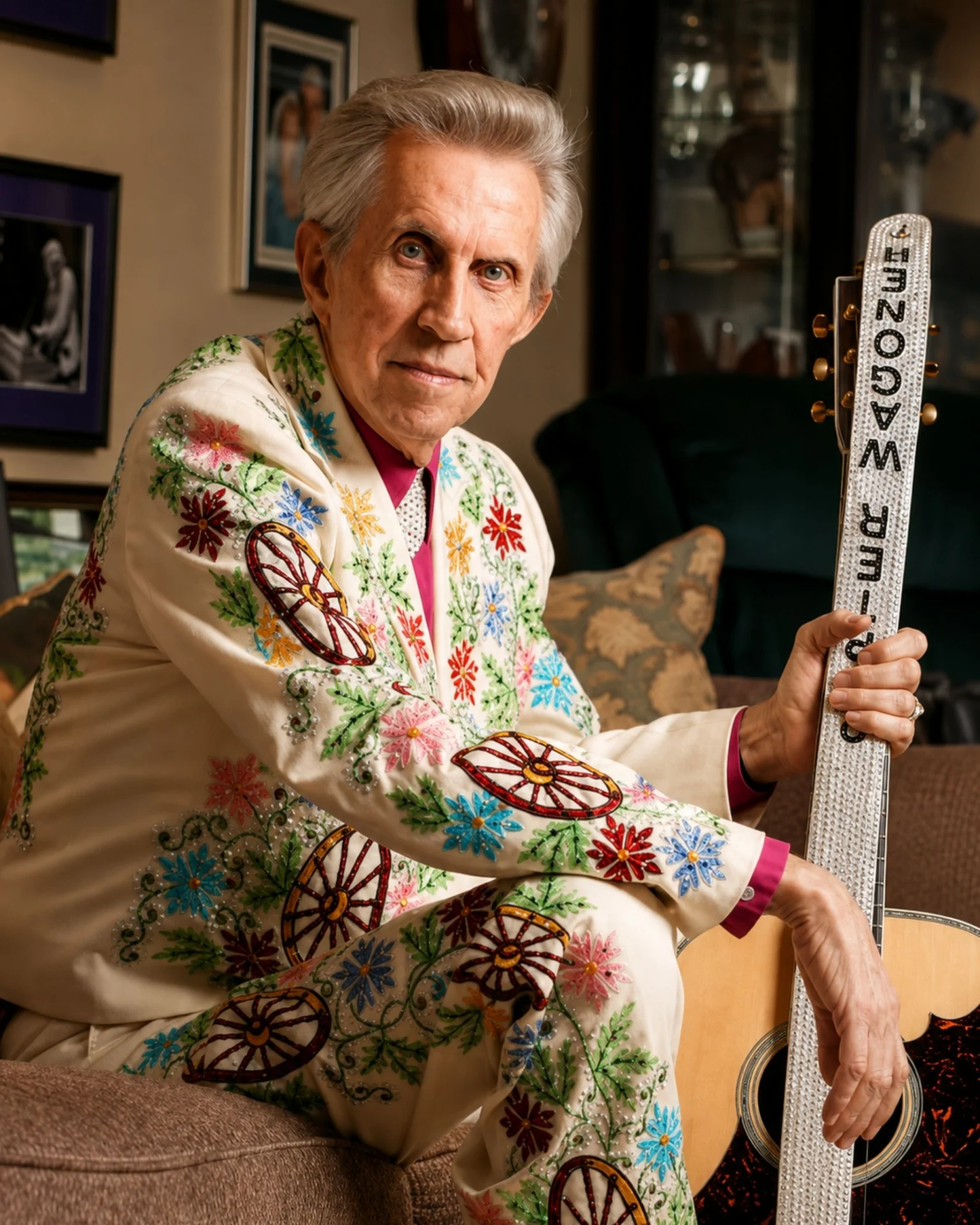
He was not a museum piece. He was a living performer still capable of holding attention far outside the world that had first made him famous.
By the 1990s, Porter Wagoner had faded from the spotlight. His iconic television show, once beamed into millions of homes, ended in 1981. New records stopped after the early 1980s. After Roy Acuff died in 1992, Porter became the Grand Ole Opry’s respected elder—still beloved, but no longer seen as a current artist.
Then Marty Stuart saw something else. Stuart, who had spent years around country music’s older masters, believed Wagoner still had a serious record in him. Porter had released The Best I’ve Ever Been in 2000, a small late-career revival, but Stuart wanted to push further.
So they went back into the studio.
Stuart produced Wagonmaster, surrounding Porter with traditional country instrumentation and songs that suited his older, darker voice. There was no attempt to make him sound young or chase contemporary radio. The record leaned into the man Porter had become—weathered, strange, dignified, and unmistakably country.
This was not nostalgia as decoration. It was age turned into authority.
Released in June 2007, when Porter was 79, Wagonmaster drew rave reviews and national features. The Country Music Hall of Fame later described the response as a wave of praise. But the comeback took an unexpected turn.
On July 24, 2007, Porter Wagoner walked onto the stage at Madison Square Garden as the opening act for the White Stripes.
It was an almost absurd pairing: the rhinestone-clad Opry veteran who started singing on Missouri radio in the 1940s opening for one of the biggest rock bands of the 2000s. But Porter played the room as Porter. He carried the Opry with him into a rock arena, not as a museum piece, but as a living performer.
That same year, the Opry celebrated his 50th anniversary as a member, with Dolly Parton among those returning to honor him.
For one strange, beautiful night, the road that began in Missouri radio and wound through Nashville television, Dolly Parton duets, and decades of Opry appearances reached Madison Square Garden.
Then time closed quickly. Later in 2007, Wagoner was hospitalized with lung cancer. He died in Nashville on October 28 at age 80. Wagonmaster became his final album.
Marty Stuart had not tried to recreate the Porter of 1967. He gave the 2007 version of Porter one last record sturdy enough to carry his own age, voice, and history. The gift was not youth. It was dignity.
For one final summer, Porter Wagoner was not just being remembered. He was moving again. The rhinestones were still there. The voice was older. The road was almost over. But thanks to Marty Stuart, the last Porter Wagoner record did not sound like an imitation of his prime. It sounded like a final statement from the man who had survived long enough to sing his own ending.