
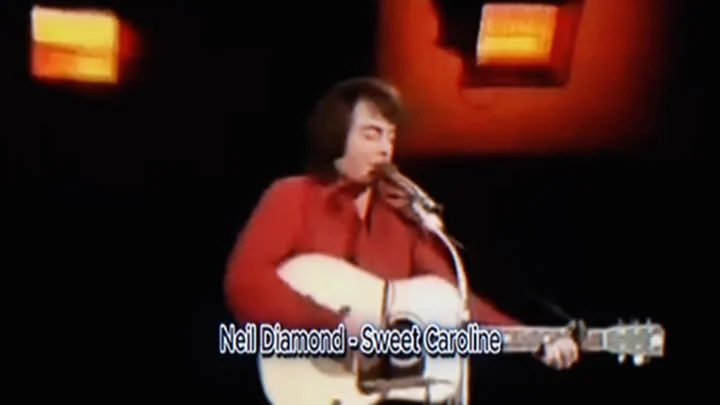
From stadium anthems to wedding dance floors, one song has an almost supernatural ability to unite strangers in spontaneous joy. It begins with those unmistakable piano notes, and within seconds, thousands of voices rise together in a chorus that feels both personal and universal. Neil Diamond’s Sweet Caroline is not merely a tune from the past; it is a living, breathing cultural pulse that has been beating for over five decades.
Released in 1969 as part of the album Brother Love’s Travelling Salvation Show, this track has outgrown its origins to become something far larger than a single artist’s creation. It belongs now to the collective memory of generations, a shared sonic touchstone that evokes warmth, nostalgia, and an irresistible urge to sing along.
The magic of “Sweet Caroline” isn’t hidden in complexity—it’s woven into the simplest of musical gestures: a piano riff, a hand clap, a heartfelt “bum-bum-bum” that feels like an old friend’s greeting.
The album that gave birth to this phenomenon marked a turning point in Diamond’s career. Brother Love’s Travelling Salvation Show showcased his ability to straddle genres, blending pop sensibility with country storytelling and rock energy. While the title track channels the fervor of a revival meeting, Sweet Caroline stands apart as a tender, melodic counterpoint, proving Diamond’s range as a songwriter who could capture both fire and tenderness in a single collection.
What makes the song’s architecture so enduring is its deceptive simplicity. The opening piano motif is a masterclass in melodic economy—four notes that immediately conjure a feeling of anticipation. Acoustic guitar joins the texture with gentle strumming, laying a rhythmic bed that feels like a heartbeat. Then, as the chorus unfolds, strings and horns swell, adding a cinematic grandeur that transforms a simple love song into an anthem of collective happiness.
The percussion is deliberately understated. A steady beat paired with hand claps creates an intimate, communal energy, as if the listener is part of an informal gathering rather than a polished performance. This careful balance between sophistication and approachability is the secret to the song’s cross-generational appeal.
Lyrically, Sweet Caroline operates on a level of pure emotion. Diamond’s vocals are earnest, almost conversational, as he sings of hands touching, spring turning to summer, and loneliness dissolving in the presence of another. The chorus, with its iconic “so good, so good, so good”, is less a statement than an invitation to join in a moment of shared joy. The song’s emotional arc mirrors its musical build: from a quiet, introspective verse to a soaring, cathartic release that feels like a collective exhale.
Why has this particular song endured across decades, across genres, across generations? The answer lies in its universality. It doesn’t rely on complex metaphors or niche references. It taps into the simplest of human experiences: the joy of connection, the warmth of memory, the feeling that—even for a few minutes—everything is exactly as it should be. Whether heard in a packed sports arena, at a wedding reception, or alone in a car, the song retains its power to transform a moment into something memorable.
The song’s adaptability is a testament to Diamond’s songwriting genius. It works as a tender serenade and a raucous sing-along. It fits both intimate playlists and stadium sound systems. That versatility is rare, and it’s what keeps Sweet Caroline from feeling dated or tired.
For those who want to explore music with a similar timeless charm, several classics share its melodic warmth and emotional resonance. Piano Man by Billy Joel uses piano-driven storytelling to create an anthem of loneliness and camaraderie. American Pie by Don McLean offers a longer, narrative-rich journey that also unites listeners in nostalgia. Country Roads, Take Me Home by John Denver echoes the acoustic gentleness and heartland sincerity of Diamond’s masterpiece. Brown Eyed Girl by Van Morrison captures the same joyful spirit, while Can’t Help Falling in Love by Elvis Presley provides the romantic undertones that make Sweet Caroline a perennial wedding favorite.
Ultimately, Sweet Caroline is more than a song; it is a cultural artifact that continues to create moments of shared humanity. Neil Diamond’s 1969 album Brother Love’s Travelling Salvation Show provided the context, but the song itself transcended its era. Its piano, guitar, strings, and horns form a tapestry that feels both meticulously crafted and effortlessly spontaneous. And its lyrics, simple as they are, have become a collective language of joy.
Whether you have known this song for fifty years or are discovering it for the first time, its message remains the same: good times can be real, connection is possible, and sometimes all it takes is a melody to remind us that we are not alone. That is why it will always be “so good, so good, so good.”