
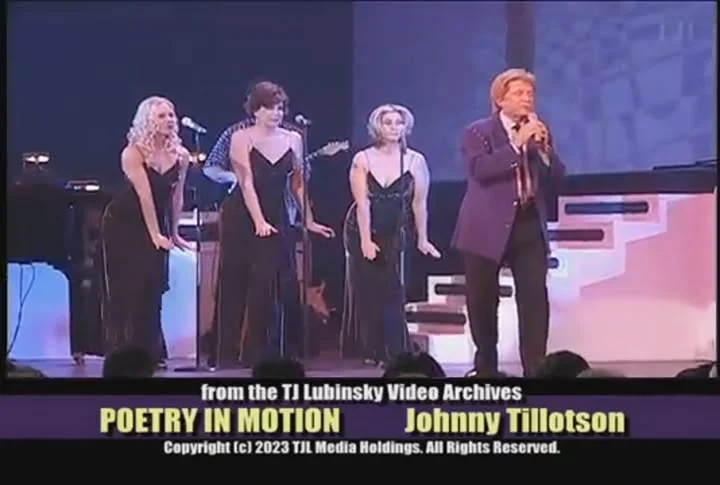
Poetry in motion, walkin’ by my side
That saxophone riff—bright, brassy, and impossibly catchy—seems to float out of the speakers and instantly transports the listener to a simpler time. It is the opening note of Johnny Tillotson’s 1960 smash, a song that has become a shorthand for the innocent euphoria of early rock and roll. Long after the final chord fades, the melody lingers, a ghost of a dance from a bygone era.
When Johnny Tillotson first recorded “Poetry in Motion,” he was a young man with a country soul and a pop star’s smile. The track, released as a single, would become the unexpected gem of his debut album, It Keeps Right On a-Hurtin’, which arrived fully two years later in 1962. That album was a study in contrasts. Its title track, a country ballad drenched in heartache, earned him fame on both pop and country charts. But the record also housed this buoyant, radio-ready pop tune—a playful piece that proved Tillotson could bridge two worlds. While the rest of the album leaned into the melancholy of country storytelling, “Poetry in Motion” was pure, sparkling optimism. That duality defined his early career and helped him attract fans from across the musical spectrum.
The instrumentation of “Poetry in Motion” is where its magic lives. A steady, driving drum beat keeps time like a pulse, begging the listener to tap a foot or sway. Beneath it, the bass guitar adds a warm, unobtrusive depth that never overpowers the melody. But the real star is the brass section, especially the saxophone. It punctuates Tillotson’s vocal lines with playful bursts of energy, weaving in and out like a conversation between friends. The solos are brief, almost fleeting, yet they leave an indelible mark—a touch of jazzy sophistication that elevates the song above standard pop fare. Backing harmonies, light and breezy, fill the space without crowding Tillotson’s smooth tenor. Their simplicity is intentional, letting the lead vocal remain the clear focus. In an era when production was growing increasingly complex, “Poetry in Motion” stuck to a clean, straightforward arrangement. That clarity has given the song a timeless quality, allowing each element—voice, drums, sax, harmonies—to shine individually and together.
Lyrically, the song captures the giddy thrill of young admiration. Tillotson sees his love interest moving “like poetry in motion,” a metaphor that feels both sweet and effortless. There is no deep ambiguity here, no hidden pain. Instead, the words reflect the post-war optimism of the early 1960s, a time when economic prosperity and social change merged into a collective sense of possibility. The lyrics are a snapshot of a carefree romance, delivered with a youthful sincerity that makes them instantly relatable even six decades later.
For fans who still can’t get enough of that vintage pop-rock sound, a handful of similar songs from the same era share that same irresistible charm. Del Shannon‘s “Runaway” (1961) offers a similarly catchy melody with its iconic keyboard riff and Shannon’s distinctive falsetto. Lesley Gore‘s “It’s My Party” (also a hit in the early 60s) bubbles with the same youthful, carefree spirit. Neil Sedaka‘s “Calendar Girl” plays with playful lyrics and a flirty rhythm that mirrors the energy of Tillotson’s hit. The doo-wop classic “Happy, Happy Birthday Baby” by The Tune Weavers (1957) shares that innocent romantic longing. And Bobby Vee‘s “Take Good Care of My Baby” (1961) combines rock and pop with a gentle, sincere melody that perfectly complements this joyful playlist.
Decades after its release, “Poetry in Motion” remains a beloved touchstone of early rock and roll. It captures a moment—a feeling—that refuses to age. Whether you hear it on an oldies station or discover it through a streaming playlist, the song offers a direct line to that hopeful, foot-tapping energy of the 1960s. Johnny Tillotson may have been a country boy at heart, but with this track, he crafted a piece of pure, lasting pop magic.