
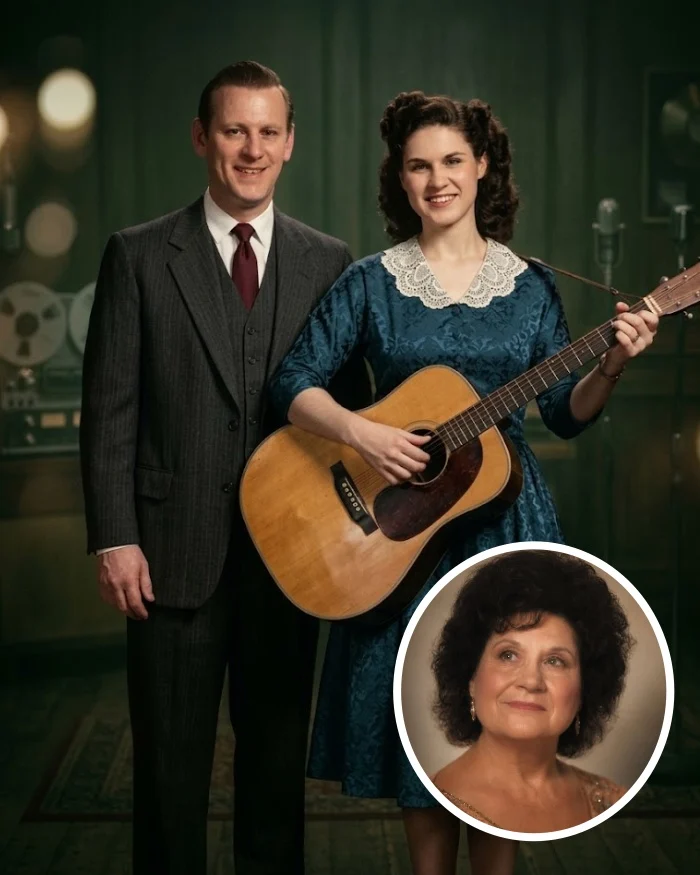
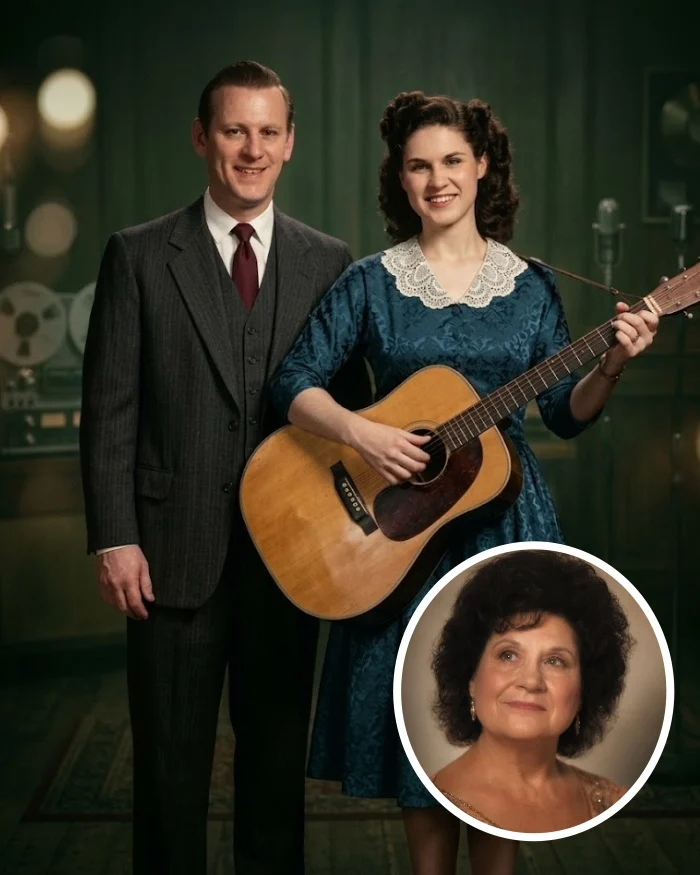
She only wanted a washing machine. That simple hope carried a tired 32-year-old mother of three into a Nashville hotel on May 3, 1952, and it carried her straight into history when a song the radio bosses tried to silence climbed to number one and made her the first solo woman ever to rule the American country chart.
By August 16, 1952, that banned record had reached the top of the Billboard country chart and stayed there for six consecutive weeks. More than 800,000 copies were sold, and the same institutions that had shut the song out were forced to welcome its singer back.
It Wasn’t God Who Made Honky Tonk Angels
The singer was Ellen Muriel Deason, known on stage as Kitty Wells. Earlier that spring she had moved back to Nashville from Shreveport, Louisiana, where she had spent the previous few years appearing on the Louisiana Hayride alongside her husband Johnnie Wright and his partner Jack Anglin.
For more than a decade she had hauled her children Ruby, Bobby, and Carol Sue across the South, heating baby bottles in roadside motel rooms and washing diapers by hand. Exhausted by the road and ready to put her family first, she had decided to retire into full-time housework and leave performing behind.
Her solo career had given her little reason to stay. RCA Victor had dropped her in 1950 after a string of singles failed to reach the national charts, leaving her to earn only a few dollars a night singing occasional gospel numbers during Johnnie and Jack’s live shows.
At the same time in early 1952, Hank Thompson’s ‘The Wild Side of Life’ was beginning a 15-week run at the top of the Billboard country chart. In Crowley, Louisiana, songwriter and producer J.D. Miller heard Thompson’s critique of a wayward woman in a honky-tonk and answered it with a song built to the exact same melody, a tune with roots in the nineteenth-century ballad ‘The Great Titanic’ and the Carter Family’s ‘I’m Thinking Tonight of My Blue Eyes.’
Miller sent his lyrics for ‘It Wasn’t God Who Made Honky Tonk Angels’ to Paul Cohen, the head of Decca Records’ country division in New York. Cohen knew that an answer record released quickly could capture half of an existing hit’s audience, so he contacted Wright in Nashville and asked if Wells would cut the track as part of a four-song trial session.
Wells hesitated. She planned instead to care for her aging mother and settle her children into Nashville schools. Wright reminded her that even if the record never sold a single copy, the American Federation of Musicians guaranteed union scale of $41.25 for a three-hour session, built around an $18 base fee per side, and that money could help buy a new washing machine for their house.
On the afternoon of May 3, Wells stepped into Castle Studio, a converted second-floor dining room inside the historic Tulane Hotel on Church Street in Nashville. Producer Paul Cohen oversaw the session as a top-tier Nashville studio crew gathered around her, with Owen Bradley on piano, Chet Atkins on electric guitar, Shot Jackson on steel guitar, Jack Shook on acoustic guitar, Charles ‘Little Chuck’ Wiggins on fiddle, and Ernie Newton on bass.
Because the studio had no vocal isolation booth, Wells stood in the open room near Jackson’s steel guitar and sang straight into the microphone in her crisp, unhurried alto. In that single afternoon session the group recorded ‘It Wasn’t God Who Made Honky Tonk Angels’ alongside three other tracks, ‘I Don’t Want Your Money, Honey,’ ‘A Wedding Ring Ago,’ and ‘Crying Steel Guitar Waltz.’
She then went back home to her housework, unsure whether Decca would ever press the disc. When the label released the single on May 30, 1952, backed with ‘I Don’t Want Your Money, Honey,’ its blunt response to unfaithful husbands immediately ran into broadcast censorship.
Executives at the NBC radio network flagged the lyrics as ‘suggestive’ and barred the record from their national programs, including the Prince Albert network segment of the Grand Ole Opry. Opry management also prohibited Wells from singing the song on the Ryman Auditorium stage during its initial weeks of release, arguing that a woman challenging male infidelity in a barroom setting violated family broadcast standards.
Independent local radio disc jockeys and jukebox operators played the record relentlessly anyway, and working-class women walked into record shops across the country to buy it. Sales surged past 300,000 copies in the first two months on the way to more than 800,000 copies, and both NBC and the Grand Ole Opry quietly lifted their bans and invited Wells back to perform the song live.
On August 16, 1952, ‘It Wasn’t God Who Made Honky Tonk Angels’ reached number one on the Billboard country chart and held the top spot for six consecutive weeks. Until that week no solo female singer had ever topped the national country charts, because major labels had long maintained that women did not buy country records and would not support female headliners.
Within months Wells’ booking fee jumped from union scale to thousands of dollars a week. She earned a permanent contract with Decca and the industry title Queen of Country Music, and her breakthrough proved to Nashville executives that female singers could carry major record sales on their own, opening studio doors for Patsy Cline, Loretta Lynn, Tammy Wynette, and Dolly Parton.
She went in for a washing machine and came out a queen.
Even after touring buses replaced cramped automobiles and royalties paid for the family home in Madison, Tennessee, Wells kept sewing clothes for her children and cooking supper between tours alongside Wright, her husband of 73 years. It all began on an afternoon at the Tulane Hotel, when she stepped up to a microphone for $41.25 to buy a washing machine.