
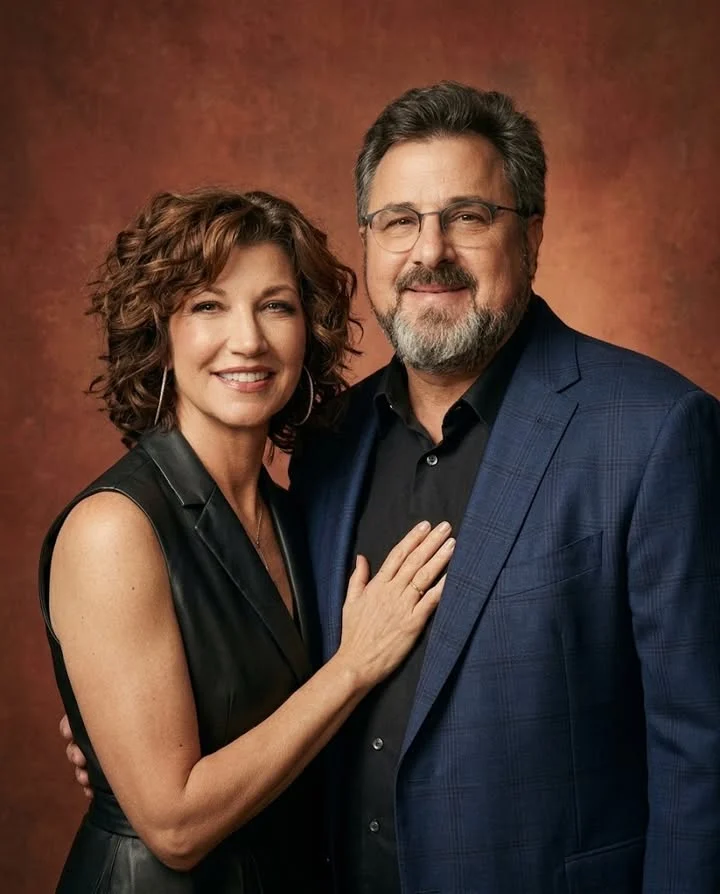
In early 2020, Amy Grant entered a cardiologist’s office not as a patient but as a loving wife. She was there to support her husband, Vince Gill, during his routine heart checkup. At 59, Grant felt perfectly healthy. She had no chest pain, no shortness of breath, and no reason to suspect anything was wrong. She had spent decades building a celebrated career as a six-time Grammy winner, touring and raising a family. But that day, a doctor’s intuition would change everything.
After examining Vince, Dr. John Thomason turned his attention to Grant. He knew her father had died from heart disease. Acting on medical instinct, he insisted she undergo immediate testing, despite her lack of symptoms. The results revealed a hidden danger she had carried since birth. Grant was diagnosed with Partial Anomalous Pulmonary Venous Return, or PAPVR. It is a rare congenital condition where some veins bringing oxygen-rich blood from the lungs connect to the wrong side of the heart. For nearly six decades, the right side of her heart had been working overtime, masking a defect that could have caused sudden catastrophic failure at any moment.
By June 2020, the roles in their Nashville home had reversed. Gill, who was supposed to be the patient, became the caregiver. He held his wife’s hand as she was wheeled into open-heart surgery. The operation was successful, but waking up marked the start of a grueling recovery. Healing from a split sternum meant intense daily pain and learning to take full breaths again. In the early weeks, Grant, who had spent her life holding a heavy guitar and moving across arenas, could not lift her arms, carry a small bag, or even sit up in bed without help. She relied on Gill for the most basic needs, from standing up from a chair to navigating their home. Months of cardiac rehabilitation followed just to regain the stamina for a normal afternoon.
Yet that forced stillness quietly reshaped her entire approach to life. Before the surgery, Grant had operated at the relentless speed of a touring artist. The vulnerable months of recovery forced her to stop rushing and view her life through a lens of absolute gratitude. She spent the following fall taking slow walks around her neighborhood, noticing the changing leaves, and finding deep joy in the simple rhythm of being alive.
She described the long scar down her chest as a visible map of her survival and a daily reminder of the moment everything changed.
When she eventually returned to the studio and the stage, her relationship with music had fundamentally shifted. The industry pressure to constantly produce and prove herself was gone. Her performances carried a new grounded weight, anchored in the fragile reality of being present. She no longer sang to maintain a career. She sang to celebrate the breath in her lungs.
Today, the discovery of her condition remains one of the most remarkable turns in her long public life. It was not a crisis brought on by a sudden collapse on stage but a quiet rescue hidden inside an ordinary errand. She did not go to the clinic looking for a lifeline. Her simple choice to look after the person she loved ended up being the very thing that allowed her to keep walking beside him.