
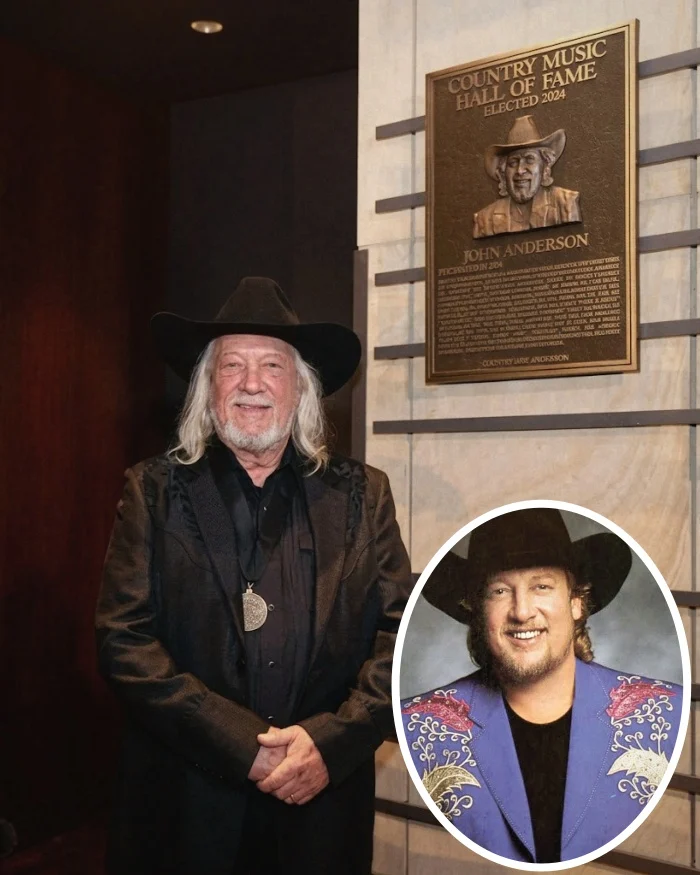
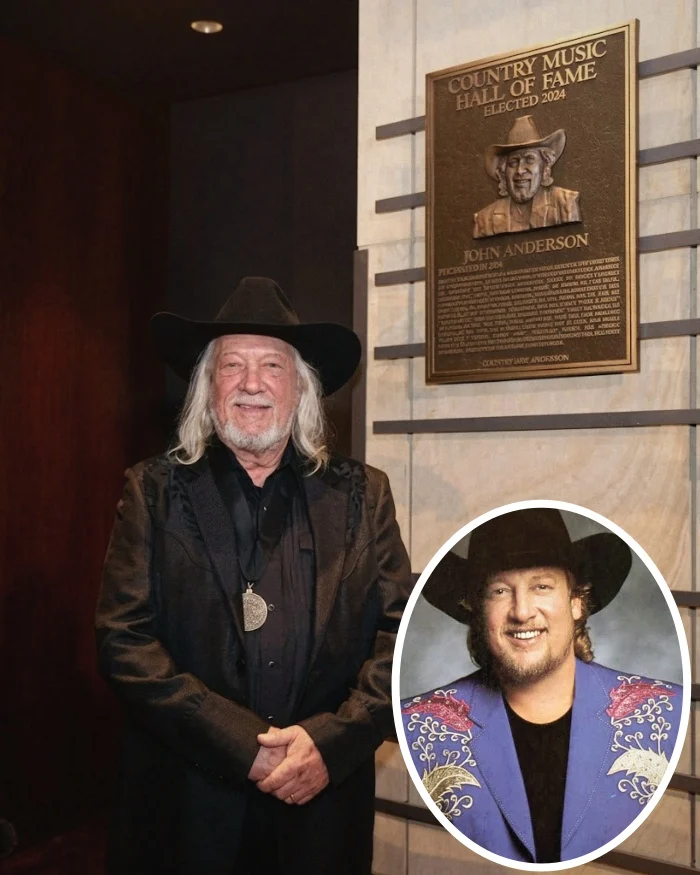
When Bobby Braddock stepped forward to hang the heavy bronze medallion around John Anderson’s neck, the eighty-four-year-old songwriter called the former roofer his country hero. The room inside the CMA Theater rose to its feet as Anderson bowed his head, tears streaming down his face, overcome by a moment he had long stopped believing would ever come.
The sixty-nine-year-old singer had gone quiet back in March 2024 when the phone rang with news of his Country Music Hall of Fame selection. For decades, Anderson had lived an hour east of Nashville on his Smithville farm, tending his garden and casting fishing lines instead of working Music Row parties. He had stopped expecting the industry to remember the man who once nailed shingles onto the Ryman Auditorium roof.
In the early 1970s, a seventeen-year-old Anderson arrived in Nashville and spent five years playing nightclubs for tips and sweating through roofing repairs on the historic Ryman and the new Grand Ole Opry House to pay his rent. His raw bent-note phrasing puzzled Music Row executives, but songwriters like Braddock heard his gift early on. It was Braddock’s ballad Would You Catch a Falling Star that gave Anderson his first major breakthrough in 1982, setting the stage for five number one hits including the record-breaking 1983 CMA Single of the Year Swingin’.
Over four decades, Anderson placed more than forty singles on the Billboard country charts. Yet every shift in radio trends kept him anchored to his farm, bound to Braddock by their shared reverence for traditional country music. That distance widened around 2017 and 2018 when a severe inner-ear illness nearly stole his hearing and his ability to sing. Teaming up with Dan Auerbach of The Black Keys on the 2020 album Years slowly helped him find his voice again.
On October 20, 2024, the long road led to the Medallion Ceremony. Museum CEO Kyle Young told the audience that while listeners often compared Anderson to Lefty Frizzell or Merle Haggard, Anderson sounded only like himself. Shawn Camp opened the musical tributes with a quiet version of I Just Came Home to Count the Memories. Eighty-five-year-old Del McCoury and his band performed Braddock’s Would You Catch a Falling Star, hitting the high notes that had changed Anderson’s life forty-two years earlier. Americana singer Lucinda Williams closed with a slow rendition of Wild and Blue.
After Braddock placed the medallion around his neck, Anderson walked to the podium as the theater roared. He singled out his family, friends, and the physicians who had pulled him through his illness.
There were a lot of hills and valleys, many twists and turns, and dead stops, Anderson said, adding that behind it all, he had been blessed to choose his own way. He bowed his head and thanked God for giving him a lifelong love of music and sparing him long enough to stand on that stage.
Almost two years to the day after that night, Anderson passed away peacefully in his sleep on October 21, 2026, at age seventy-one. The boy who once nailed shingles onto the Opry roof left behind a bronze plaque in Nashville and the quiet satisfaction of having heard the applause while he was still here to take it in.