
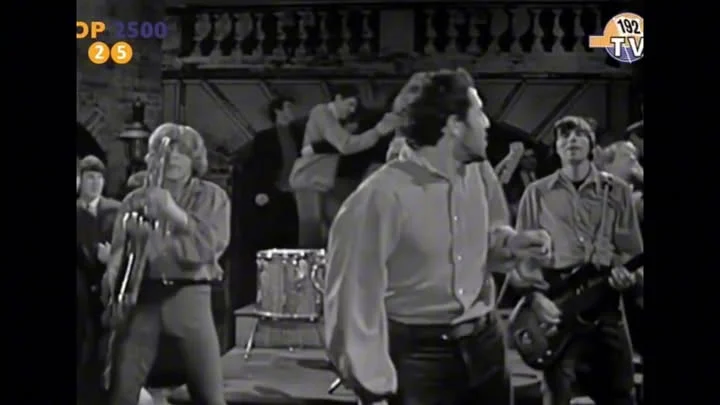
It begins with a countdown that sounds like a dare shouted from a speeding hearse. “Uno, dos… one, two, tres, cuatro!” The command slices through the static of a Memphis AM station, and in that split second the polished pop of 1965 shatters into something grittier, wilder, and unmistakably alive. This is the moment Domingo “Sam” Samudio, a Texas-born showman in a turban, dragged American garage rock into the mainstream with a two-minute explosion called “Wooly Bully.” The song that would become Billboard’s number‑one single of 1965 wasn’t a calculated hit. It was a glorious accident, a recording so raw it felt like a live wire left on the studio floor.
Samudio and his band, Sam the Sham & the Pharaohs, were outsiders from the start. While the British Invasion ruled the airwaves with crisp harmonies and studio polish, this Memphis quintet brought the sound of a basement party where the furniture had been pushed aside. The track, first released in late 1964 by a small label then reissued by MGM in 1965, sold a million copies in the United States alone. It was a homegrown counterpunch, a declaration that rock and roll still belonged to the restless and the reckless.
“The greatest hits often aren’t perfect recordings, they are simply perfect moments captured on tape.”
That moment happened at Sam C. Phillips Recording Studio, the second Memphis location of the Sun Records pioneer. Producer Stan Kesler, a veteran of the Sun orbit, kept the session lean. There was no budget for reverb chambers or string sections. Instead, the tape captured a band playing as if the room were about to catch fire. Drummer Jerry Patterson laid down a two‑beat thump that never wavered. Bassist David A. Martin locked into a hypnotic repeated line. And at the center of the chaos stood Samudio, his fingers pressing the keys of a cheap Farfisa organ that buzzed like a hornet in a jar. That thin, trebly riff became the song’s signature, a sound that defined an entire subgenre of garage rock.
The rest of the arrangement was economy at its most electrifying. Ray Stinnett chugged along on rhythm guitar, stepping forward only for the simplest, most effective riff. Then, one minute in, Butch Gibson unleashed a honking, frantic saxophone solo that felt like a car backfiring at a dance party. Clocking in at barely two minutes and twenty seconds, “Wooly Bully” was a masterclass in less‑is‑more. It hit, it made you move, and it vanished before you could ask what the words meant.
And the words—what words? Samudio’s slurred, shouted vocal made the lyrics about two characters named Matty and Hatty and a mysterious “Wooly Bully” almost secondary to the rhythm. That deliberate ambiguity sparked suspicion. Some radio programmers banned the record, suspecting the unintelligible lines concealed something risqué. On a compressed AM radio broadcast, it became a Rorschach test for teenage rebellion. The real point was never the story; it was the energy, the call‑and‑response shout of “Watch it now, watch it now, here he come!”
That energy came from Samudio’s Mexican‑American heritage. He fused rock and roll’s raw power with the borderland rhythms of conjunto music, creating a hybrid that felt both familiar and alien. It was a sound that proved you did not need a huge budget or a symphonic arrangement to dominate the charts. You just needed an undeniable three‑chord hook and the nerve to follow it. For anyone who ever took a guitar lesson and wondered how to maximize impact with minimal notes, “Wooly Bully” remains the ultimate textbook.
The track peaked at number two on the Billboard Hot 100, kept from the top spot by the Beach Boys and the Supremes. But Billboard later named it the number‑one song of 1965 based on sustained commercial performance. That distinction tells the real story: this was not a flash in the pan. It was the soundtrack to a whole summer, a constant pulse that refused to fade. Its success helped define the garage‑rock movement sweeping the U.S., a sound that prized attitude over technique, energy over perfection.
Today, “Wooly Bully” is a living document of an era’s spirit—joyous, reckless, deeply authentic. It is the sound of a band enjoying the sheer kinetic pleasure of making a glorious noise. And it still commands you to stand up and dance, or at least to shout along to the gibberish.
Listening Recommendations
“96 Tears” – ? and the Mysterians (1966): The same driving Farfisa organ defines this classic, cementing the sound of garage rock.
“Hang On Sloopy” – The McCoys (1965): Another mid‑sixties anthem built on a simple, infectious melody and unpolished vocals.
“I Fought the Law” – The Bobby Fuller Four (1966): Raw production and a three‑chord structure rooted in Sam Phillips’ Memphis lineage.
“Do Wah Diddy Diddy” – Manfred Mann (1964): High‑energy simplicity with vocal interjections that capture what makes “Wooly Bully” so engaging.
“Louie Louie” – The Kingsmen (1963): The ultimate predecessor, sharing deliberate lyrical ambiguity and cheap, raw production that became garage‑rock hallmarks.