
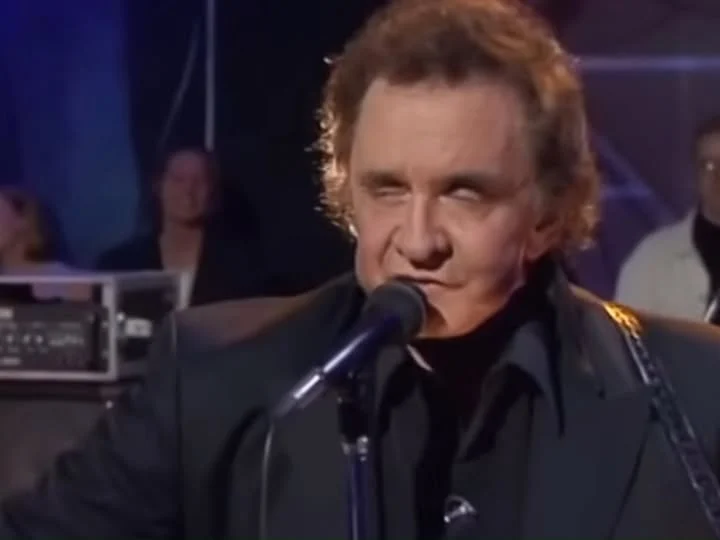
Three men walked into a tiny Memphis studio in 1955 and conjured hell with a guitar, a bass, and a voice that sounded like judgment itself.
Long before the cheers of 1968 swallowed Folsom Prison whole, before the Man in Black became a symbol of redemption and rebellion, there was a single that arrived like a cold blade through the noise of American music. It was not the wild howl of early rock and roll nor the polished sentiment of Nashville country. It was something else entirely. It was the sound of a man staring at four concrete walls and refusing to blink.
That single was Folsom Prison Blues, released by Sun Records in 1955 with Sam Phillips at the controls. It arrived unassuming, backed with So Doggone Lonesome, and would later find its home on Cash’s debut album Johnny Cash with His Hot and Blue Guitar! But in that original moment, it was a standalone statement. A declaration. A threat and a confession rolled into two minutes and fifty seconds of unrelenting rhythm.
To understand what Cash achieved here, you must first forget the legend and meet the man still wearing his Air Force uniform. In 1955, Johnny Cash was a young man recently returned from service, chasing the siren call of country music with a strange trio of musicians who barely resembled a band. Luther Perkins on electric guitar and Marshall Grant on upright bass formed The Tennessee Two, a unit that functioned less like musicians and more like a machine built for repetition and weight. There was no drummer. There was no piano. There was no safety net.
Sam Phillips, the architect of the Sun sound, understood exactly what he had. He did not sweeten the piece of music with reverb or strings. He let it stand naked in the studio, every imperfection and every stroke of genius laid bare. The result is a recording that still sounds like it could have been made yesterday or a hundred years ago. It exists outside time.
The Machinery of Doom
The rhythm that would define Johnny Cash for the next half century was born in this room. The boom-chicka-boom pulse emerged not from a drummer but from the interplay of two men who knew exactly how to make less sound like more. Luther Perkins held a low, dampened tremolo riff on his electric guitar, a sound that resembled a train grinding down steel tracks. It was percussive, hypnotic, and utterly without mercy. Cash himself contributed by dampening his acoustic guitar strings with a dollar bill, producing a snare-like thwack on the off-beats. This homemade hack gave the recording its signature dry, driving dynamic. It was not a party. It was a work gang. It was a forced march toward some inevitable dark horizon.
Marshall Grant’s upright bass walked beneath it all with solemn precision. There was no improvisation, no jazz flourish, no escape. Just the deep, woody weight of a man carrying his own sentence. Together, the three created a sound that suggested not freedom but confinement, not celebration but counting down the hours.
Cash’s vocal delivery on this 1955 recording is startling in its maturity. He does not plead. He does not whine. He states his condition with the calm of a man who has already accepted his fate. His baritone sits unnervingly close to the microphone, lending the narrative an intimacy that borders on discomfort. You are not listening to a song. You are sitting in the cell with him.
The economy of the original recording cuts deeper than any orchestral swell could ever reach, using just three instruments to summon an entire lifetime of regret.
The Weight of a Single Line
The lyrics of Folsom Prison Blues have passed into American mythology, but their power remains undiminished. Inspired by the film Inside the Walls of Folsom Prison and borrowing structure from Gordon Jenkins’s Crescent City Blues, Cash created a narrator whose moral compass had been shattered beyond repair.
I shot a man in Reno just to watch him die remains one of the most cold-blooded lines in popular music. What makes it so devastating is not the violence itself but the narrator’s detachment. There is no motive beyond pure, nihilistic observation. He has paid his debt to society, but his soul remains locked in a cage of his own making.
The true torment of the song lies not in fear but in envy. The narrator watches the rich folks eating and drinking on the passing train, their lives moving forward while his own stands still. This contrast between the glamorous world outside the walls and the desperate monotony within taps into a primal human anxiety, the fear of being left behind. The song understands that punishment is not just about losing freedom but about watching everyone else continue without you.
The tempo of the recording contradicts its subject matter. The guitar and bass move so fast, so relentlessly, that the prison song becomes a rockabilly frenzy. The pace is a desperate heartbeat, a furious pacing back and forth in a tiny cell. There is no time for reflection. The three members of the ensemble must simply keep the engine running, propelling the grim story forward at a speed that allows no pause for self-pity.
The Moment Everything Changed
When this single climbed near the top of the Country and Western charts in early 1956, it signaled that America was ready for something different. Audiences recognized in Cash’s stark narrative a broader commentary on class, consequence, and the American dream gone sour. It was the first clear statement of the outlaw persona that Cash would carry for the rest of his life, sometimes reluctantly, always authentically.
For anyone seeking to understand the roots of this sound, a wealth of guitar lessons now exists breaking down Luther Perkins’s deceptively simple technique. But the magic cannot be taught. It was born from the specific chemistry of three men in a room on Union Avenue, with the Memphis humidity pressing against the windows and the ozone from Sam Phillips’s old tube gear hanging in the air.
The Echo That Refuses to Fade
The 1955 recording remains a masterclass in musical minimalism. It proves that to convey a desolate world, you do not need lush arrangements or studio trickery. You need a strong voice, a heavy subject, and a rhythm that pulses like an inescapable doom. When you listen to the 1968 live version, you hear catharsis and release and the roar of a crowd that has come to celebrate a man who survived. But when you put on this 1955 studio original, you hear something far more intimate. You hear the quiet, claustrophobic despair of the moment before redemption. You hear the true cold sound of the walls closing in.
This is not the sound of a man who has found his way out. This is the sound of a man who is still counting the days. And that is what makes it essential listening, a blueprint for American grit that rings just as true today for anyone caught in a cycle of regret.
Songs That Walk the Same Dark Road
Sixteen Tons by Tennessee Ernie Ford shares the low-voiced working class narrative of inescapable hardship from the same era. That’s All Right by Elvis Presley demonstrates Sam Phillips’s recording philosophy applied to a different kind of early rockabilly track. Long Black Veil by Lefty Frizzell carries the same somber narrative intensity and theme of tragic consequence. Hobo Bill’s Last Ride by Hank Williams connects to the train song folk tradition and the lonely forgotten man on the margins. The Ballad of Jed Clampett by Flatt and Scruggs offers a comparison in relentless forward momentum between Perkins’s guitar and Scruggs’s banjo roll. Cocaine Blues by T.J. Arnall shares the prison theme with dark humor and the fast driving pace that defined Cash’s early work.