

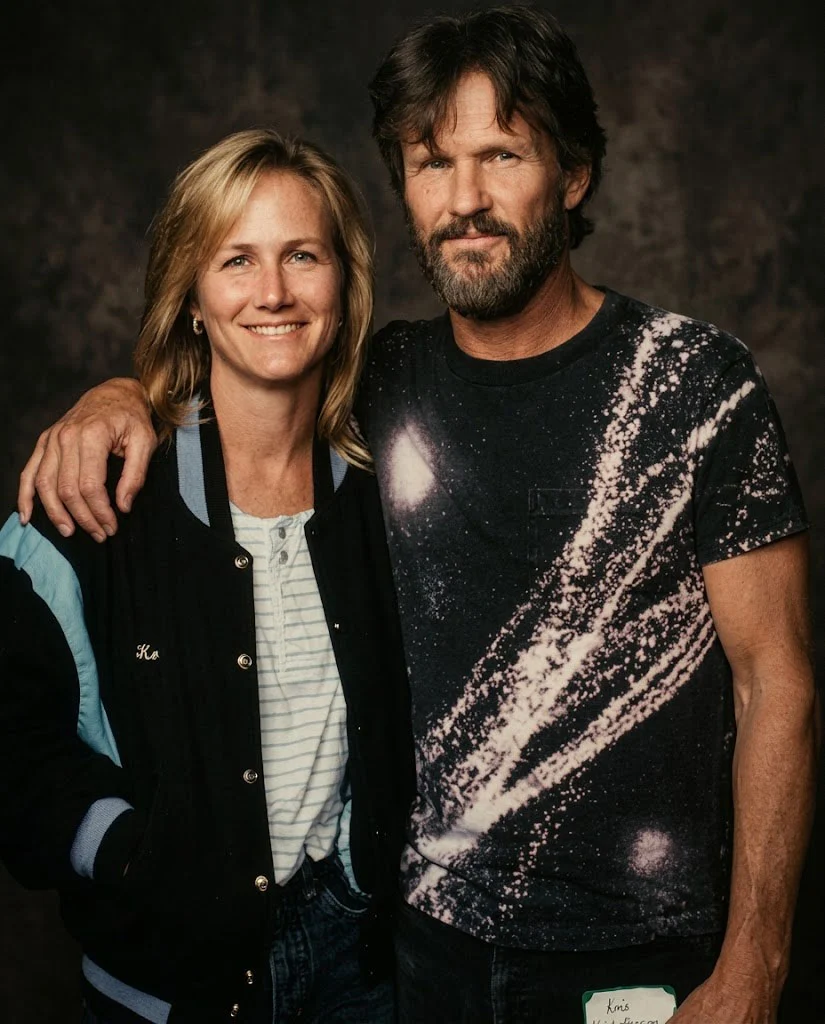
At the end, the room held no applause and no spotlight. There was only the steady weight of a hand holding another hand, and the man who had sung about drifters for decades did not have to walk the final road alone.
Kris Kristofferson lived many lives before he found a quiet one. He was a former Rhodes Scholar, a Music Row janitor, a cinematic star, and the poet of heartbreak who gave country music Sunday Mornin’ Comin’ Down and Help Me Make It Through the Night.
By 1982, the outlaw legend had survived hard drinking, broken marriages, and the blinding glare of Hollywood. He crossed paths with Lisa Meyers in a Malibu gym. She was a Pepperdine law student, far from the chaotic orbit of fame, and she saw not the myth but a tired man searching for rest.
She did not try to rescue a legend. She met a person who needed peace.
They married a year later in a private ceremony. It was a gentle act of rebellion, a choice to turn away from the consuming fire of celebrity and build a life off the radar.
Maui became their sanctuary. The songwriter who had lived a thousand lifetimes on stage traded the fast lane for the rumble of a tractor and the warmth of Hawaiian sun. He cleared grass with his hands and found a calm that fame had never given him.
Lisa paused her legal ambitions and became the anchor of a large blended family. She helped raise their five children alongside his three from earlier relationships, creating a home where normalcy became the real achievement.
For decades, their marriage stayed grounded in respect and privacy, beyond the reach of tabloids. Then, in the twilight of his life, his memory began to fracture.
Before doctors confirmed tick-borne Lyme disease, the family endured years of terrifying assumptions, including Alzheimer’s fears. Lisa stepped forward as protector and manager, shielding his dignity while navigating a health crisis that tested every part of their bond.
On the heaviest days, the illness could steal the lyrics to his own classics. The man who had written some of the most masterful poetry of the twentieth century would search for words that had once come so easily.
The music could leave him, but he never forgot her.
Whenever Lisa entered the room, confusion seemed to break. His eyes lit with recognition and peace, as if she were the one melody that memory could not erase.
She stayed by his bedside, holding his hand until his final breath. He had spent a career singing about goodbyes, empty roads, and missed chances, yet she gave him a love story that required no farewell.
His songs remain, but the deepest masterpiece may have been the quiet life they built when the world stopped watching.