
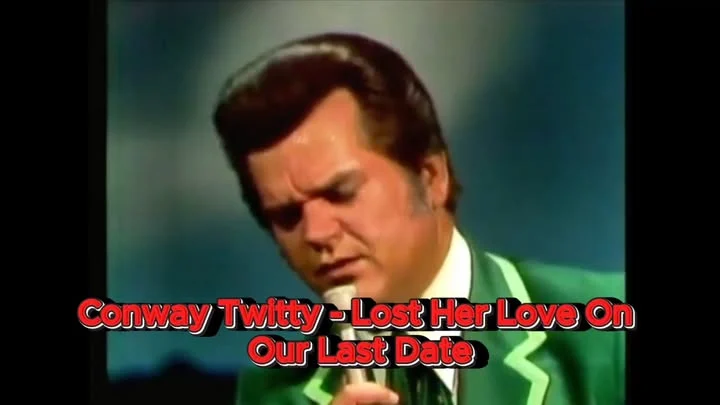
The listening room falls silent, not from the absence of sound but from the weight of a story landing like a punch to the chest. Through a carefully calibrated home audio system, the saturated emotion of the Nashville Sound fills every corner. The track is Conway Twitty’s “(Lost Her Love) On Our Last Date,” and it unfolds as a meticulously crafted three-minute tragedy that leaves you breathless.
This piece of music thrives on a magnificent scale of contrast. It pairs the polished, almost antiseptic glamour of early-1970s country production—soaring strings, velvet reverb—with a vocal performance so exposed it feels like a raw nerve wrapped in that famous, almost spoken-word growl. Twitty mastered this dichotomy, taking the shimmer of countrypolitan and driving a rusted truck straight through its heart.
“The most devastating songs are not about the moment of betrayal, but the creeping, quiet realization that the love is already gone, and you were the last to know.”
Conway Twitty, born Harold Lloyd Jenkins, had long moved past his rockabilly days on MGM by 1972. He earned the title “The High Priest of Country Music” through a remarkable string of chart-topping, deeply felt singles. At Decca (soon to become MCA), he worked with legendary producers like Owen Bradley, though exact production details sometimes blur across compilations. What remains clear is his status as a commercial powerhouse, a brand synonymous with sophisticated heartbreak.
The recording hit number one on the US Country Chart and came from the album I Can’t Stop Loving You / (Lost Her Love) On Our Last Date. Its context matters: this was not just another sad song but a vocal adaptation of a beloved instrumental. The melody originated from Floyd Cramer’s iconic 1960 track “Last Date,” a piece built around Cramer’s signature slip-note piano technique. Twitty took that classic arrangement and, by adding his own melancholy lyrics, transformed a familiar soundscape into a personal confessional.
The production here serves as a clinic in the Nashville Sound’s later evolution. The song opens with a delicate, almost hesitant guitar figure—a clean, single-note line played lightly, immediately establishing quiet reflection. This is not the electric roar of rockabilly; it is a man staring at a motel ceiling at three in the morning.
A soft, pulsing rhythm section forms the foundation. The bass line is simple and supportive, perfectly rounded, never fighting the mournful narrative. Then the signature instrumentation arrives: the piano, a ghostly echo of Cramer’s original, provides gentle, rolling chords. It is not a flashy lead but a textural element, a low-key murmur of regret.
But the real drama comes from the strings. The string section—a hallmark of this era—does not just fill space. It acts as the tragic chorus, swelling and receding in great, mournful waves, orchestrated to follow Twitty’s voice. When he delivers the critical line, “I held her close beneath the pale moonlight,” the strings rise in a sighing crescendo, a moment of cinematic grandeur that underscores the memory’s painful beauty. The vibrato on sustained notes hangs in the air, a physical representation of the singer’s lingering ache.
Twitty’s voice is the absolute center. His baritone is deep, resonant, utterly controlled. He does not shout; he whispers secrets. His famed growl and almost-spoken phrasing are used with surgical precision. Consider the lines detailing the realization of loss. Twitty allows his voice to crack just barely, pulling back from full projection to create intimacy. He is not performing for an audience; he is telling us, the listener, what happened. This restraint is the song’s primary source of power—the difference between a loud lament and quiet, profound despair. Every phrase carries a palpable sense of loss that is both universal and intensely specific.
The overall dynamic range is subtle yet powerful. The song maintains a mid-tempo ballad pace, but intensity builds through texture, not volume. The mix places Twitty’s vocal right at the front, dry and immediate, while the orchestration floats slightly behind, bathed in classic studio reverb. It gives the impression of a man pouring out his heart in a vast, empty ballroom.
The main guitar work is restrained, offering subtle fills and tasteful countermelodies. Often an electric guitar with a touch of tremolo, it produces a watery, shivering sound that mirrors the singer’s emotional instability. This arrangement proves that in Nashville, sometimes less really is less, and what you need is a full orchestral backing to convey the weight of an ordinary human failure. For aspiring musicians trying to capture this emotional depth, a foundation in technical skill is essential, and access to quality guitar lessons can unlock the sophisticated chord voicings at play here.
The true genius of this song lies in its ability to graft Twitty’s story onto any listener’s memory. It becomes the soundtrack to every inevitable final evening that felt like any other night. I remember driving late one night, the radio casting a dim glow on the dashboard. It was raining—a slow, relentless Nashville drizzle. The song came on, and I did not think of Twitty’s rockabilly past or his duet partner Loretta Lynn. I thought of a friend who described his own last date: an evening where conversation was cordial, kisses polite, but the usual spark was extinguished—a tiny flame snuffed by an invisible draft. He drove her home, feeling the absence before it was confirmed, exactly as Twitty narrates.
This is why the song endures. It is not about grand drama but the devastating smallness of the moment. The silence on the car ride home. The hand held just a little too loosely. The slightly rushed goodnight. The production, for all its lushness, serves only to elevate this mundane, common heartbreak to the level of operatic tragedy. The entire piece stands as a timeless monument to the fact that endings rarely announce themselves with fireworks. They arrive on soft strings, in a low, rumbling voice that admits, finally, the truth.