
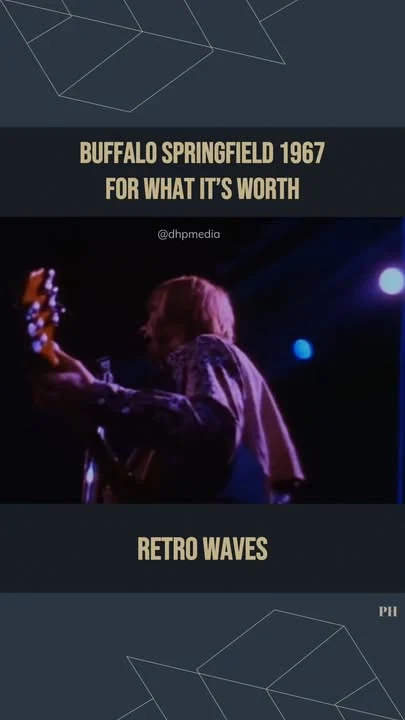
Listen closely to the opening notes and you can hear the tension before a single word is sung. A bassline, warm and insistent, repeats like a steady heartbeat. The drums enter with a slow march. Then the guitar shimmers, delicate and ghostly, like a premonition. And then that voice cuts through with four simple words that would echo through generations. “There’s something happening here.”
That voice belongs to Stephen Stills, and the song is “For What It’s Worth,” the defining anthem of Buffalo Springfield. But what makes it truly remarkable isn’t just its place in rock history. It’s how perfectly it captured a moment of cultural rupture, and how effortlessly it has transcended that moment to remain relevant in every era since.
The Scene of the Unrest
Los Angeles in late 1966 was a city on the brink. The glossy pop of the surf rock era was giving way to something grittier, more introspective. The counterculture had taken root, and young people were pushing back against authority in ways that unsettled the establishment. Nowhere was this tension more visible than on the Sunset Strip, where a nightclub called Pandora’s Box had become a flashpoint.
When police imposed a curfew and clashed with young crowds, the confrontation became known as the Sunset Strip curfew riots. Stills, who had been driving through the area, watched the scene unfold. He didn’t see it as a political statement in the making. He saw it as a human moment, charged with fear, confusion, and adrenaline. Within days, he had translated that energy into a song.
The Rush to Record
Buffalo Springfield was already gaining momentum with their self-titled debut, released in late 1966 on Atco Records, a subsidiary of Atlantic. But their producers, Charles Greene and Brian Stone, sensed something bigger. When they heard Stills’ new composition, they knew it had the potential to be the hit that would launch the band into the stratosphere.
On December 5, 1966, just weeks after the riots, the band gathered at Columbia Studios in Hollywood for a hurried recording session. The result was a track that felt spontaneous yet meticulously crafted. It was released as a single almost immediately, and by the spring of 1967, it had climbed into the Billboard Top 10. The album was quickly re-pressed, with “For What It’s Worth” replacing the original track “Baby Don’t Scold Me.”
The speed of its creation and release was no accident. The song was a time capsule, capturing a specific moment before it could fade from memory. It was a musical photograph, developed and printed before the moment slipped away.
The Art of Sonic Restraint
What makes “For What It’s Worth” so enduring is what it leaves out. In an era when many protest songs relied on bombast and volume, this track is the sound of quiet power. It’s built on Bruce Palmer’s simple, hypnotic bassline and Dewey Martin’s measured drum pattern, which together evoke the feeling of a slow, deliberate march.
Neil Young’s guitar work adds an ethereal layer. Using harmonics, he produces high, glassy tones that float above the mix like whispers in a crowded room. These sounds create an atmosphere of unease, of being watched, of knowing that something is about to happen. It’s a masterclass in musical tension, where every note serves a purpose and nothing is wasted.
“In a song about unrest, the quiet spaces are often the loudest.”
The Lyrical Genius of Ambiguity
Stills’ lyrics are deceptively simple. He doesn’t tell you what to think or who to blame. Instead, he describes a scene with the detachment of a journalist filing a report. “There’s something happening here,” he sings. “What it is ain’t exactly clear.”
This ambiguity is the song’s greatest strength. By refusing to take a side or make a specific accusation, Stills allows every listener to find themselves in the narrative. Whether you’re a young protester facing down a riot shield or a parent watching from home, the song speaks to a universal feeling of uncertainty and unease.
The refrain, “Stop, hey, what’s that sound? Everybody look what’s going down,” is both a warning and a call to awareness. It asks us to pay attention, to question the narratives we’re given, and to notice the tension building around us.
Why It Still Resonates
Decades later, “For What It’s Worth” has become more than a song. It’s a cultural touchstone, played at protests, featured in films, and shared across generations. When a young person hears it for the first time today, they connect not just to the music of the 1960s but to a legacy of questioning authority that remains as vital as ever.
The technology has changed. The setting has changed. The faces in the crowd are different. But the underlying dynamic of youth versus establishment, the desire to be heard, the fear of surveillance, the urgency of collective action, all of these remain as relevant today as they were in 1966.
Further Listening
If “For What It’s Worth” resonates with you, these songs capture a similar spirit of restlessness and reflection.
Bob Dylan – The Times They Are A-Changin’ (1964) set the template for the modern protest anthem, blending folk tradition with urgent social commentary.
The Byrds – Turn! Turn! Turn! (1965) shares the same jangly folk-rock DNA, with lyrics drawn from the Book of Ecclesiastes that speak to the seasons of change.
Simon & Garfunkel – The Sound of Silence (1966) uses hushed acoustics and poetic imagery to capture a sense of alienation that mirrors the paranoia of the era.
Crosby, Stills, Nash & Young – Ohio (1970) channels a more explicit anger, written by Neil Young in direct response to the Kent State shootings.
The Youngbloods – Get Together (1967) offers a more hopeful counterpoint, urging unity and love in the face of division.
Creedence Clearwater Revival – Fortunate Son (1969) pairs a driving rhythm with sharp political commentary, a raw and unapologetic protest against inequality.
The story of Buffalo Springfield is one of brilliant potential and all-too-brief existence. The band fractured under the weight of its own creative tensions, but not before leaving behind a song that would outlive them all. “For What It’s Worth” is more than a piece of musical history. It’s a reminder that sometimes the most powerful statement you can make is not a shout, but a careful observation. It’s an invitation to look closer, to question more, and to never stop paying attention.