
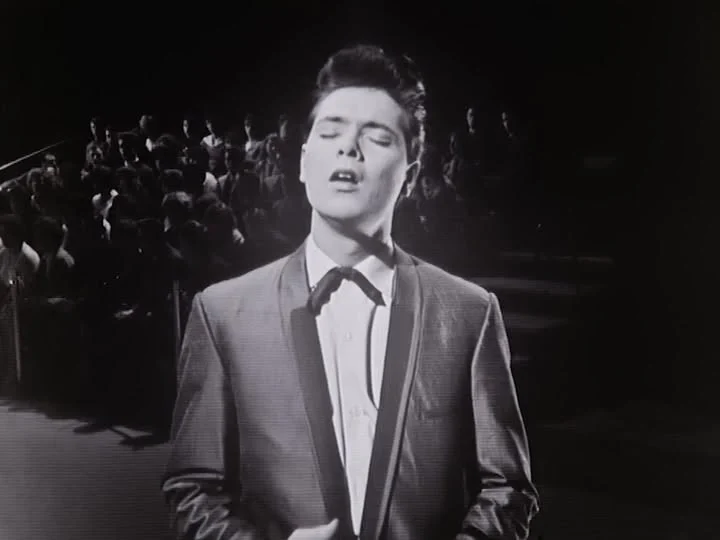
There are songs that float through the decades, carried by the voices of those who dare to reinterpret them. Few have traveled as gracefully as Blue Moon, the 1934 classic by Richard Rodgers and Lorenz Hart. Yet one rendition captures something rare—a moment when a British rock icon paused the electric energy of his youth to whisper a lullaby to the night. That version belongs to Cliff Richard, and it remains a secret treasure for those who seek sophistication in vinyl grooves.
Imagine a quiet room, the needle dropping on a 1959 pressing. A gentle guitar strum, soft as footsteps on carpet. Then Richard’s voice, warm and controlled, eases into the melody. Blue Moon becomes not just a song, but a scene. It is the sound of a man stepping away from the roar of rock ‘n’ roll to prove that his artistry could bloom in any garden. This is not the doo-wop frenzy of The Marcels or the croon of Elvis. This is something else—a polished, jazz-kissed ballad that invites intimacy.
Cliff Richard recorded his version for the album Cliff Sings, a crucial pivot from his early rockabilly days. Produced by Norrie Paramor, the album showcased Richard’s ability to traverse genres with ease. Where his earlier hits had the swagger of a teenage idol, Blue Moon revealed a maturity that would define his later career. The track sits among ballads and jazz-infused standards, a deliberate choice that signaled his ambition to be more than a flash in the pop pan.
His rendition stands as a testament to his versatility, bridging the golden age of songwriting with the fresh sounds of a new decade.
The arrangement itself is a study in restraint. The guitar opens with a gentle, steady hand, its electric tone adding a subtle rock influence without overpowering the mood. Piano glides underneath, creating a dreamy atmosphere that feels both romantic and nostalgic. A double bass provides the warm pulse of a heartbeat, while percussion remains a whisper—light cymbal touches and a soft snare drum that never interrupt the song’s flow. At the center, Richard’s vocals are the anchor. He sustains notes with ease, letting a slight vibrato color the emotion without theatricality. It is a performance that understands the power of quietude.
What makes this version of Blue Moon so worth revisiting is the way it honors the original while making it unmistakably his. Unlike the upbeat tempo and playful harmonies of The Marcels, or the sentimental weight of Billie Holiday, Richard chooses elegance. He turns the song into a crooner’s piece, ideal for late-night reflection or a candlelit room. The production quality, even by today’s standards, is remarkable. Each instrument is given space to breathe, yet the vocals remain the clear focus—a balancing act that speaks to Paramor’s skilled direction.
For those drawn to vintage music, this track serves as a bridge between the jazz era and the emerging pop sounds of the late 1950s. It is a lesson in how timeless melodies can be reimagined without losing their soul. If Blue Moon by Cliff Richard stirs something in you, allow yourself to wander through similar landscapes. Elvis Presley with Love Me Tender offers the same smooth romanticism. The Platters capture emotional depth in Smoke Gets in Your Eyes. Paul Anka brings heartfelt simplicity to Put Your Head on My Shoulder. Frank Sinatra swings with elegance in Fly Me to the Moon. And Nat King Cole remains the epitome of refined beauty with Unforgettable. Each of these songs shares the same spirit—a belief that a well-sung standard can transcend time.
Cliff Richard’s Blue Moon is more than a cover. It is a declaration of artistic range, a love letter to a song that has been sung a thousand times but never quite like this. For fans of finely crafted ballads, the album Cliff Sings is a doorway into a world where rock meets romance, and where a British star proves he can stand among the great vocalists of his era. The next time you hear the opening chords of Blue Moon, listen closely. You might just hear the sound of an artist finding his true voice.