
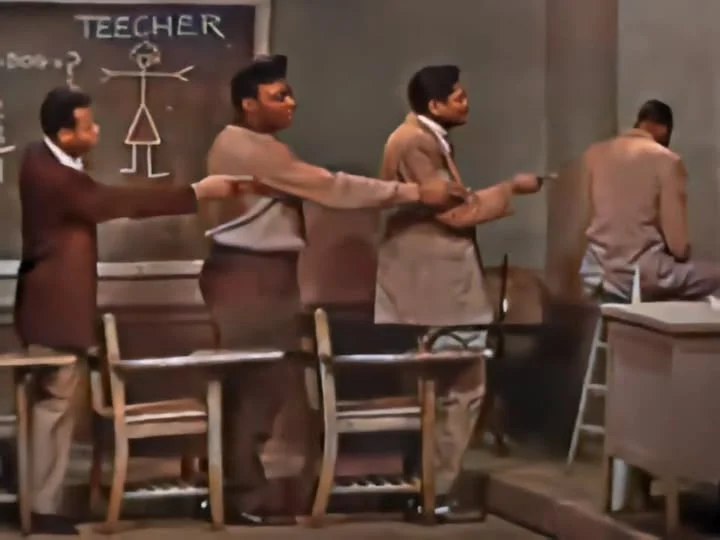
Why is everybody always pickin’ on me?
That question, delivered with a perfect blend of bewilderment and theatrical self-pity, has echoed through decades of pop culture. It belongs to Charlie Brown, the perpetual scapegoat immortalized by The Coasters in a 1959 recording that sounds less like a song and more like a two-minute-and-nineteen-second comedy short film pressed onto vinyl. The magic begins not in a polished studio but in the chaos of a high school auditorium, where the air still hangs heavy with cheap hairspray and stale popcorn, and a lone microphone dangles beneath flickering fluorescent lights. This is the world the song builds, complete with spitballs, hallway antics, and the eternal suspicion of an authority figure who smells smoke where there is none.
What many listeners do not realize is that this track emerged from one of the most unconventional creative partnerships in early rock and roll history. The Coasters functioned as the musical embodiment of the songwriting and production team Jerry Leiber and Mike Stoller, two architects who secured an independent production deal granting them unprecedented creative autonomy. This arrangement allowed them to craft each record from the studio floor upward, shaping arrangements, dictating vocal performances, and building what they called playlets — short, theatrical narratives populated by memorable characters and driven by urban wit. Their previous smash, Yakety Yak, had established the formula, but Charlie Brown deepened the characterization, transforming a juvenile delinquent into a genuine antihero whose protests of innocence only cemented his guilt in the court of public opinion.
The Coasters made an art form of finding the comedy and the pathos in the micro-dramas of the street and the school hall.
Released in January 1959 as a standalone single on Atco Records, this track never appeared on a formal studio album, which was standard practice for hit singles at the time. It was quickly collected on The Coasters’ Greatest Hits later that same year, after climbing to number two on both the US Pop and R&B charts. That commercial success cemented the group’s reputation as rock and roll’s most sophisticated humorists, telling teenage stories with a level of self-aware theatrical exaggeration that elevated the material far beyond simple novelty.
The production by Leiber and Stoller remains a masterclass in economy and narrative drama. The arrangement opens with bass vocalist Will “Dub” Jones intoning the now-legendary line, Fee fee fi fi fo fo fum, I smell smoke in the auditorium. It is a dramatic device that transports the listener instantly into the scene, establishing tension before the groove even arrives. What follows is a relentlessly propulsive rhythm section, drums locked into a crisp swing that never wavers, while a bright honky-tonk piano holds the melodic and harmonic structure together. The piano often doubles the bass line or stabs out quick chords that push the story forward. There is a palpable energy of barely contained mischief, and the musicians seem to struggle, delightfully, to hold it in check.
Carl Gardner delivers the lead vocal with perfect enunciation and mock indignation, capturing the perpetual state of being misunderstood. He plays the ringleader who always ends up taking the fall. The call-and-response vocals that The Coasters perfected are deployed with pinpoint timing. Lines like He’s a clown, that Charlie Brown arrive with the collective sneer of a student body passing judgment. The entire vocal arrangement functions like a Greek chorus of cool kids mocking the scapegoat, making the listener complicit in the laughter.
A brief, electrifying solo by tenor saxophonist King Curtis slices through the middle section. His brass contribution is pure exuberant R&B muscle, a moment of necessary chaos that matches the delinquent energy of Charlie Brown’s antics. Beneath it all, a chugging guitar provides subtle textural support, dry rhythmic strumming that adds grit beneath the smoother vocal harmonies and the dominant piano-bass tandem. This stripped-down punchy sound remains an essential benchmark for anyone seeking clarity in early rock and roll recordings.
The lyrical genius rests entirely in that central hook: Why’s everybody always pickin’ on me? It transcends its high school setting to become the universal cry of the perpetual outsider, the one whose reputation precedes them, the one blamed for every ill regardless of evidence. The irony is unmistakable — Charlie Brown is throwing those spitballs — yet his protest still feels genuine in its exaggerated teenage drama. Leiber and Stoller understood that the most effective comedy requires a kernel of truth, and that kernel here is the aching vulnerability of adolescence itself.
What makes this track endure is its refusal to be merely a period piece. The chord progression remains simple enough that aspiring musicians still learn it through basic piano lessons as a perfect example of early rock structure. The narrative is self-contained, immediate, and utterly infectious. It requires no historical knowledge to appreciate, no context to enjoy. It is kinetic musical theater that has never lost its snap, its comic timing, or its underlying plea for teenage empathy.
The Coasters did not write love songs or simple dance tunes. They wrote miniature films, fusing the sophisticated structure of pop writing with the raw energy and vernacular of rhythm and blues. This track signaled a shift in their career arc, moving them from a doo-wop group into rock and roll’s foremost interpreters of teen comedy. Their records were required listening because they were funny, but the songs succeeded because the grooves were impeccable. To listen now is to remember that rock and roll, in its purest form, was an act of energetic storytelling — and that sometimes the most complex cultural statements can be made with the simplest musical tools.