
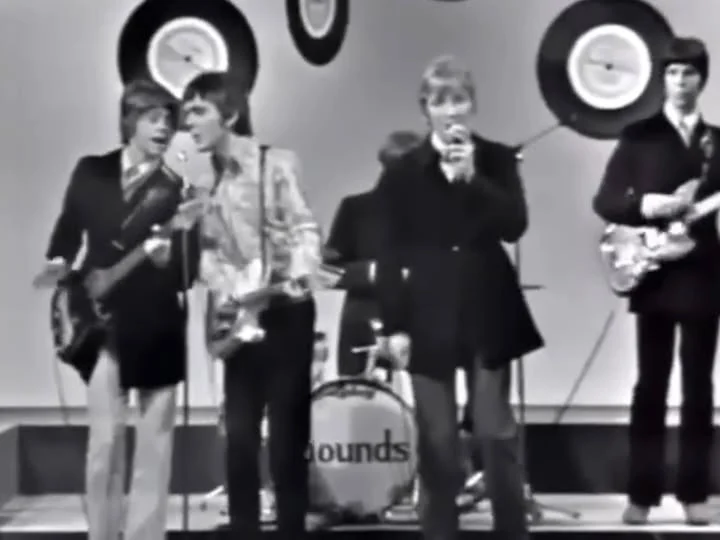
The smoke hangs thick in the air of a Helsinki youth club. A jukebox stands idle, usurped by the live band on the small stage. The bassline walks a tightrope of melody and propulsion as a Finnish vocalist turns a familiar American lament into something raw and immediate. This is the world captured on the 1966 single by The Hounds. Their cover of “Sealed With A Kiss” sounds less like a tearful farewell and more like a desperate promise shouted over the roar of an engine.
Most of us know the song through Brian Hyland‘s 1962 version, a piece of heartbreak pop so pristine you can practically smell the dust motes dancing in the studio sunlight. The Hounds, a Finnish rock band riding the first wave of their country’s rock revolution, smashed that crystal glass. Their version strips away the orchestral sheen and vibraphone sighs. They replace them with a dry, punchy snare and stinging guitar fills borrowed straight from the British Invasion playbook.
The genius of this recording is its economy. The drums hit with clean authority, offering an urgency completely absent from the original. The lead guitar does not just accompany the melody. It interjects with tight, twangy bursts of controlled intensity. This is a garage band that polished its sound just enough to get on the radio without losing its edge. The vocals mirror this transformation. Where Hyland was vulnerable and boyish, the vocalist for The Hounds delivers the lyrics with a weary, melancholic resignation. The close-miked backing harmonies feel less like a celestial choir and more like a group of friends sharing a collective sigh of despair.
The emotional center of this recording is the tension between the driving rhythm and the yearning vocal.
This tension is the key. The propulsive rhythm, anchored by a wonderfully melodic bassline, creates a frantic energy. It turns the promise to “write every day” into something almost desperate. The very act of parting requires a kinetic soundtrack to survive.
Released as a non-album single, this track serves as a perfect cultural artifact. It captures the moment when the language of global rock and roll was being translated into local dialects. The production feels close and slightly boxy. This is a byproduct of a quick-cut session prioritizing immediacy over endless polish. Yet this very compression lends itself perfectly to the emotional core of the song. There is no escaping the feeling of being in that room with the band. The Hounds took a proven melody and injected it with their own pop-rock grit. They charted in their home country and left behind a micro-story of a summer’s end.
To listen to this piece of music today is to be transported. It invites us to reconsider the song. It is not just a monument of 1962 pop. It is also a sturdy frame capable of holding vastly different pictures. The Hounds’ interpretation encourages us to hunt for these forgotten corners of the global singles market. This is where big dreams and limited budgets created pockets of pure, unvarnished brilliance. It is the sound of a goodbye, sealed not with a simple kiss, but with a punchy, insistent beat that refuses to fade away.
For those compelled by this grittier, European pop-rock sound, the rabbit hole runs deep. Seek out the jangly twang of The Searchers. Explore the driving melancholy of The Zombies. Listen to the folk-rock sentiment of The Beau Brummels. Each of these acts, like The Hounds, captured a specific moment. They found a place where pop structure met raw emotion. They offered a blueprint for heartbreak that still echoes today.