
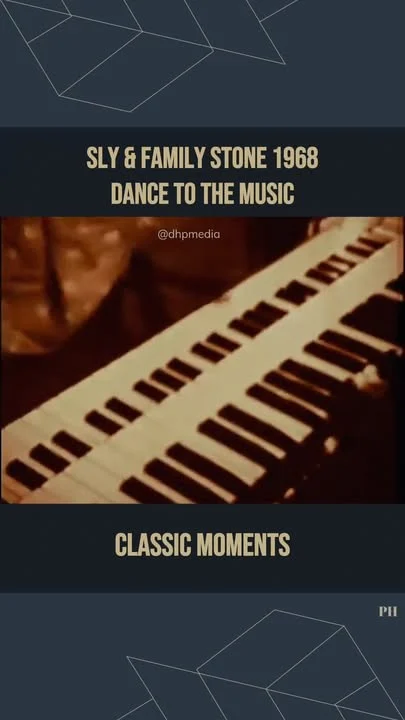
On a night thick with revolution and the promise of a new world, Sly Stone found himself at a crossroads. The year was 1968 and the air in that dimly lit studio between Los Angeles and San Francisco carried the weight of expectation. His label Epic CBS had one demand for the polymath already known for producing hits and spinning records on the radio give them something pop. Something the masses could grasp.
Sylvester Stewart better known as Sly Stone had already shattered norms with his integrated band Black and white male and female playing together when segregation still ruled the airwaves. Yet his first album A Whole New Thing from 1967 was considered too raw too uncompromising for the mainstream audience the executives desperately wanted to reach.
The pressure was simple deliver a hit.
What emerged was Dance To The Music the title track of their second album released in 1968. It is not merely a song it is a declaration of purpose a meticulously constructed blueprint for the next decade of funk soul and pop. It is perhaps the ultimate meta-statement in music a piece of music about the act of making music and the sheer joy of dancing to it.
The track crashes in with startling percussive energy. Greg Errico drums lay down a crisp four-on-the-floor beat that grounds the entire arrangement. This is instantly recognizable as the foundational rhythm for a new kind of social movement. Then the bass enters.
Larry Graham line is a masterpiece of kinetic propulsion. His thumb-fired slap technique gives the bottom end a sharp attacking quality making the bass not just harmonic filler but a lead percussive voice. This low-end drive is the emotional anchor the element that truly elevates the track beyond conventional soul.
Freddie Stone guitar enters lean and wiry a series of clipped rhythmic jabs. It is not a melodic lead but a textural contribution a psychedelic counter-rhythm woven tightly into the drums and bass. This is electric funk before electric funk was truly a thing relying on groove over flash.
But the defining texture is the organ. Sly Hammond B-3 playing is pure church fire a gospel-infused blast of sustained chords that provides the emotional lift. It is the sound of the sanctuary moved to the dance floor its deep swirling timbre contrasting beautifully with the dry clipped attack of the rhythm section.
The band communal integrated vocal attack is deployed to maximum effect. Call-and-response trades seamlessly among Sly his brother Freddie his sister Rose Stone and Larry Graham. This constant shifting of lead vocal duties mirrored the group revolutionary integrated lineup presenting a utopian vision of harmony right there in the sound waves.
Get on up and dance to the music
Cynthia Robinson trumpet and Jerry Martini saxophone provide bright shouting punctuation marks driving the energy upward. Cynthia famous vocal ad-libs serve as pure unadulterated hype breaking the fourth wall between the artist and the listener. The recording feels close slightly compressed with a generous reverb tail that gives the track a unified celebratory feel tailor-made for transistor radios and powerful home audio systems alike.
The track structure itself is a marvel of simplicity. It does not rely on verses choruses or traditional bridges. It is built on a singular hypnotic repetitive groove that just builds. This repetition this circularity is key to its psychedelic appeal a trance-like insistence that never loses its celebratory focus. It was a risk avoiding typical pop architecture but it paid off handsomely soaring into the top ten on both the Pop and R&B charts.
Dance To The Music was the hinge. It was the moment Sly Stone realized how to package his revolutionary psychedelic soul for a mass audience without sacrificing its political and musical integrity. Without this song the subsequent perfection of Stand from 1969 and the dark genius of Theres a Riot Goin On from 1971 would likely not have reached the same massive platform.
It is the Trojan horse of funk sneaking complex rhythms and an integrated message into the heart of mainstream America. It set a new standard for arrangements a sonic palette that future artists would use to build new worlds. If you are learning an instrument today the rhythms laid down by Freddie Stone in this period are a required study in minimalist funk economy.
Today listening to this track offers a kind of necessary reset. It is a sonic pallet cleanser a reminder that the most profound shifts in culture often arrive disguised as simple party records. It strips away the cynicism and complexity leaving only the essential instruction get on up and dance.
The song is the antidote to stasis the ultimate instruction manual for collective joy. It is why it still works its magic in a sudden club moment or as the perfect sonic backdrop to a road trip that needs a jolt of pure unadulterated energy. The groove remains eternal.
For those wanting to follow the thread here are five essential tracks that share this spirit
The Isley Brothers Its Your Thing from 1969 adopts a similar hard-driving dry funk rhythm that moved beyond traditional soul.
James Brown Mother Popcorn from 1969 delivers hyper-syncopated percussive emphasis and shouted call-and-response vocals.
Funkadelic I Got a Thing You Got a Thing Everybodys Got a Thing from 1970 shares the communal repetitive psychedelic-tinged group vocal approach over a tight hypnotic groove.
The Temptations Cloud Nine from 1968 represents Norman Whitfield explicit foray into psychedelic soul directly influenced by the success and textures of Sly and the Family Stone.
Booker T and the MGs Soul Limbo from 1968 captures the era tight organ-driven instrumental funk feel prioritizing groove and texture over vocal melody.