
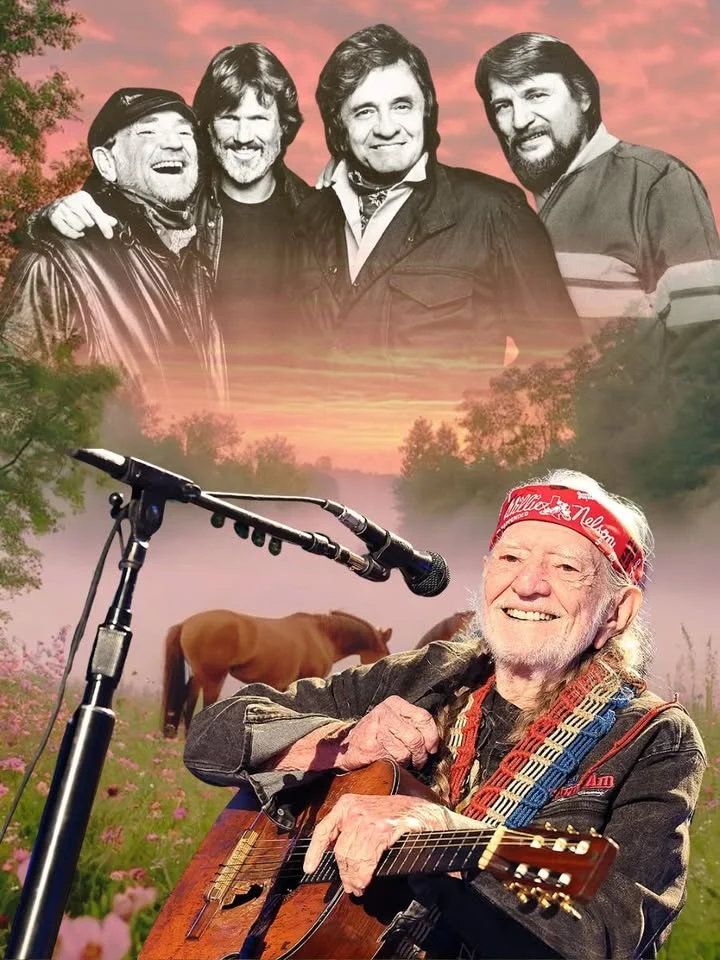
The lights at the Hollywood Bowl found Kris Kristofferson one final time in April 2023, and he did not use them to summon applause for himself. He stood beside Rosanne Cash, the daughter of Johnny Cash, and sang “Loving Her Was Easier (Than Anything I’ll Ever Do Again)” for the man he had come to honor, Willie Nelson, on the night of Nelson’s 90th birthday concert. His voice was visibly worn by time, but his presence carried the same quiet respect it always had. It was a frail but deliberate act of devotion, a last public stage moment that would only later feel like a goodbye.
On September 28, 2024, Kristofferson passed away at 88. The legendary songwriter and outlaw pioneer had already helped write a towering chapter of American music, first as a revered storyteller and later as one of The Highwaymen. With his death, the greatest quartet in country history has been reduced to one. Waylon Jennings died in 2002, Johnny Cash in 2003, and now Kristofferson is gone. Willie Nelson is the last surviving Highwayman.
For Nelson, the math of survival is cruel. He is left at the summit of a legacy the four men built together, and his response to losing Kristofferson was stripped of polish and painfully human.
“I hate losing him.”
Nelson has admitted that being the last one left is no fun at all, a burden made heavier by the quiet that now surrounds a stage once filled by his closest peers.
The final appearance gains its weight from a friendship that began long before the stadium tours and supergroup fame of the 1980s. Kristofferson revered Nelson as a songwriting hero years before they crossed paths. Their brotherhood took real shape in 1973 in Durango, Mexico, on the dusty movie set of Pat Garrett and Billy the Kid. Nelson traveled to visit the production, and away from the industry glare the two men became fast friends. They bonded over Nelson’s unmatched humor and a shared reverence for the written word. They shared an unspoken understanding that the music always mattered more than the fame.
Through changing trends, personal battles, and industry chaos, they never lost that first connection. They were two rebels who survived their own wild years and leaned on each other when the spotlight grew too hot. They did not simply share a genre. They shared a philosophy on life.
That history changes the way the 90th birthday performance feels. Kristofferson was already frail, largely retired, and dealing with the physical tolls of aging. Yet he summoned his remaining stage energy for the friend who had stood by him since Mexico. He did not step into the lights to promote a project or take a victory lap. He came to honor Nelson, and in doing so he offered a quiet gesture of loyalty that spoke louder than any grand speech.
The performance was never announced as a farewell, but it became one. Today Nelson carries their collective memory alone. The Highwaymen began as four distinct voices echoing across the country, and that legacy has now been entrusted to just one man. Kristofferson’s final stage was not built around saying goodbye. It was built around giving everything he had left to his oldest friend.