
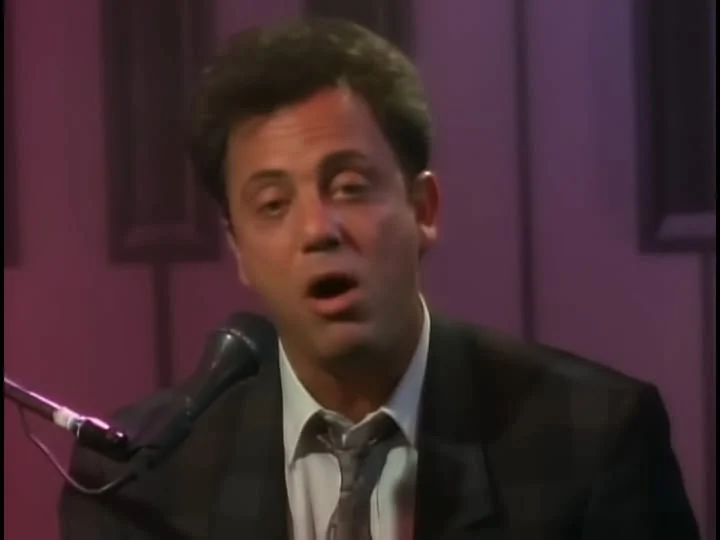
There was a time when Billy Joel was nobody. A young man with a record deal that had gone sour, a stage name that wasn’t his own, and a gig playing requests for a handful of drinkers in a California piano lounge. The year was 1972, the place was the Executive Room, and the man at the keys called himself William Martin because the courts had made it impossible for him to use his real name. He was trapped in a bad contract, barely earning a living, and far from the stadiums that would one day sing his name back to him. But something strange happened in that smoky little bar. The disappointment, the humiliation, and the parade of lonely regulars all became raw material for a song that would define his entire career.
That song is Piano Man, the title track from his second studio album, released in late 1973. Clocking in at five minutes and thirty-seven seconds, it is a miniature epic built from the most ordinary of scenes. It is also the track that pulled Joel out of the wreckage of his failed debut, Cold Spring Harbor, and set him on a path to becoming one of America’s most beloved storytellers in music. The move to Columbia Records gave him a second chance, and producer Michael Stewart decided to present Joel not as a polished pop star but as a folk-inflected piano poet. That choice shaped everything that followed.
What is remarkable about Piano Man is how gently it begins. No crashing chords. No theatrical declaration. Instead, there is a modest drumbeat, a steady sway, and a piano tone that sounds like a well-worn instrument in a human-sized room. It is intimate, almost conversational, as if the player is about to share a secret. Then comes the acoustic guitar, soft and grounding, and a harmonica that floats in like a sigh. This is not a song written by someone looking down at a bar from a penthouse. This is a song written from inside the bar, with the sticky floors and the lonely regulars and the clinking glasses all around.
As the verses unfold, Joel introduces a cast of characters who feel instantly familiar. There is John the bartender, described as practicing politics, and a sad-eyed old man who has seen better days. There is a novelist, a real estate mogul, and a pair of waitresses who are hoping for something more. These are not caricatures. They are portraits of people who show up night after night, nursing their drinks and hiding their dreams. Joel does not judge them. He simply watches, listens, and turns their quiet lives into poetry.
The true genius of this song is not in the melody alone but in the way it refuses to look away from human fragility.
The arrangement builds with remarkable discipline. Each chorus adds a little more motion, a touch more bass, a hint of that rolling drum groove. Strings appear only in the final stretch, subtle and cinematic, casting a soft glow of melancholy over the entire scene. By the time the last harmonica solo arrives, the song has transformed from a quiet confession into a sweeping communal anthem without ever losing its humble heart. It is a masterful shift from grit to glamour, though the dust of the barroom never fully leaves the lyric.
The background of the song makes its emotional weight even more potent. Joel’s first recording contract with Family Productions had left him legally shackled, and he moved to Los Angeles under a false identity just to play music for a living. That experience lives inside every line of Piano Man. But instead of writing a bitter complaint, he wrote an anthem of empathy. He found a way to turn his own failure into a mirror for everyone else’s quiet desperation. It is the rare song that makes loneliness feel both personal and universal at the same time.
Listeners who return to Piano Man with good headphones or a quality stereo can appreciate the subtle details stitched into the production. The backing vocals are warm, the piano has a lovely decaying resonance, and the harmonica’s vibrato lingers beautifully near the fadeout. For those who want to learn the piece, the sheet music reveals a surprisingly simple yet effective left-hand pattern, a rolling triplet that powers the song forward. It is a reminder that great art often lives in a few carefully chosen notes played with real sincerity.
Here are a few songs that share a similar spirit of cinematic storytelling and piano-driven emotion, each one a worthy companion to Joel’s classic
Taxi by Harry Chapin offers a deeply detailed first-person narrative about a cab driver and a former lover with all the intimacy and sadness of a short film
Tiny Dancer by Elton John embraces a sweeping piano arrangement and a nostalgic portrait of faded West Coast glamour much like Piano Man does
American Pie by Don McLean is another long-form folk epic that blends personal memory with larger cultural themes and remains anchored by a strong melodic core
Lullabye (Goodnight, My Angel) by Billy Joel is a quieter counterpoint that shows how deeply he understands the solo piano ballad
Come Sail Away by Styx begins with a gentle piano and slowly erupts into a majestic rock anthem, echoing the same dramatic arc as Joel’s song
New York State of Mind by Billy Joel is a sophisticated jazz-flavored meditation on place and identity that captures his ongoing love for character-driven songwriting
In the end, Piano Man is more than just a song about a bar band. It is a promise kept, a record of an artist who chose to find beauty and tragedy in the people around him. Billy Joel began that era as a man hiding from his own name. He emerged from it as the voice of everyone who ever raised a glass to a song and hoped for a little something better. Decades later, that voice still feels like a friend. It still feels like home.