
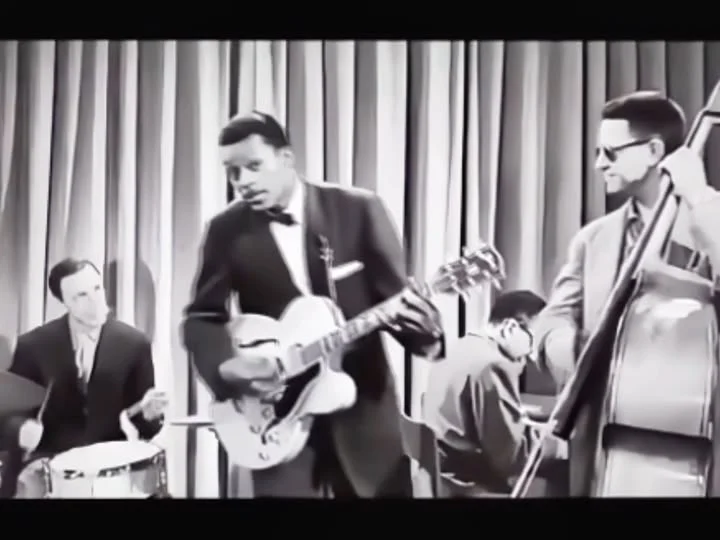
The first sound arrives like a bolt of light cutting through a dim gymnasium. A three count drum fill, sharp and dry, then the shimmering chime of Chuck Berry’s guitar. No introduction needed. That bell like cascade of notes is a masterclass in controlled chaos, a coiled spring releasing tension. The opening of Chuck Berry’s 1959 single “Little Queenie” is not just music. It is a cultural declaration, a scene setter for an entire genre.
It is late November 1958. The session unfolds at Chess Records studios in Chicago, an address drenched in the primal electricity of the blues. Label founders Leonard and Phil Chess produced the track. They understood Berry’s genius lay in fusing the rhythmic drive of urban Black experience with the narrative language of white Americana. They were not recording a song. They were documenting the vanishing point where country music dissolved into R&B, birthing a sound suddenly and universally available.
“Little Queenie” arrived in March 1959 as the flip side to the equally compelling “Almost Grown”. It later appeared on the career defining album Berry Is On Top. Context is critical. 1959 finds Berry at his peak, having already delivered foundational texts like “Johnny B. Goode” and “Sweet Little Sixteen”. His career arc soared, creating a deep catalogue of instantly recognizable pieces that defined the teenage experience. This single cemented his role not just as musician but as vernacular poet of the high school dance and the late night drive. The track made a modest yet powerful showing on the charts, demonstrating sustained cultural influence without hitting the very top tier.
II. The Architecture of the Groove
The arrangement distills the classic Chess rock and roll ensemble with unique textural clarity. The foundational rhythm section features Willie Dixon on upright bass, providing a grounded resonant thump, and Odie Payne on drums, keeping the beat straightforward and insistent. That is the grit beneath the glamour of Berry’s narrative.
In the middle register, Lafayette Leake or Johnnie Johnson handles the piano. The role is not ornamental. The keys anchor, laying down a dense rolling triplet pattern that fills the spaces between Berry’s syncopated vocals and his primary guitar lines. This is classic Chicago rock and roll where the piano is not a lead instrument but a powerful engine, hammering chords driving momentum with a blues informed percussive attack.
The dynamic profile of the recording feels close mic’d and immediate. A slight controlled echo sits on the vocal, but the instruments themselves are right in the room, creating a sense of raw contained energy. This recording technique, favoring presence over polish, makes vintage premium audio playback of these tracks so rewarding. Every snare hit and string bend is preserved with stark fidelity.
III. The Story and the Sound
Berry’s lyric is pure narrative perfection, an observer’s journal entry set at a high school dance. The narrator scans the room, seeking the object of his desire, a girl dancing with “no particular place to go.” It is a beautifully succinct summation of youthful longing, framed by the chaos of a crowded gym.
He uses concrete vivid imagery. The “frisky risky” movement, the “red dress,” the simple profound question that frames the entire song. “Tell me who is the queen. Who’s that girl in the popular jeans?” This is why Berry is hailed as a lyricist. He captures a universal feeling, the yearning for a moment of connection, using details specific to the post war American teenager. The lyrics are less sung and more declaimed, delivered with Berry’s characteristic almost conversational pace.
Then comes the centerpiece, the famous guitar solo, bursting forth from the groove with incredible velocity. It is a whirlwind of double stops and string bends, a single concise statement of purpose. It does not wander. It drives, an extension of the lyrical tension. This solo is an essential piece for anyone interested in guitar lessons, codifying the exact mixture of blues phrasing and rock and roll attack that became the foundation for a thousand subsequent shredders.
“The true power of ‘Little Queenie’ lies not in its lyrical complexity, but in its perfect electric balance between observation and kinetic release.”
It is a sonic blueprint for rock and roll’s enduring appeal, the simultaneous experience of watching the beautiful dancer and being the beautiful dancer. The song perfectly channels that moment of electrifying realization, that the real action is not on the stage but on the floor.
IV. The Legacy: A Perpetual Motion Machine
The true legacy of “Little Queenie” is written not on the charts of 1959 but in the countless covers that followed. The Rolling Stones, The Beatles, The Kinks, and countless garage bands recognized the song’s inherent powerful simplicity. It is an artifact that proves the old cliché, that if the rhythm section is solid, the song can survive anything.
It is a track that reminds us that before rock became stadiums and excess, it was tight, focused, and utterly immediate. It is a perfect sonic capsule of its era, capturing the moment when teenage desire became a commercial force, a phenomenon that could be captured on tape and pressed onto a seventy year old single. Listening to it now, you hear the conversation between Chuck Berry’s vision and the musicians who supported it. The rhythmic interplay between bass, drums, and the pumping piano creates a bedrock of pure American rhythm. This brief potent track remains a non negotiable component of the rock and roll canon, a quick essential dose of pure undiluted swagger.
V. Listening Recommendations If You Love “Little Queenie”
Chuck Berry – Carol (1958) shares the same essential dance floor narrative and comparable driving tempo. The Rolling Stones – Get Yer Ya-Ya’s Out! (Live Version of Little Queenie) (1970) shows how the next generation ramped up the aggression and spectacle. Eddie Cochran – Summertime Blues (1958) offers another definitive narratively focused rock and roll track capturing the teenage predicament. Bo Diddley – Who Do You Love? (1956) provides the raw elemental Chess Records rhythmic grit underlying Berry’s smoother style. Little Richard – Keep A Knockin’ (1957) delivers similar relentless energy and iconic call and response vocal attack.