
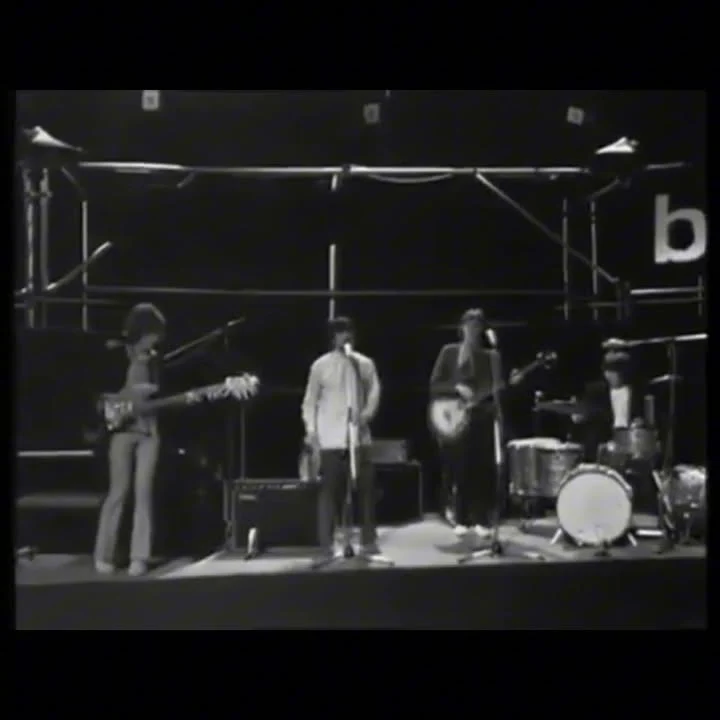
The first time you hear Raymond Froggatt sing the opening of “Callow-La-Vita,” something shifts. Not dramatically, not with fireworks, but with the quiet authority of a song that has been waiting for you, perhaps for decades. The melody lifts slowly, like a curtain rising on a small stage, and a voice roughened by Birmingham grit begins to tell a story about innocence, a red balloon, and a field of view that feels both familiar and fleeting. This is not a song that rushes into your life; it steps in gently and occupies a space you did not know was vacant.
Released in April 1968 on Polydor, “Callow-La-Vita” arrived as a B‑side companion to “Lost Autumn” but quickly became the centerpiece of Froggatt’s early discography. Its story, however, did not unfold in a straight line. The single scraped the UK charts modestly, but across the North Sea the Netherlands took it to heart, lifting Froggatt’s original to number two on the Dutch charts. Meanwhile, back in Britain, the song’s true breakthrough came through another band entirely. The Dave Clark Five reimagined the tune as “Red Balloon” later that autumn, scoring a top‑ten hit that introduced a wider audience to the melody Froggatt had written.
The strange and lovely truth is that Froggatt’s version did its most immediate flying across the North Sea while the UK looked elsewhere until the cover made people look back.
Froggatt himself was no stranger to resilience. Born in Birmingham, he had been releasing music since the mid‑sixties, carrying a voice that felt like a souvenir from a working‑class youth. His songwriting was direct and pastoral, rooted in imagery of fields and simple actions. For “Callow-La-Vita,” producer Terry Kennedy and arranger Phil Dennys built an elegant frame. Strings glide in like light on water, acoustic guitar forms a soft bed beneath the vocal, and the rhythm section cushions each phrase with brushed drums and a bass that walks in quiet shoes. The arrangement is economical: harmonies appear only at the chorus, a gentle nudge rather than a choir. A tambourine ticks in the periphery; a single held note in the strings blooms and recedes. This is chamber‑pop restraint at its finest, a sound that refuses to shout.
The lyric world of “Callow-La-Vita” sketches innocence without naïveté. Froggatt delivers his images with the timing of a storyteller, a breath before each line, a conversational rise at the end that suggests both hope and acceptance. The red balloon in the field of view is not a metaphor that announces itself; it is something seen and felt, like weather. The song’s pacing has a tide: verses ease forward, then the chorus lifts with a small swell that never overwhelms. There is no grandstanding outro, no cadenza, only a sure hand guiding a melody that knows how to turn its face to the sun.
The single later found a home on Froggatt’s 1969 album The Voice and Writing of Raymond Froggatt, a title that reads like a mission statement. Here the song becomes part of a larger conversation, one that includes other compositions such as “Big Ship,” which would later be recorded by Cliff Richard. Froggatt’s craft as a writer was always built on sturdy melodic skeletons, and “Callow‑La‑Vita” demonstrates that durability. It survives the wardrobe change of the Dave Clark Five cover, which paints the same hillside in brighter primary colors. Listen to both versions back‑to‑back, and you hear how a song can be reinterpreted without losing its essential character.
Two small vignettes capture what this record means in a quiet moment. One: a late‑night drive on a two‑lane road, hedges leaning in close, the dashboard light low, and “Callow‑La‑Vita” whispering from the speaker like a postcard without a return address. The strings lift at the chorus, and for a second the car seems to float a half‑inch higher. Another: a city morning in winter, blinds drawn, kettle on, and Froggatt’s voice gathering the room, not as nostalgia but as a tool to make time measurable again. These are not grand gestures, yet the song leaves a residue of warmth.
Pop history keeps a long ledger, and not every entry is written in thick ink. “Callow‑La‑Vita” does not need thickness. It has the sort of contour you only appreciate when the volume sits at a humane level and the room is still. On a premium audio system, the fine grain in the strings emerges; on a transistor radio, the melody works just as well. The song understands the difference between sentiment and sentimentality. It creates the illusion of a wider narrative without demanding a backstory to land. That is why it dovetails so easily with modern listening habits, where shuffled playlists and algorithmic recommendations can still discover something delicate.
A note for those searching: digital platforms sometimes list the track under “Red Balloon (Callow La Vita),” pairing the original title with the better‑known cover. Do not let that hybrid label confuse you. Froggatt wrote it and recorded it first, and his original draws its own borderlines in your ear. If you approach the song as a musician, notice how economically it is built: verse, refrain, instrumentation that knows when to stand behind the vocal, a willingness to let silence count. A young writer today could learn from that architecture. And if you are simply a listener with a few minutes to spare, give those minutes to Froggatt’s version. Let it draw its small circle around your morning or evening. You might step away feeling lighter, not because the world changed, but because the record remembered something on your behalf.
Callow‑La‑Vita floats without drifting, a song that trusts its own quiet and wins your trust back.
By the time the last chord rings, you may think of the song as a companion for unhurried hours. Not the soundtrack to a revolution, but a keeper of weather: a little warmth, a small wind, a red shape against a pale sky. That is a good trade for three minutes of your day. Consider revisiting The Voice and Writing of Raymond Froggatt to hear how this single converses with the rest of that period’s material. The conversation is gentle but insistent, the kind that never tries to win arguments and somehow wins them anyway. And put the needle back at the start. This single rewards repetition the way good memories do: specifics sharpen, edges soften, and the shape becomes clearer each time.
Listening Recommendations
The Dave Clark Five – “The Red Balloon” (1968) – The cover that carried Froggatt’s tune into the UK top ten, with a punchier arrangement and radio‑ready sheen.
The Tremeloes – “My Little Lady” (1968) – Orchestral pop sparkle from the same year, balancing strings and beat‑group charm.
The Casuals – “Jesamine” (1968) – A velveteen slice of chamber‑pop whose lush arrangement plays to similar late‑60s strengths.
Barry Ryan – “Eloise” (1968) – Grand, symphonic drama, showcasing how far orchestral pop could scale that year.
Cliff Richard – “Big Ship” (1969) – A Froggatt‑penned song that shows his melodic instincts in a different, statelier register.
The Hollies – “King Midas in Reverse” (1967) – Textbook British pop craft with intricate arrangement, sitting adjacent to Froggatt’s blend of clarity and color.