
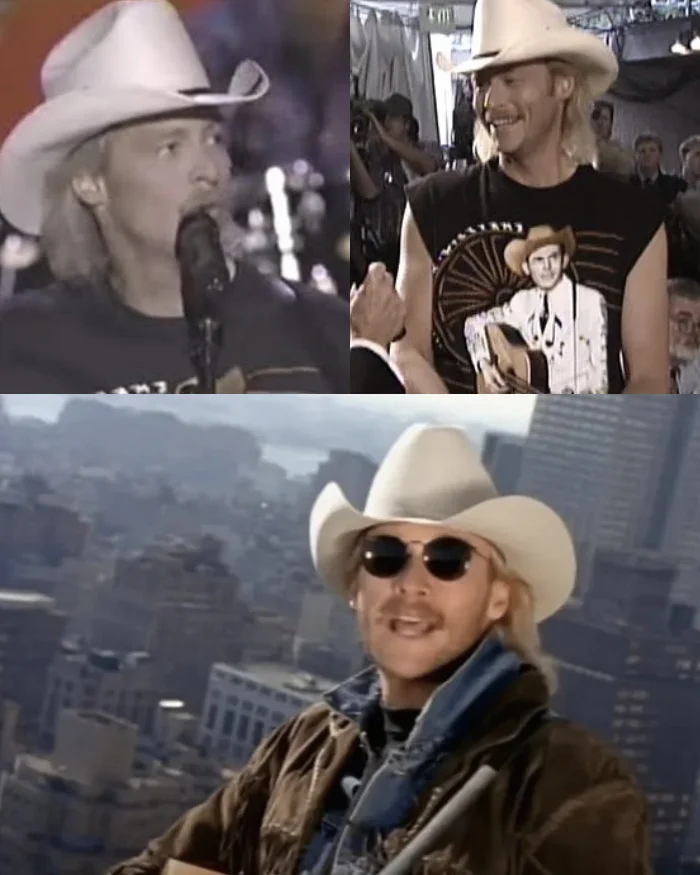
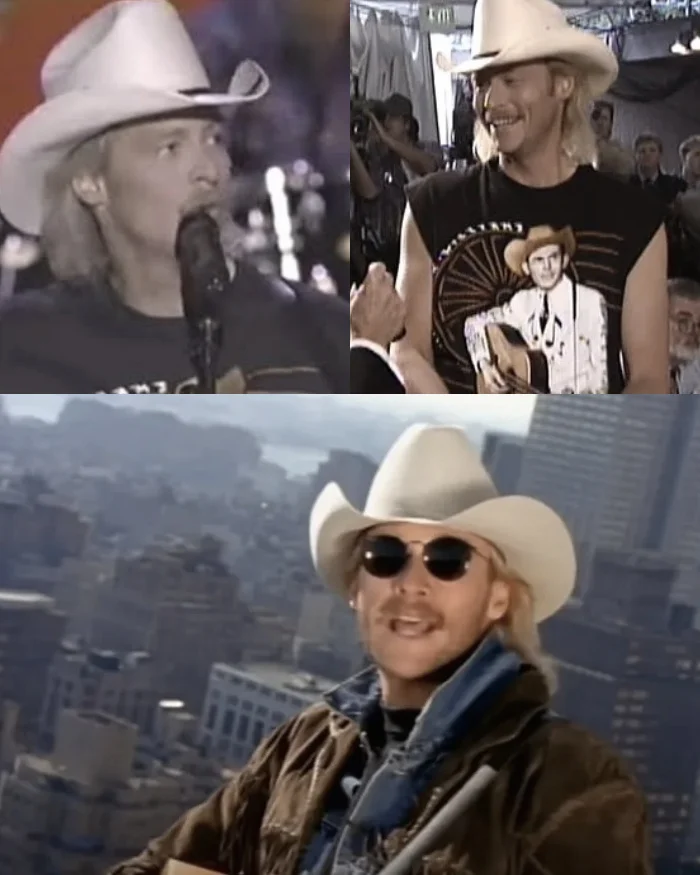
Bruce Rutherford stood behind his drum kit at the 1994 ACM Awards with fierce concentration. He swung his arms with full force, hitting at the air. The cameras broadcast his performance to millions. There was no sound from his instrument because his hands held no sticks. “He was attacking the kit with complete seriousness, but his hands were entirely empty.” This was not a mistake. It was a deliberate act of defiance.
The network had demanded all performers use pre-recorded backing tracks for a flawless show. For Alan Jackson, a country music purist, this requirement stripped away the authenticity of live music. He saw it as a betrayal of the road musicians who had earned their place on stage.
Rather than boycott, Jackson chose to comply with the letter of the rule. He told his drummer to leave the drumsticks in the dressing room. Then he took the stage and sang “Gone Country,” a Bob McDill song that criticized Nashville’s commercial turn. The irony was crushing.
The camera operators focused on the band, expecting a normal performance. Instead, they found Bruce Rutherford playing invisible drums. His hands were empty, but his spirit was full. The broadcast could not stop it. The damage to the network’s polished image was done.
This quiet rebellion defined Alan Jackson’s career. He refused to let his band become silent television props. Five years later, he would again stand up for authenticity, stopping a performance to honor George Jones. But on that night in 1994, he only needed a drummer without drumsticks to tell the audience what was real.
Jackson just stood under the lights in his signature hat, letting a pair of empty hands broadcast exactly what was real and what was manufactured.