
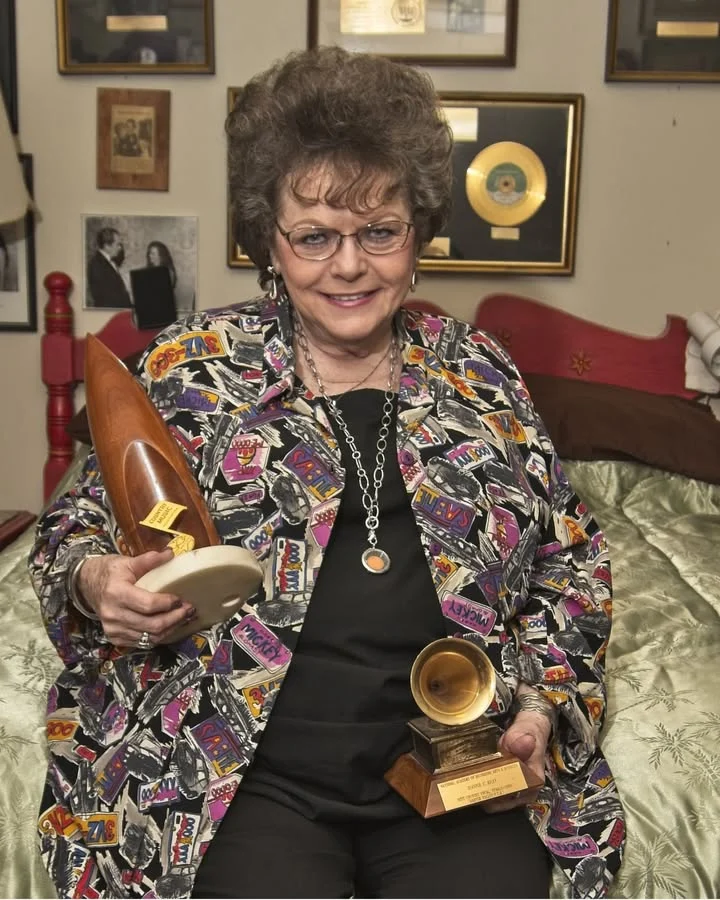

The miniskirt she wore on album covers was not her choice. The husband she kept out of interviews was not her secret. Jeannie C. Riley had become the very woman she sang about in ‘Harper Valley P.T.A.’ — a person reduced to an image by people who claimed to see right through her.
Riley was a twenty-two-year-old Texas secretary living in Nashville when producer Shelby Singleton handed her a song written by Tom T. Hall. She did not think it was the best song available. But once recorded, the single climbed with astonishing speed to number one on both the country and pop charts, making Riley the first woman to achieve that feat. A Grammy and CMA Single of the Year award followed. Then the industry began remaking her in the image of the fictional Mrs. Johnson.
The lyric described a widowed mother accused of wearing her dresses too high. Her response was to walk into a PTA meeting and expose the hypocrisy of her accusers. Riley’s label saw commercial gold in that confrontation and decided the singer herself should embody it. Promotional photos and television appearances placed her in miniskirts and boots identical to the song’s description. Interviewers were discouraged from asking about her husband or young daughter. The married mother was erased in favor of a provocative small-town character who fit the hit song perfectly.
I was a robot whose songs and public appearance had been chosen by other people.
Riley continued recording and scored additional country hits, but producers kept searching for another song about small-town hypocrisy. When she began writing her own material, the songs were rejected. The success of ‘Harper Valley’ had become a trap: the industry believed only one version of her was commercially useful.
She left Plantation Records in 1972 and recorded for MGM, Mercury, and Warner Bros., but no later single matched the scale of her breakthrough. The song itself grew beyond her — inspiring a film with Barbara Eden and a television series. Riley moved toward gospel music in the 1970s, converting to born-again Christianity and finding creative freedom in recording religious albums. In 1980 she published her autobiography, ‘From Harper Valley to the Mountain Top,’ a title that acknowledged even her departure from that famous place began with its name.
Riley never stopped singing ‘Harper Valley P.T.A.’ at her shows. Audiences demanded it. She understood the gratitude she owed to the song — the money, the awards, the place in history. But she also recognized the cost: the song had given a fictional woman the power to confront every person who had judged her, while the woman who gave that character a voice spent decades trying to reclaim the same freedom for herself.
Between the opening guitar riff and the final note of that PTA meeting stood a real woman — a wife, a mother, a songwriter — whose own story was written by the very forces the song condemned. Jeannie C. Riley wore the miniskirt, but she never stopped asking for permission to take it off.