
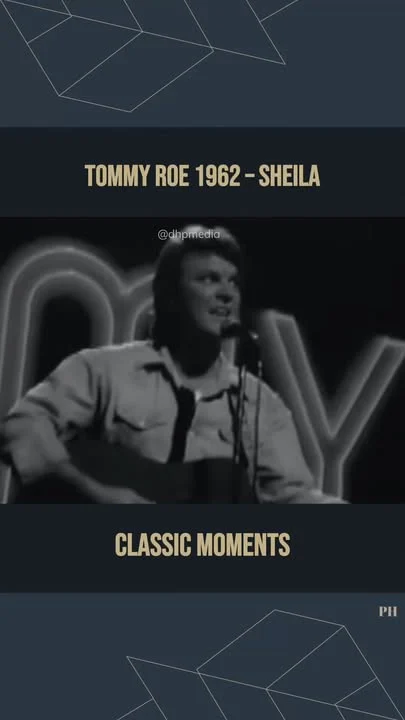
You slide onto a cracked vinyl stool at a roadside diner, the kind with fluorescent lights that hum and coffee that burns your tongue. The jukebox in the corner coughs to life, and suddenly a two-minute blast of pure joy fills the room. That feeling of being transported is exactly what happens when Tommy Roe’s “Sheila” spins. Decades after its release, it still sounds like a Polaroid snapshot of a world in fast forward.
Tommy Roe was a young electrician in Atlanta in 1960, strumming songs for a high school crush. He called that first attempt “Sweet Little Frieda,” a regional rockabilly track that fizzled. Two years later, fate intervened. A producer named Felton Jarvis recognized a gap in the musical landscape left by the tragic death of Buddy Holly in 1959. Jarvis had a plan: resurrect the “Lubbock Sound” with a Nashville session. And so in 1962, “Sheila” was reborn.
The recording session was a masterstroke of controlled chaos. Jerry Reed laid down guitar lines that cut like bright surgical steel. The Jordanaires whispered harmonies like ghosts from a golden age. And the drumming—a relentless, clattering paradiddle pattern—was an unmistakable wink at Holly’s “Peggy Sue.” That drumbeat is the heart of the song, a jittery engine that refuses to idle. It forces you to move, to tap your foot, to grin despite yourself.
Roe’s vocal delivery is a marvel. He sings of a sweet little girl with blue eyes and a ponytail, his voice catching with a slight Southern hiccup. That vocal tic, that nervous catch, was a deliberate homage. It wasn’t imitation; it was a passing of the torch. Jarvis and Roe understood that honoring the past could create something entirely fresh.
The arrangement is sparse, almost skeletal. A bright rhythm guitar, a submerged piano part from legend Floyd Cramer that serves as texture rather than melody, and that drumbeat. Nothing wasted. The song barrels to a finish in just over two minutes, leaving no room for anything but the hook. It is the definition of a perfect single.
The power of “Sheila” lies not in innovation but in perfect distillation—the raw urgency of the past polished into a pop gem for the future.
The song shot to number one on the Billboard Hot 100, launching Roe into the stratosphere of pre-Beatles teen pop. It took until 1969 for the RIAA to hand him a gold record for sales exceeding a million copies. By then, the song had become a time capsule, a sound that felt both old-school and startlingly fresh. It charmed traditionalists and laid the groundwork for bubblegum pop.
Imagine a teenager in 1962, hearing “Sheila” for the first time on a crackling radio. They rush home with sheet music from the local store, desperate to learn the chords. It is a soundtrack for first dances, nervous glances, sweetheart romance. The reverb on Roe’s voice wraps around you like a warm blanket, lending a cinematic depth to his earnest confession of love. Her name drives him insane. You believe it.
The song’s cultural ripples are astonishing. A French singer named Annie Chancel covered it later that year and adopted “Sheila” as her stage name, becoming a massive star in France. The essence of the song—catchy, driving, deeply romantic—proved universal.
Today, through good headphones or premium audio, the clean production shines even brighter. “Sheila” lives outside categories. It is rockabilly revivalism and proto-bubblegum. It is Nashville session musicians channeling Texas brilliance. It is a two-minute slice of unadulterated joy. Put it on. Try to keep your foot still. You cannot.
For those who crave more of that same irresistible energy, consider these companion tracks that share the spirit of “Sheila”
“Peggy Sue” by Buddy Holly (1957) The spiritual blueprint with its driving drum pattern and vocal hiccups
“Travelin’ Man” by Ricky Nelson (1961) Clean pop-rock perfection from the same golden era
“Palisades Park” by Freddy Cannon (1962) Another propulsive two-minute thrill with a beat that refuses to quit
“The Loco-Motion” by Little Eva (1962) Bright infectious dance energy wrapped in a brilliant production
“Let’s Twist Again” by Chubby Checker (1961) Rhythm-forward pop construction that sets the feet in motion
“Hey Paula” by Paul & Paula (1963) A sweeter turn into early 1960s sentimentality with clean harmonies