
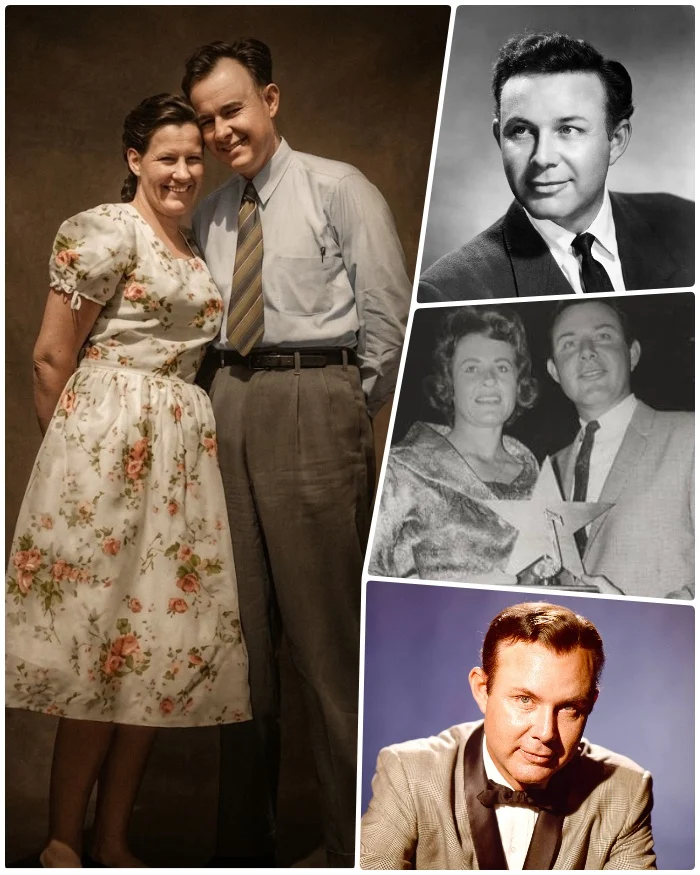
For forty-two hours, searchers pushed through thick Tennessee timber, calling a name that would not answer back. When they finally found the twisted wreckage near Brentwood on August 2, 1964, the silence that followed felt impossible to bear. Jim Reeves was forty years old, and the smooth baritone that had helped shape the Nashville Sound was suddenly gone. Yet in the weeks that followed, his thirty-five-year-old widow made a decision that would keep that voice singing for another thirty-five years.
Mary Elizabeth White had never sought the spotlight. Born in Texas in 1929, she married Jim on September 3, 1947, in Henderson, Texas, just as a torn ankle ligament ended his dream of playing minor-league baseball in the St. Louis Cardinals organization. He was twenty-four and starting over from scratch, and she was the steady paycheck that made starting over possible.
While Jim took low-paying announcing shifts at KGRI in Henderson and later at KWKH in Shreveport, Mary taught school by day and listened to his early morning broadcasts. She urged him to step up to the microphone not only as an announcer but as a singer, believing in a voice that radio listeners were only beginning to discover.
For seventeen years, she worked quietly behind the scenes as his business partner while his gentle baritone, shaped in the studio by producer Chet Atkins, helped define the Nashville Sound for audiences around the world.
On July 2, 1964, Jim finished his final session for RCA Victor in Nashville, cutting songs that included “Is It Really Over?” and “Make the World Go Away”. Twenty-nine days later, on July 31, 1964, the single-engine Beechcraft Debonair he was piloting from Batesville, Arkansas, flew into a violent thunderstorm and fell into the wooded hills near Brentwood, Tennessee. Hundreds of fellow musicians and searchers combed the dense woods for forty-two hours before the wreckage was found.
Left to manage both her grief and a sprawling musical estate, Mary refused to let the funeral be the final note. She drew a clear line between private loss and public duty.
Jim Reeves my husband is gone. Jim Reeves the artist lives on.
Stepping into the executive seat at Jim Reeves Enterprises, she opened a tape vault that held far more than memories. Inside Jim’s basement studio and the label’s vaults were dozens of unreleased studio masters, radio transcriptions and sparse guitar demos waiting for a careful ear. At the time of his death, six of his future country number-one singles had not yet reached the public, and Mary understood that those tapes were not leftovers. They were the next chapter.
One discovery changed everything. Among the tapes was a quiet voice-and-guitar demo of Cindy Walker’s “Distant Drums”, recorded mainly for the songwriter’s publishing files after Atkins had initially passed on the song for a regular session. In early 1966, Mary and Atkins carried that solitary vocal into RCA Studio B, where guitarist Harold Bradley and other session musicians built a full orchestral arrangement around Jim’s voice. Released that spring, “Distant Drums” spent four weeks at number one on the country chart in the United States and five weeks atop the British pop chart.
Mary applied the same patience to the rest of the archive for two decades. Instead of flooding the market, she spaced out releases and authorized updated instrumental overdubs throughout the 1970s so older recordings matched contemporary radio production. The approach produced six posthumous country chart-toppers, beginning with “I Guess I’m Crazy” in 1964 and continuing through “This Is It”, “Is It Really Over?”, “Distant Drums”, “I Won’t Forget You” and “Blue Side of Lonesome”. Her choices kept his voice on country and international charts through the 1970s and 1980s, turning an unfinished vault into one of the longest posthumous runs in music history.
Even in the early 1980s, she found new ways to bring him back to country radio. In 1981, she worked with producer Owen Bradley to splice Jim’s vocal with a separate recording by Patsy Cline, creating the top-ten duet “Have You Ever Been Lonely” nearly two decades after both singers had died in plane crashes. Jim’s final charted single, “The Image of Me”, reached the Billboard country listings in 1984, twenty years after his death.
Alongside the studio work, Mary wanted fans to have a physical place to remember him. In the mid-1970s, she opened the Jim Reeves Museum near Gallatin Pike and Briley Parkway in Madison, just outside downtown Nashville.
Inside, she displayed the everyday pieces of his life and career, including his tailored stage tuxedos and stage suits, acoustic guitars, handwritten letters and international gold records, along with the bedroom furniture from their home. She also tracked down and repurchased “Big Blue”, the custom Flxible Clipper tour bus Jim had used on the road, and built a covered deck on the museum grounds so visitors could step inside it.
For more than twenty years, until the museum closed in 1996, Mary regularly stood in the lobby herself. Tourists from across the United States, Britain, Ireland and Scandinavia often realized only after starting a conversation that the polite woman welcoming them at the door was the singer’s widow.
Mary Reeves died in Nashville on November 11, 1999, at the age of seventy. In 1947, her teaching paycheck had given a sidelined ballplayer the chance to sing on a small Texas radio station. After 1964, her thirty-five years guarding his tapes and greeting visitors at the museum doors made sure the microphone never truly went cold. Because of the woman who stood by him in 1947, his voice kept reaching listeners for decades after his final flight.