
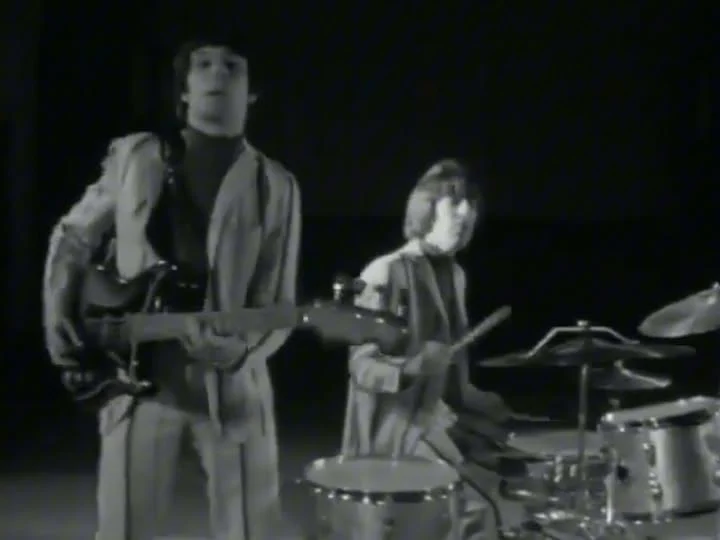
There are songs that sound best through a crackling speaker, their imperfections part of the charm. For me, “With A Girl Like You” by The Troggs was discovered on a worn-out cassette, the hiss blending with the raw recording. It captures a moment of teenage courage that feels timeless, a two-minute burst of nervous hope that still works its magic six decades later.
Back in 1966, four young men from Andover, England, were facing the impossible task of following up “Wild Thing.” That primal snarl of garage rock had crossed the ocean and conquered charts, leaving the band under sudden pressure to deliver a second miracle. Reg Presley, Chris Britton, Pete Staples, and Ronnie Bond had exploded onto the scene with a sound so raw it felt like a dare. The question hung in the air: what next?
The answer came months later in the form of a two-minute, five-second diamond. On first listen, “With A Girl Like You” feels like an anomaly. Where its predecessor was a grunt of lust delivered through a distorted ocarina, this new single was surprisingly melodic, almost tender, yet retained the band’s signature stripped-down ferocity. That juxtaposition is the key to its enduring charm.
The recording session itself speaks volumes about the chaotic early days of British rock. Tracked at Olympic Studios in London, the song was squeezed into a short window booked by manager Larry Page for his own orchestra. The Troggs waited in a van, given barely 45 minutes to set up, soundcheck, and record. This do-or-die atmosphere is baked into the sound’s very DNA. The frantic energy, the lack of polish, the sense of a band racing against the clock—all of it translates into something electrifyingly urgent.
“The sound is the anti-glamour of pure rock and roll: a testament to the fact that emotional directness always trumps technical polish.”
Released as a non-album single in the UK, it became the band’s only number one at home. In the US, it appeared on their debut album Wild Thing (the UK version was called From Nowhere). The song’s global success, particularly across Europe, proved that The Troggs were more than a one-hit wonder. This wasn’t just a riff; it was a bona fide song penned by frontman Reg Presley. Their career arc in 1966 was defined by lightning-fast ascent: from provincial obscurity to international chart-toppers on the strength of two singles built on urgency and unvarnished feeling.
Musically, “With A Girl Like You” is a masterclass in economy. The opening is instantly recognizable: a four-on-the-floor drum shuffle from Ronnie Bond—crisp, dry, relentlessly driving—paired with a simple, propulsive bassline from Pete Staples. Chris Britton’s electric guitar plays a tight, ringing chord sequence that eschews complexity for sheer rhythmic momentum. The arrangement is so fundamental it feels like a template for a thousand future punk and power-pop bands.
The central hook is a fascinating sonic device. After each line of Presley’s vocal, he delivers the famous wordless chant “ba-ba ba ba baa ba-ba ba baa.” This rhythmic scat was reportedly intended to be an actual trumpet riff, but the rushed session meant the vocal was used instead. It functions as a minimalist human horn section, injecting a burst of melodic rhythm that perfectly complements the lyrical theme of hopeful nervous anticipation on the dancefloor.
Presley’s performance is key. His delivery is conversational and slightly breathless, portraying the quintessential shy guy working up courage to cross the floor and ask for the last dance. The lyrics are pure, unironic romanticism: he likes the way she dresses, the way she talks, she’s just my kind. This raw sincerity demonstrates The Troggs’ surprising range—a world away from the proto-punk aggression of “Wild Thing.”
The song’s texture is wonderfully grubby. The drum sound is flat and immediate, capturing every rattle of the snare. There is no trace of the lush, complicated soundscapes dominating the charts elsewhere in 1966. This is the sound of a garage band thrust into a professional studio for too short a time, and that limitation became their aesthetic triumph. It’s a reminder that rock and roll doesn’t need mythological scale to be profound; sometimes, all it needs is a dark corner, a beat, and a single moment of nerve.
Nearly sixty years later, the song still lands with the satisfying thud of a perfect pop hook. It tells a micro-story everyone understands: the paralyzing hope of first contact. That little “ba-ba ba ba baa” hook is the internal monologue of a heart accelerating. It’s the two-second burst of courage, the mental rehearsal of the question, “Can I dance with you?” Listen to it again, and let that simple, hypnotic chant pull you across the room, decades later.
Listening Recommendations
Fans of this raw energy should explore The Monkees “Pleasant Valley Sunday” (1967), which shares punchy pop-rock energy with simple hooks. The McCoys “Hang On Sloopy” (1965) offers another mid-tempo garage anthem with a gruff lead vocal. Tommy James & The Shondells “I Think We’re Alone Now” (1967) captures teenage urgency with a no-frills band performance. The Seeds “Pushin’ Too Hard” (1967) embodies the primal raw guitar sound. The Grass Roots “Let’s Live for Today” (1967) features a bright beat and romantic focus. The Strangeloves “I Want Candy” (1965) uses simple chant-like backing vocals to great effect.