
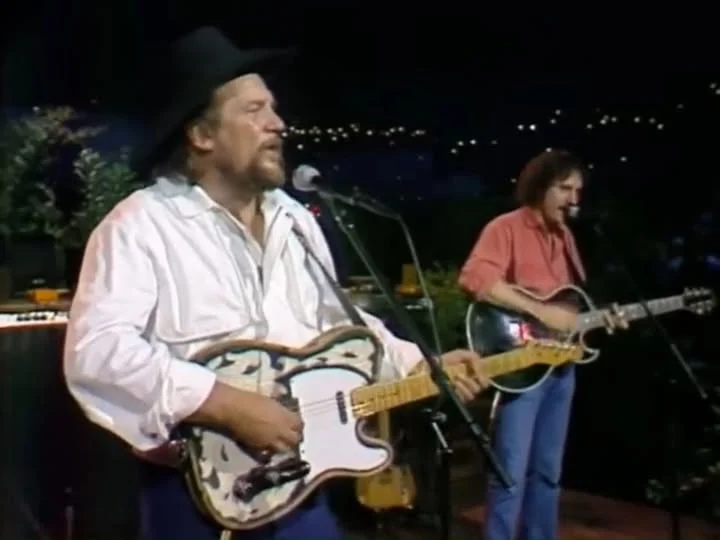
I was born a runnin’ and I’ll die runnin’ / But I got tired of livin’ alone…
These opening lines from Waylon Jennings don’t just begin a song; they lay bare a soul wrestling with the very contradictions that made him an icon. In “Don’t You Think This Outlaw Bit’s Done Got Out of Hand,” the man who helped define outlaw country turns the mirror on himself, confessing the exhaustion hidden behind the rebel stare. The track, released in 1978 on the album I’ve Always Been Crazy, remains a masterclass in raw vulnerability, blending gritty guitar with a piano that aches with melancholy. It is a confessional booth disguised as a honky‑tonk anthem.
To understand the weight of this song, you must first travel back to the late 1970s. The outlaw country movement was at its peak. Waylon Jennings, alongside Willie Nelson, Johnny Cash, and Kris Kristofferson, had rejected Nashville’s polished assembly line in favor of something rougher, truer. On I’ve Always Been Crazy, Jennings documented his own battles with fame and identity. The album’s title itself is a declaration, but it’s the third track that digs deepest. Here, the outlaw’s swagger gives way to exhaustion. The instrumentation is deliberately sparse—a steady guitar riff, a soft piano that colors the verses, and a rhythm section that never rushes. This restraint allows Jennings’ voice, worn and wise, to carry every ounce of regret.
The guitar in this piece is no virtuoso soloist; it serves the story. Its twang is the sound of a man too tired to glamorize his own myth. The piano enters like a late‑night companion, offering chords that feel both supportive and sorrowful. Together, these instruments create a soundscape where every note feels earned, every silence pregnant with meaning. Jennings knew that the outlaw persona, while lucrative, had also become a cage. The song recounts a real‑life drug bust—a misunderstanding born from that very image—and asks a question that echoes beyond his career: When does rebellion stop being a choice and start being a sentence?
Lyrically, the song navigates the tension between freedom and consequence. Jennings sings not just about fame but about the loneliness that fame magnifies. He longs for simplicity even as he acknowledges that the outlaw shadow is now part of his fabric. This duality is what makes the track so timeless. It is a piece of music that does not offer easy answers; instead, it sits with the discomfort of being both iconic and trapped.
For fans of outlaw country, the interplay of guitar and piano in this song is a signature element worth exploring further. The guitar brings the grit; the piano brings the heart. Listeners who find themselves moved by this track will discover similar emotional landscapes in other classics: Willie Nelson’s “Blue Eyes Crying in the Rain,” Johnny Cash’s “Sunday Morning Coming Down,” Kris Kristofferson’s “Me and Bobby McGee,” Merle Haggard’s “Mama Tried,” and Waylon Jennings’ own “Are You Sure Hank Done It This Way.” Each of these songs shares a willingness to bare the soul behind the leather jacket.
More than forty years later, “Don’t You Think This Outlaw Bit’s Done Got Out of Hand” remains a crucial listen—not just for country fans, but for anyone who has ever struggled with the gap between who they are and who the world expects them to be. In an age of glossy production and curated personas, Jennings’ blunt honesty is a gift. The track stands as a testament to the power of vulnerability, the weight of authenticity, and the enduring legacy of a man who knew that even outlaws need a moment of grace.