
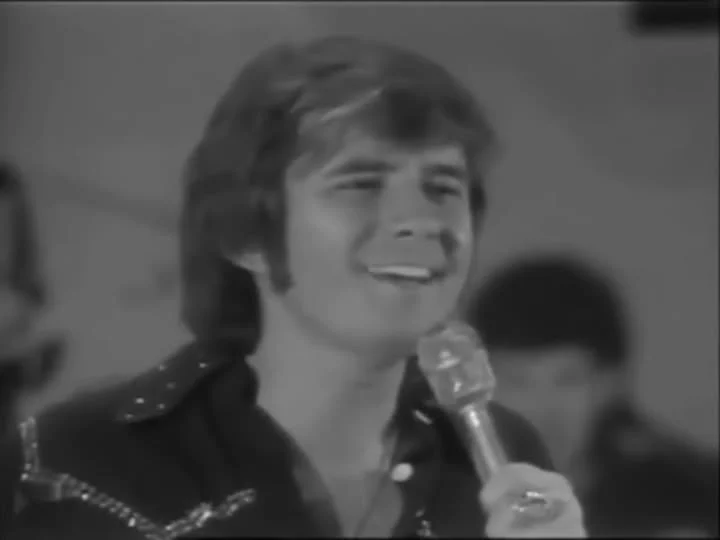
The glow of the radio dial casts a soft amber light across the dashboard. It is late autumn, 1960, and the highway stretches empty ahead. From the speaker comes a sound that feels like pure momentum – clean, buoyant, impossibly fresh. The song is Poetry in Motion and it marks the moment Johnny Tillotson transcends from promising newcomer to international sensation. For those who first heard it through the crackle of a car radio, it is an instant transport back to a time when innocence and sophistication danced together on the pop charts.
This single arrived at a crossroads. The raw energy of 1950s rock and roll was mellowing into something more polished, more refined. Cadence Records released the track just as teenagers were trading leather jackets for clean cardigans. The song captured that shift perfectly – a snapshot of an era where teenagers still swooned but demanded elegance in their melodies. Its success was immediate and lasting, eventually anchoring Tillotson’s debut album Johnny Tillotson’s Best in 1962.
The singer himself came to Nashville with an unusual background. A University of Florida graduate with a degree in journalism, Tillotson had already caught the ear of producer Archie Bleyer. Earlier efforts hinted at what was possible, but Poetry in Motion launched him into orbit. It climbed high on the Billboard Hot 100 in the United States and claimed the top spot in the United Kingdom. That transatlantic success established Tillotson as a master of country-pop crossover, a style he would refine with his own songwriting in later hits.
The greatest songs don’t just describe a feeling; they translate physical motion into sound.
Behind the scenes, a dream team of session musicians brought the song to life. Engineer Bill Porter captured the session with remarkable clarity in Nashville. The arrangement, overseen by Bleyer, is a study in precision. The rhythm section sets an immediate driving pulse. The drums crack tight on the backbeat, creating the feeling of perpetual forward motion – the very essence of the title. The bass walks with a gentle bounce, while the piano of Floyd Cramer rolls through the instrumental break with a joyful, almost honky-tonk counterpoint. Then comes the signature saxophone riff from Boots Randolph, four ascending notes that punctuate the title line with an almost spoken-word emphasis. That warm, muscular tone gives Tillotson’s clean tenor a hint of R and B grit.
Tillotson’s vocal delivery is pure teen-idol charm: earnest, slightly breathless, but impeccably controlled. He does not belt the lyrics; he swoons and glides through them. Listen to the way he stretches the vowels on lines like “her lovely locomotion,” transforming the simple observation of a beautiful walk into something cinematic. The guitar work remains restrained, playing clipped chords on the off-beats, supporting the rhythm without dominating the mix. It is an economy of sound where space and dynamics matter as much as the notes themselves.
The lyrics themselves are disarmingly simple. They capture pure street-corner romance: the wonder of watching a girl walk by. Writers Mike Anthony and Paul Kaufman tapped into a universal experience – that moment when ordinary movement becomes extraordinary spectacle. The genius lies in the metaphor, turning pedestrian movement into the lofty art of poetry. The song does not need complexity to stir emotion; it relies on the clean architecture of the melody and the airy arrangement to carry its magic.
Half a century later, the recording remains surprisingly fresh. Played back on a premium audio system, you can almost hear the slight reverberation of the room around Tillotson’s voice, the air moving off the reed of the saxophone. The mix is wide and dynamic, avoiding the murky compression that plagued much of the mid 60s pop output. For a generation, this song became the default soundtrack for a specific kind of innocent, exhilarating observation. You might be standing at a bus stop, on a boardwalk, or simply looking out a window, and the rhythm starts playing in your head, synchronizing with the effortless stride of someone walking past. It creates a micro-story in the listener’s life, connecting a perfectly crafted piece of music from the past with a beautiful moment in the present.
For anyone seeking to understand how early rock evolved into the polished pop of the early 1960s, Poetry in Motion is essential listening. Its enduring simplicity, paired with its sophisticated arrangement, proves that sometimes the most profound emotional impact comes from the most buoyant and seemingly straightforward material. It remains a sonic smile – a two minute fourteen second masterclass in converting infatuation into an indelible groove.