
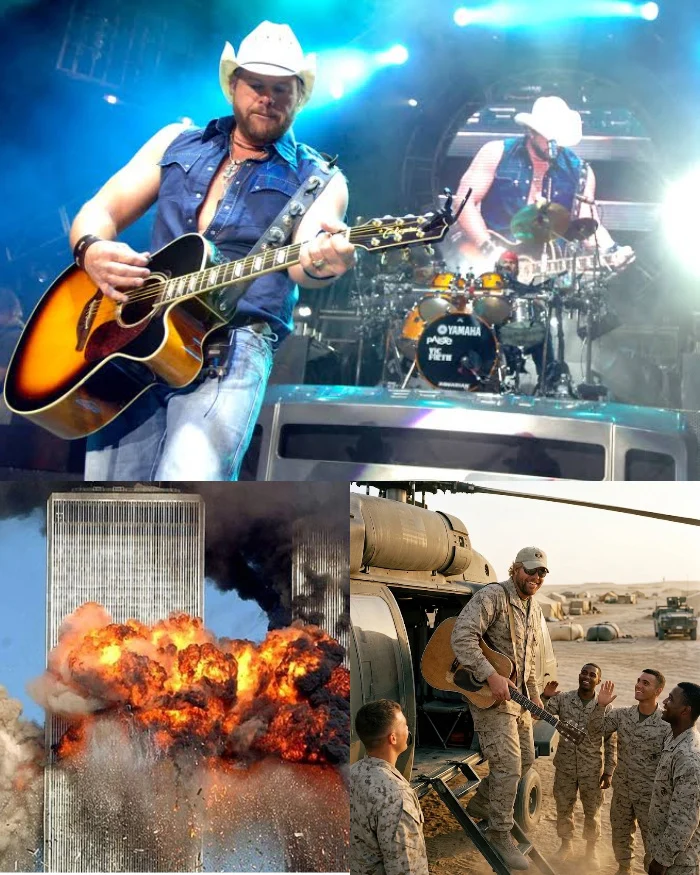
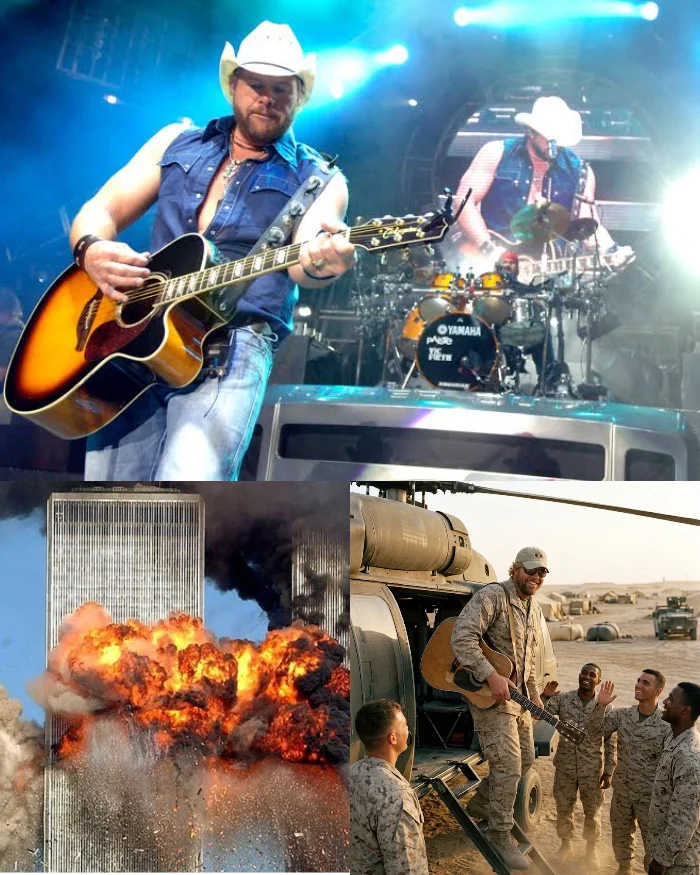
When ABC asked Toby Keith to soften the song his father had made sacred, the Oklahoma singer did not negotiate. He walked away from a Fourth of July broadcast that would have reached twenty million living rooms and kept a promise to the men and women in uniform.
The moment came in early summer 2002. The network had invited Keith to open its prime time Independence Day special with “Courtesy of the Red, White and Blue,” the raw anthem that had swept country radio within months of the September 11 attacks. For Keith, the invitation seemed like a chance to bring the song to families across the country on the holiday he loved.
But the song was never meant to be a polished sales pitch. Keith wrote it in roughly twenty minutes at his kitchen table after grief and rage collided. One wound was national. The other was personal. His father, Hubert Keith “H.K.” Covel, was an Army veteran who lost an eye in a training accident and taught his son a fierce respect for service. H.K. died in a car crash on Interstate 35 in March 2001, months before the towers fell.
For Keith, the lyric was not a TV moment. It was a promise to the uniform his father wore and to the troops he wanted to reach.
He initially planned to perform it only on military bases. That changed after a private Pentagon performance where Marine Corps Commandant James L. Jones urged him to record the song for service members heading overseas. Keith listened and placed the track on his 2002 album Unleashed.
The television invitation unraveled days before air. News anchor Peter Jennings objected to the song’s combative tone. ABC executives told Keith’s team to soften the words or choose another song. Keith refused to change a syllable and withdrew from the broadcast.
The decision shocked the industry. He gave up an audience estimated at twenty million viewers. Radio switchboards then lit up with listener requests, and the song raced to the top of the Billboard Hot Country Singles and Tracks chart. Unleashed also entered the Billboard 200 at Number One and eventually sold more than four million copies.
The standoff became a cultural flashpoint. Coastal television rooms and working class households suddenly heard the same song through different ears. Keith kept the line he had drawn for his father and carried it through eleven overseas USO tours, playing for troops in Iraq, Afghanistan, and remote operating bases.
In the end, the broadcast he lost became the story he never softened. Toby Keith chose honor over exposure, and the anthem stayed angry, honest, and unedited.