
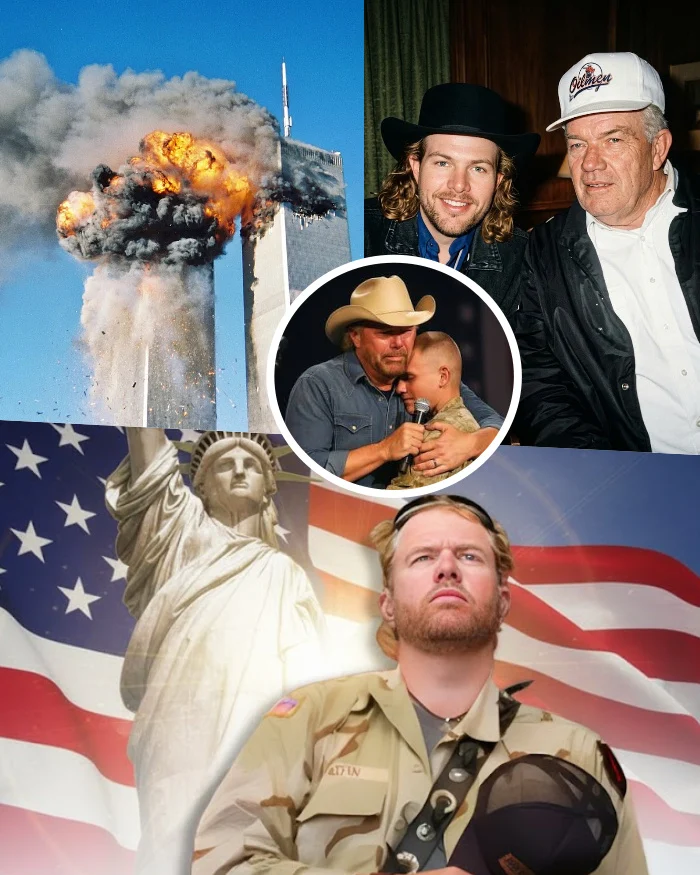
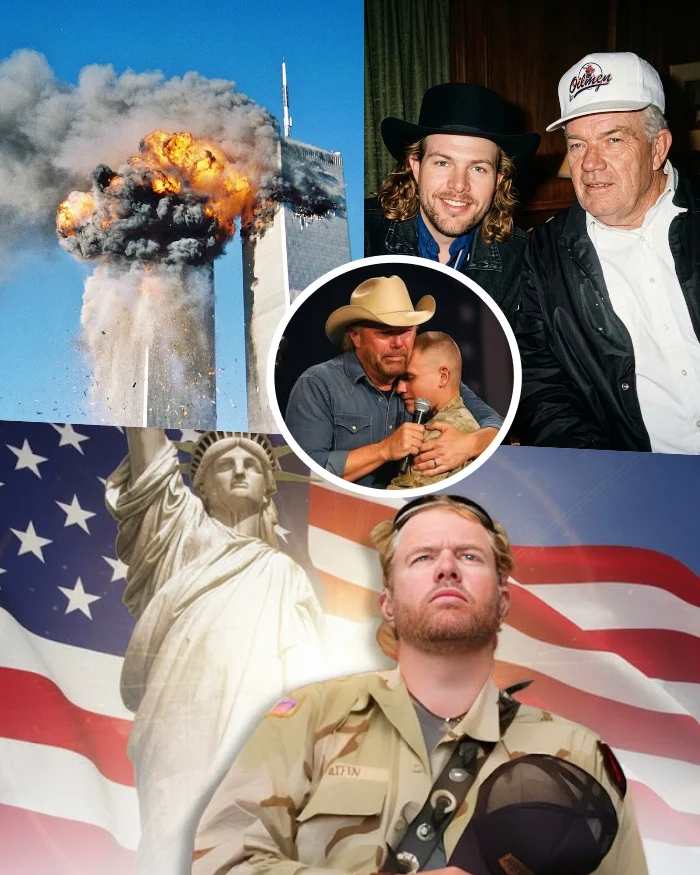
Twenty minutes. A pencil. A brown paper sack. A son trying to survive grief for his veteran father and a country reeling from attack.
On March 24, 2001, Toby Keith lost his father, Hubert Keith Covel, at age sixty-seven in a multi-vehicle collision along Interstate 35 near Purcell, Oklahoma. Hubert was an Army veteran who lost the sight in his right eye during military service, yet he raised the American flag on the pole in his front yard every morning without fail. Six months later, the September 11 attacks hit home for Keith because he was still mourning his father while watching towers fall.
Keith kept asking what his father would have said seeing those buildings fall. He grabbed a pencil and turned over a brown grocery bag. In twenty minutes, he wrote raw thoughts to process grief. He first called the acoustic piece Angry American and never intended for the public to hear it.
The song found its audience during Keith’s first overseas USO tour for military personnel preparing for deployments to the Middle East. He carried an acoustic guitar into aircraft hangars, mess halls, and remote forward operating bases. The room would fall dead silent as he sang about the quiet pride of working men and the resolve of those in uniform.
After a gathering at the Pentagon, retired four-star Admiral James L. Holloway III approached Keith and told him that service members needed that piece recorded and released to the public.
Keith returned to Nashville to cut the track for his 2002 album Unleashed. Several music row executives and radio consultants initially balked at the record’s unapologetic tone and blunt phrasing, warning that lyrical defiance could invite corporate boycotts. Keith stood his ground and said the sentiment was an honest reflection of military families across the country.
Retitled Courtesy of the Red, White and Blue, The Angry American, the single soared to number one on the Billboard Hot Country Singles and Tracks chart in July 2002 and became a defining fixture of American country music during a turbulent era.
Between studio release and relentless touring, Keith kept personal USO tour logs, quietly documenting handshakes, flight schedules, and individual conversations he shared with frontline troops across eighteen international tours and more than two hundred shows.
The anthem anchored Keith’s career for the next two decades, but for the singer its real value never came from industry sales or arena ovations. It was built around a son honoring an Oklahoma father who never asked for recognition while standing beside the American flag in his yard.
A private promise kept between an artist and the quiet veteran who taught him how to stand his ground.
Toby Keith left behind stadium records and chart milestones, yet that song remained what it was from the very first minute on that paper sack, a private promise kept between an artist and the quiet veteran who taught him how to stand his ground.