
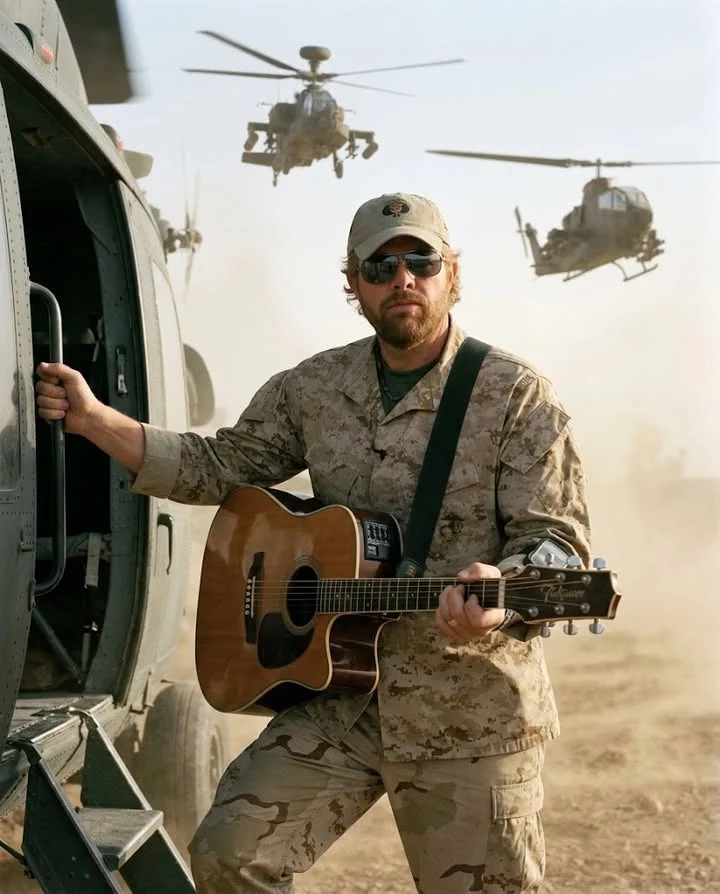
The thud of rotors drowned out everything except the pounding of his own heart. Toby Keith, strapped into a military helicopter, knew that the only thing separating him from the hostile ground below was the skill of the pilots and the armor of the birds surrounding him. He was not a superstar in those moments. He was a man keeping a promise to young gunners and pilots.
In the spring of 2009, Keith embarked on his seventh USO tour, a grueling stretch of dates that took him deep into the forward operating bases of Afghanistan. There were no luxury tour buses, no climate-controlled green rooms, and absolutely no guarantees of safety. Moving a high-profile civilian through an active war zone required an unprecedented level of military security.
The threat level on the ground in regions like Helmand and Kandahar dictated every movement. Keith’s transport flights could not travel alone. The U.S. military deployed its heaviest aerial firepower, including Apache and Cobra attack helicopters, flanking his transport chopper as it skimmed over the rugged Afghan terrain. Aviation task forces coordinated his movements not as simple VIP transports but as full-scale tactical combat missions.
“He traded his cowboy hat for a ballistic helmet and heavy Kevlar body armor,”
a pilot recalled. The contrast was profound. Here was one of the biggest stars in American music, flying in the center of a heavily armed formation with an acoustic guitar strapped in next to him. The glamour of the music industry was stripped away entirely.
Military aviators who navigated him through those skies later detailed how they frequently flew nap-of-the-earth, dangerously low and incredibly fast, to evade ground fire. Through it all, flight crews recalled how remarkably calm Keith remained, sitting in the back of a vibrating CH-47 Chinook and trading stories with the door gunners as if they were old friends.
Every time he stepped onto the shaking, oil-stained floor of a military helicopter, he handed his life over to the very men and women he had come to entertain. He understood the risks entirely, comparing the intense danger of the Afghan deployment to his turbulent early trips to Iraq.
When the landing gear finally hit the dirt at remote, dust-choked outposts, the rotors had barely stopped spinning before Keith was walking out to greet the troops. Sometimes the stage was the bed of a military flatbed truck parked in the blazing sun. Other times it was a dusty dining facility, a hot aircraft hangar, or just a makeshift wooden platform constructed in the middle of a desert camp.
He sang over the persistent roar of diesel generators, the whir of helicopter blades, and the distant thud of artillery. When alarms for incoming mortar fire interrupted his sets, sending everyone scrambling into concrete bunkers, the music stopped, but only temporarily. As soon as the military gave the all-clear, Keith walked right back out, picked his guitar up from the dust, and finished the song.
The military deployed premium aerial assets to protect him because of the immeasurable morale he carried into the front lines. To the young gunners, mechanics, and infantrymen stationed thousands of miles from home, his arrival was a physical piece of America breaking through the isolation.
Keith did not just sing patriotic anthems from the comfort and safety of an arena stage in the States. He willingly stood inside the harsh reality of war, breathing the same dust and facing the same alarms, to make sure the troops heard him. By the end of his life, he had completed 11 USO tours, performing for more than 250,000 service members across 17 countries. He never once asked for an easier route or a safer base.
The airspace was hostile, and the flights were perilous, but his mission never wavered. He just trusted the pilots to get him there, proving that the heaviest armor in those skies was carrying the heart of a songwriter.