
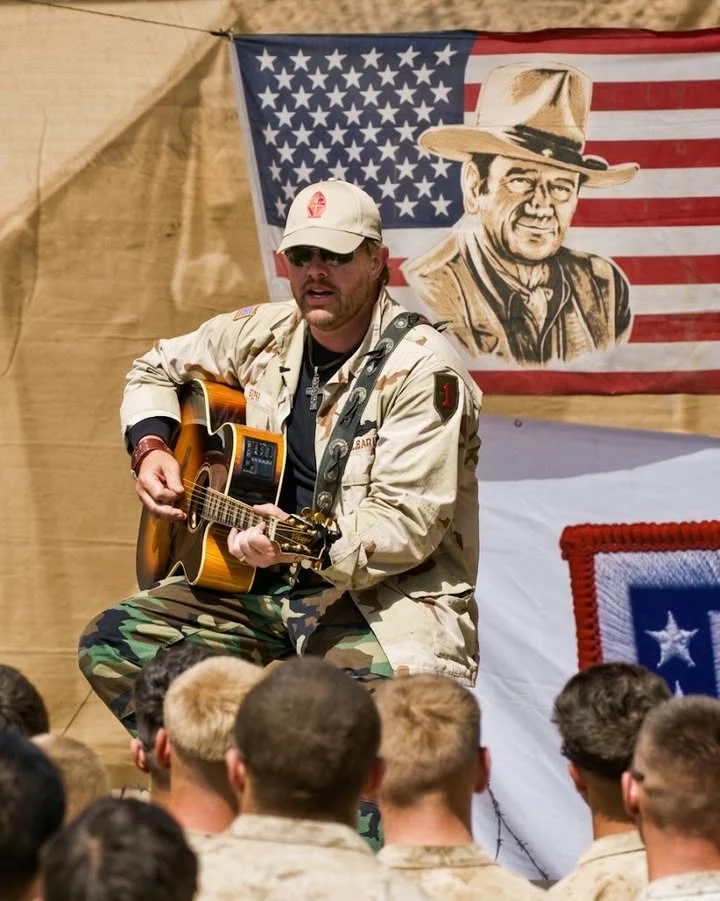
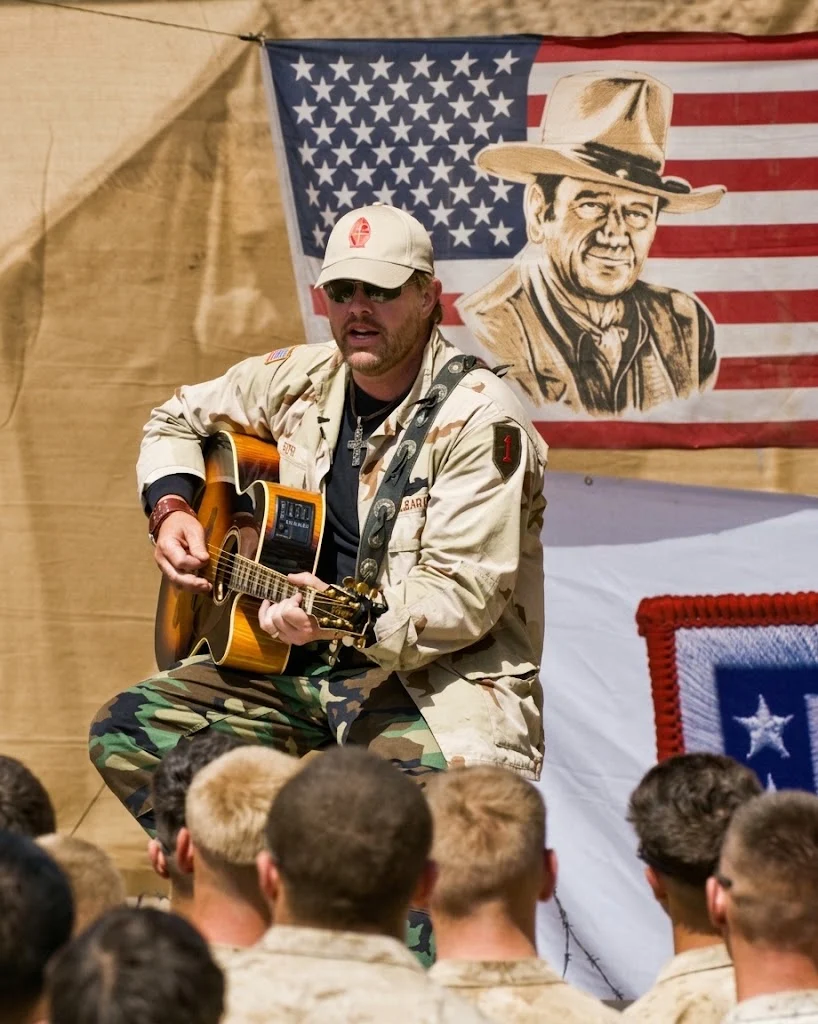
In the sweltering desert of Kandahar, a mortar explosion shattered the stillness. Toby Keith and a group of soldiers scrambled into a concrete bunker, huddled together as the ground shook. When the all-clear finally sounded, the country star emerged without a word, picked up his acoustic guitar, and returned to shaking hands and taking photos. That single moment captured the essence of a man whose enduring legacy was built not on platinum records but on dusty, unguarded moments like those.
Keith’s father, Hubert Covel Jr., served in the U.S. Army in the 1950s and lost his right eye during his service. That personal example instilled a deep sense of duty in the singer, a duty that could never be satisfied by writing hit songs from the comfort of Nashville. Instead, he committed himself to one of the most grueling tours in country music history.
Over 11 large-scale USO deployments, Keith traveled across 18 countries, delivering 285 official events and nearly 300 performances. He reached more than 256,000 active-duty service members and their families. But he didn’t stop at safe rearward bases. He brought his music to forward operating bases in Iraq and Afghanistan, to the steel decks of naval ships isolated in the ocean, and to makeshift stages built from plywood and flatbed trucks.
His familiar baritone voice was not just a concert. It was a tangible piece of the American homeland brought directly to the dirt and gravel of our temporary outposts.
Keith operated under a strict personal code during these trips. He would not leave any location until every single service member who wanted a moment of his time received one. Long after the formal sets ended, he stood for hours in 120-degree heat, signing everything from uniform scraps to well-worn guitars. He listened to stories about college football, small-town diners, the changing seasons back home, and the families waiting for their return.
These quiet conversations rarely touched on the war itself. Keith deliberately brought a sense of normalcy to the frontlines, offering a brief anchor for troops missing their loved ones. Even when mortar attacks forced him into bunkers, he simply waited, emerged, and continued without complaint. The sight of a major superstar enduring the same extreme heat, heavy dust, and imminent danger proved to the soldiers that they were not forgotten.
The anthems Toby Keith recorded will always play on national holidays. But the true weight of his devotion—the handshakes, the conversations, the shared moments of relief—remains the chapter of his life that those who served will never let go.