
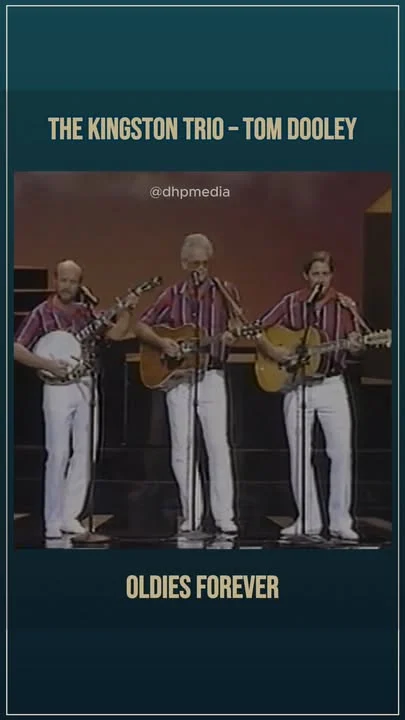
Ghosts do not usually reach the top of the pop charts. But in 1958 the ghost of Tom Dula did. The Kingston Trio, three clean-cut college boys, turned an Appalachian murder ballad called Tom Dooley into a number one record that sounded like nothing else on the radio. Elvis Presley was shaking his hips, Jerry Lee Lewis was burning up the piano, and yet this quiet acoustic lament slipped past the noise and changed American music forever.
The song had deep roots in American sorrow. In 1866 Laura Foster was murdered in North Carolina, and Tom Dula, whose name the local dialect turned into Dooley, was arrested, tried, and hanged. The old ballad wandered through the Appalachian hills for decades before it reached the ears of Dave Guard, Bob Shane, and Nick Reynolds. They were not mountain singers. They were bright, clean-cut young men with a knack for tight harmonies, and they saw a different future in the dusty song.
Recording for Capitol Records, the trio worked with producer Voyle Gilmore, who understood the value of space in a song. He brought in bassist Elmer “Buzz” Wheeler to add depth, though Wheeler remained uncredited, and the resulting session felt honest and warm. The group relied on their usual setup, a guitar, a tenor guitar, and a banjo, with some accounts placing a four-string banjo at the center. There were no drums and no frantic energy. The percussive pulse came from the fingers hitting the strings, and the story did the rest. The record appeared on the band’s eponymous debut album, The Kingston Trio, released in 1958, and the single pulled that album to a wide audience.
The arrangement trimmed the sprawling ballad down to three verses and a chorus, making it ready for the airwaves. The close harmonies moved together like a single voice, with the tenor line floating just above the melody and a gentle call-and-response shaping each line. The lyrics asked listeners to hang down Tom Dooley’s head and cry, yet the delivery stayed measured and strangely serene. That contrast between a brutal story and a polite performance gave the record its power. It felt like a campfire lament that somehow reached millions of living rooms.
Listeners did far more than welcome the song. They made it a number one hit on the Billboard Hot 100 and bought more than six million copies, proving that an acoustic record could compete with rock and roll. The commercial success of this one track also changed how record labels thought about folk music. It made the genre safe for the suburban living room and profitable enough to invite serious investment. The path later taken by Joan Baez, Bob Dylan, and the protest singers of the 1960s would have been far harder without the door that The Kingston Trio pushed open.
One lasting critical insight still follows this record.
The Kingston Trio’s “Tom Dooley” was not a protest song. It was a perfect pop object wrapped in the haunting shroud of American history.
The song became the first folk tune many young listeners ever learned on an instrument. Its simple modal melody and plain verse-chorus shape sit naturally in the hands, which is why so many beginner guitar lessons turned to “Tom Dooley” in the years after its release. Personal memory still attaches to the song in a million ordinary ways. I first heard it through an old guitar resting in the sun at my grandmother’s house, as my uncle found the opening chord pattern and let the melody fill the room.
Part of the song’s lasting gift is that it sounds like nothing else in its era. There is no piano flash and no orchestral swell. The whole weight sits on the voices and the light pulse of wood and metal. That purity lets the tragedy keep its shape, and the ending leaves a hollow space where the listener can feel the poor boy’s fate settle in the dark. It is a rare performance that asks to be heard in a quieter way.
To hear “Tom Dooley” clearly is to hear its musical family. The Weavers had already shown with “Goodnight, Irene” in 1950 how a clean acoustic arrangement could reach a mass audience. The Brothers Four followed the same polished path with “Greenfields” in 1960. Peter, Paul and Mary took the polish and added a sharper social edge with “If I Had a Hammer” in 1962. Harry Belafonte‘s “Day O” brought a new flavor to the charts in 1956. And going further back, The Carter Family‘s “John Hardy Was a Desperate Man” from 1930 carries the unpolished mountain sound that gave birth to the entire tradition.
The Kingston Trio did not invent folk music, nor did they clean up its history alone. They simply found the right harmonies and the right timing, and a story from the 1860s became the sound of the late 1950s. In a loud year for rock and roll, the most memorable voice belonged to a hanged man and a group of young men who sang about him with strange, perfect calm. The studio lights faded long ago, but the melody still hangs in the air, waiting for the next person to strum it on an old guitar and hear a distant century answer back.