
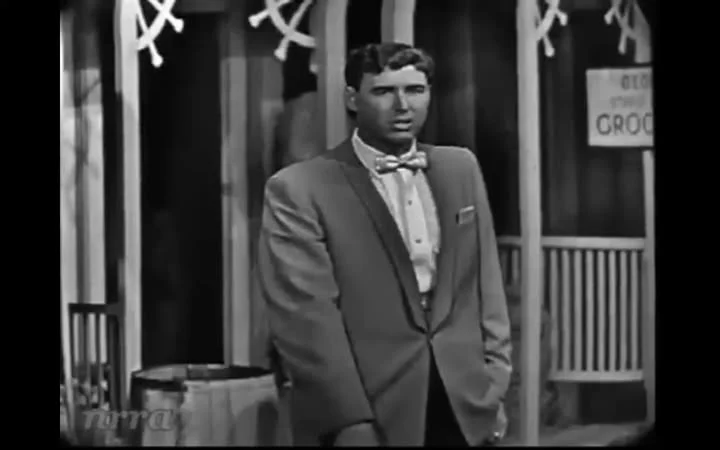
There is something about the ocean after dark that alters its voice. The high frequencies fade, leaving only the low, rhythmic groan of the current. On one particular night in a small coastal town, that deep sound was interrupted by something far more urgent: the unmistakable narration of Johnny Horton recounting a colossal 1941 naval engagement. Tinny speakers in a lonely cabin began broadcasting the sound of history itself. This is the lasting magic of Horton’s 1960 hit, Sink the Bismark — a song that compresses a real-life, high-seas drama into three minutes of rousing, folk-infused pop.
The song arrived at a spectacular, though tragically brief, peak in Horton’s career. He had already reinvented the pop landscape with The Battle of New Orleans and North to Alaska, essentially crafting a new subgenre: the pop-savvy historical saga. Sink the Bismark was released as a standalone single in 1960 by Columbia Records, later becoming the centerpiece of the compilation Johnny Horton Makes History. It was reportedly commissioned by the American distributors of the British war film Sink the Bismarck! to close the gap in American knowledge of the famous naval hunt. Produced by the veteran Don Law, the track rode a polished yet earthy Nashville Sound foundation, carrying Horton’s vivid storytelling to number 6 on the C&W Sides chart and number 3 on the Billboard Hot 100.
The opening strikes like a signal flare — a sharp, martial drum roll that yanks the listener to attention. This is no slow lament. It is a brisk, four-on-the-floor march, a frantic scramble onto the deck of the pursuing British fleet. The instrumentation is classic Nashville, but played with a sense of desperate urgency. An upright bass pumps out a driving root-fifth pattern while the snare drum gives the entire piece a military precision. Over this foundation, an electric guitar delivers crisp counter-melodies and punchy chords, slightly back in the mix yet essential. The piano, often overlooked in this era, fills the mid-range with rolling chords, adding a bright, saloon-style buoyancy that keeps the track from sounding too grim. It is the piano that injects a subtle spirit of defiance, ensuring the song remains pop-friendly even as it recounts a deadly serious hunt.
Horton’s vocal is the anchor. He becomes the earnest narrator, a man on the deck or perhaps in the crow’s nest, recounting facts with straightforward enthusiasm. His voice has a clear, slightly nasal quality that cuts through the mix, delivering lyrics with the clipped diction of the folk revival that was blending with country and rockabilly. The words, written by Horton and Tillman Franks, are cinematic in their brevity. “The Bismarck was the fastest ship / That ever sailed the seas / On her deck were guns as big as steers / And shells as big as trees.” This hyperbolic, tangible imagery reduces a complex multi-day naval operation into vivid, memorable vignettes. The storytelling moves with the brutal efficiency of a Hollywood screenplay: the initial threat, the tragedy of the Hood, the six-day chase, and the final decisive engagement.
The structural brilliance lies in the chorus, which functions as both a rallying cry and an emotional release.
“We’ll find that German battleship, that’s makin’ such a fuss / We had to sink the Bismark ’cause the world depends on us.” The moment the chorus hits, the dynamics swell — a slight increase in vocal fervor and a sharper attack from the band. It is a catharsis built not from wailing but from determined action. Listening back today on a good premium audio system, you can appreciate the simple yet effective power of early stereo separation, giving the listener a sense of the sheer scale of the event.
For all its simplicity, this recording is a masterclass in songcraft aimed at a mid-century audience hungry for history presented with populist flair. It is a sonic bridge between the folk ballad tradition and the emerging world of country-pop. The repetitive melodic figures make the song sticky — not for deep study, but for the road trip when you need an injection of rousing narrative energy. The single’s massive success solidified the final chapter of Horton’s career, casting him as the history man, just months before his untimely death in a car crash. It elevated him from regional favorite to pop star, placing a historical narrative squarely in the American mainstream alongside early rock and roll. This strain of song also encouraged a generation of writers to look at sheet music not just for love songs but for the dramatic potential of factual events. The simplicity of melodies and chord structures means that amateur guitarists and pianists have likely worked through this song, understanding it as foundational American musical folklore.
Sink the Bismark is more than a novelty. It is a perfectly executed piece of narrative-driven popular music, the sound of a bygone era’s myth-making. It is a gritty yet glamorous recounting of courage under fire, delivered with the swagger and simplicity of a classic Country A-side. It reminds us that sometimes the most complex stories are best told with a simple beat, a clear voice, and a rallying cry that transcends the decades. A final listen, eyes closed, and you can almost hear the wind whipping across the battleship’s deck.
Listening Recommendations
Johnny Horton – The Battle of New Orleans The definitive prototype for the historical saga song, sharing the brisk tempo and narrative focus.
Jimmie Driftwood – The Battle of New Orleans (original) The folk source material for Horton’s style, with a less polished, more traditional sound.
Tex Ritter – High Noon (Do Not Forsake Me, Oh My Darlin’) A different historical context but a similar blend of narrative balladry and mainstream arrangement.
Marty Robbins – El Paso A longer, more romantic narrative song with cinematic sweep, showcasing storytelling power in country-pop.
Hank Snow – I’ve Been Everywhere A rapid-fire list song relying on fast tempo and engaging rhythmic vocal delivery.
The Kingston Trio – Tom Dooley A quintessential folk revival track using simple acoustic arrangements to tell a tragic historical story.