
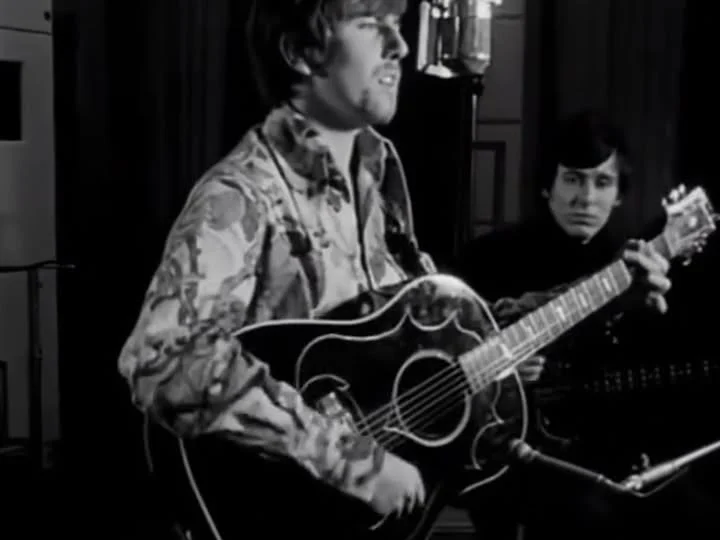
There is a moment in On a Carousel when the harmonies of Allan Clarke, Graham Nash, and Tony Hicks lock into a spinning orbit that feels almost impossible to resist. The three voices rise together on the title phrase, circling back like the fairground ride itself, and for a few seconds the world outside the speakers dissolves. This is British pop at its most deceptively effortless—a single that sounds like pure sunshine but was built with meticulous craft.
Released in February 1967 as a standalone single, the track was written collectively by Clarke, Nash, and Hicks during the same creative surge that produced the album Evolution. Yet in the United Kingdom, it never appeared on that LP, a decision that has puzzled fans for decades. Across the Atlantic, however, the song anchored The Hollies’ Greatest Hits (Imperial/Capitol, 1967), a compilation that became the band’s highest-charting US album at the time. The discrepancy between territories remains one of the song’s most fascinating footnotes, a reminder of how differently the same music could be packaged in the 1960s.
Commercially, the single performed exactly as a well-crafted A-side should. It peaked at No. 4 on the UK Official Singles Chart and climbed to No. 11 on the Billboard Hot 100 in the United States. Those numbers testify to the band’s ability to resonate with audiences on both sides of the Atlantic during a year when pop music was rapidly splintering into psychedelia, soul, and baroque experimentation.
“Riding along on a carousel… wasn’t intended to be philosophy,” Nash later reflected. “It was pop poetry built for airwaves and jukeboxes.”
That self-assessment captures the song’s charm perfectly. The lyric may be light, but the arrangement is anything but. Tony Hicks sets the tone with a clean, assertive guitar figure that loops back on itself like the ride’s mechanical horses. Graham Nash adds rhythm guitar with a breathy softness, while Allan Clarke’s harmonica darts through the gaps with a splash of color. Beneath it all, Bobby Elliott’s drumming drives the track forward—brisk snaps on the snare, crisp ride cymbal, and push-and-pull fills that lift the band into each chorus. The bass, handled by Bernie Calvert who had replaced Eric Haydock in mid-1966, locks with the drums to provide a grounded yet dancing foundation.
The real signature of the Hollies, of course, is their three-part harmony. On On a Carousel, the voices dovetail with a precision that borders on architectural. Nash takes the first verse lead, lending a yearning timbre before Clarke steps forward and the harmonies stack in tight thirds and sixths. The chorus blossoms with a canny trick: the voices not only widen but also mimic the circular imagery of the lyric, creating an aural metaphor of a carousel made of sound. Tambourine accents and distant handclaps flicker in the mono mix, while keyboards remain almost invisible, leaving the palette to guitar shimmer, vocal sheen, and crisp percussion.
For listeners discovering the Hollies today, the song works as a calling card. It sits at a hinge moment in 1967 when British pop was absorbing psychedelic color without sacrificing concision. The track hints at the technicolor textures flooding studios that year—the same year gave us Penny Lane and Happy Together—but stays proudly radio-first. Every part serves the whole: guitars glimmer, bass grounds, drums articulate, voices soar. The result is a recording that rewards both casual listening and close attention.
The album confusion continues to intrigue collectors. In the UK, fans who bought Evolution in 1967 found Carrie Anne and Ye Olde Toffee Shoppe but not this single. In North America, the song was embedded in a hits narrative that mapped the band’s evolution from beat-band punch to baroque-pop grace. Modern listeners should simply track it down wherever they can—whether on the original 45, a US compilation, or a streaming playlist—and let it spin.
On a Carousel is radiantly crafted pop: generous with hooks, rich in vocal color, and executed with the kind of understated studio discipline that endures. It may be thematically light, but its emotional honesty and musical precision keep it fresh. For anyone mapping the bridge between tidy British Invasion craft and the pastel swirl of 1967, this single is essential listening.