
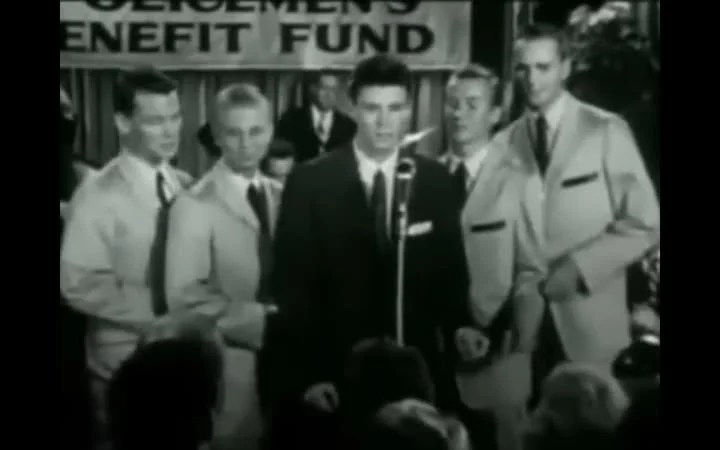
He was the boy next door who sang like an angel, but Ricky Nelson’s “Poor Little Fool” is about the moment innocence crashes into cynicism. When it hit number one on the Billboard Hot 100 in 1958, it wasn’t just a victory for a teen idol—it was a seismic shift in music history.
In the galaxy of early rock ‘n’ roll, few stars shined with the quiet brilliance of Ricky Nelson. With his gentle voice and wholesome smile, he became a bridge between country twang, pop melody, and rockabilly swagger. Among his many hits, “Poor Little Fool” remains a landmark. It was the first song ever to top the Billboard Hot 100, a chart that would go on to define generations. But beyond its historic debut, the song is a fragile, beautiful meditation on heartbreak—a theme that resonates as deeply today as it did six decades ago.
This track anchors Nelson’s third album, simply titled Ricky Nelson, released in 1958. By then, he was already a household name, thanks to his role on the family sitcom The Adventures of Ozzie and Harriet. That show became his stage, merging television with music in a way that felt revolutionary. The album itself is a masterful blend of rockabilly, country, and pop, with other standouts like “Lonesome Town” and “Don’t Leave Me This Way.” Yet “Poor Little Fool” remains the crown jewel—a song that proved Nelson could turn a simple story into a universal anthem of lost love.
At first listen, “Poor Little Fool” might seem like a straightforward pop tune. But peel back the layers, and you’ll find a richly textured soundscape that captures the late 1950s in all its tender, rebellious spirit.
The song is built around a soft, twanging guitar riff that nods to rockabilly roots while staying smooth enough for pop audiences. The piano glides in with a warm, melodic undertone, adding depth without overpowering Nelson’s vocals. The bass keeps a steady, understated groove, while the drums—played with brushes—create a gentle, shuffling heartbeat. Together, these instruments weave a sound that feels both intimate and expansive, like a quiet confession whispered in a crowded room.
But the true centerpiece is Nelson’s voice. He doesn’t shout or sob; instead, he lets his vulnerability speak. His restrained delivery makes lines like “I played this game before and lost, but now I’m not playing anymore” feel achingly real. The lyrics tell the story of a young man who thought he was the heartbreaker, only to have his own heart shattered. It’s a bittersweet lesson in humility, wrapped in a melody that invites you to sway along.
Why does this song still matter? Partly because of its place in music history. “Poor Little Fool” signaled the rise of pop and rock as the dominant forces in mainstream culture. But more than that, it endures because of its emotional honesty. Nelson captured a moment of disillusionment that everyone recognizes—the moment you realize love doesn’t always win.
For those who love this track, dive deeper into Nelson’s catalog. Try “Hello Mary Lou,” a bouncy rockabilly gem that shows his playful side. Or “Lonesome Town,” a haunting ballad that reveals his ability to channel sorrow without melodrama. Beyond Nelson, explore “It’s Only Make Believe” by Conway Twitty, which echoes the same theme of unrequited love. The Everly Brothers’ “All I Have to Do Is Dream” offers a dreamy companion piece, while Patsy Cline’s “I Fall to Pieces” delivers heartbreak with stunning vocal clarity.
“Poor Little Fool” is more than a song—it’s a time capsule. It carries the sound of an era when music spoke directly to the heart, without irony or pretense. So cue it up, let its gentle melodies wash over you, and remember the power of simplicity.
I used to play around with hearts that hastened at my callBut when I met that little girl I knew that I would fallPoor little fool, oh yeah, I was a fool, uh huhShe played around and teased me with her carefree devil eyesShe’d hold me close and kiss me but her heart was full of liesPoor little fool, oh yeah, I was a fool, uh huh