
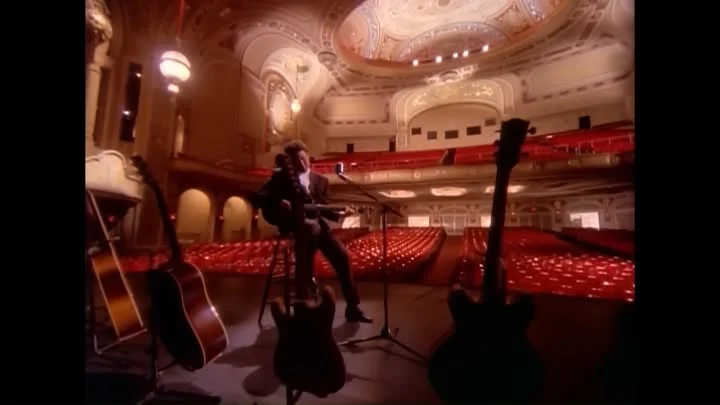
There is a kind of silence that exists only in a recording studio. It is not the absence of sound, but rather the presence of everything that is about to happen. It lives in the space between the engineer’s finger hovering over the record button and the first trembling intake of breath. In 1992, that silence held the weight of a confession.
When Vince Gill first began recording the song that would define his career, “I Still Believe In You,” he did not approach it with confidence. Instead, he brought a quiet vulnerability. The track opens with a simple, almost hesitant acoustic strum—a C-chord arpeggio that sounds like someone knocking on a door they are not sure will open. The tone is clean, direct, and devastatingly intimate. It is the sound of a man who has rehearsed his apology a thousand times and is finally daring to speak it aloud.
When Gill’s voice enters, it is stripped of all pretense. His signature high tenor, usually so powerful, softens to a near whisper. “Every now and then, I cry,” he sings, and the words linger in the studio air, unadorned by anything but that simple guitar pattern. There is no fanfare, no orchestral swell to hide behind. It is just a man, a microphone, and a mistake he can no longer carry alone. This is how masterpieces often begin: not with a bang, but with the quiet acknowledgment of a human failing.
The song arrived at a pivotal moment in country music history. Released in 1992 as the title track from his sixth studio album, “I Still Believe In You” solidified Gill’s transformation from a respected musician’s musician into a bona fide superstar. The album, produced by the legendary Tony Brown for MCA Records, became a commercial and critical juggernaut. It was the culmination of years of hard work, following the breakthrough success of his previous record, When I Call Your Name.
Tony Brown’s production is a masterclass in elegant restraint. In an era leaning toward louder, more rock-influenced country sounds, Brown and Gill crafted a ballad that drew its power from space and dynamics. The initial sparseness forces the listener to lean in, to focus on the raw sentiment of the lyric. It is a musical representation of isolation—the sound of a man alone with his regrets.
As the song moves into its first chorus, the arrangement begins to bloom. A fretless bass slides in, providing a warm, melodic foundation. John Hobbs’ piano enters with gentle, supportive chords, adding harmonic depth without ever demanding the spotlight. Then comes the signature sound of 90s country heartbreak: John Hughey’s pedal steel guitar. It does not just play notes; it weeps. Each swell is a sigh, a wordless echo of the singer’s lament. The sonic architecture builds, mirroring the rising emotion in Gill’s voice.
Imagine a couple driving late at night, the dashboard lights casting the only glow in the car. An argument, or perhaps worse, a heavy silence, has settled between them. The radio, left on low, becomes the third passenger. As Gill’s voice fills the space, singing of a love “that will not die,” the unspoken tension in the car becomes unbearable. The song is not just background noise; it is a catalyst, forcing a confrontation or a concession. It has served this role in countless cars and quiet rooms for over three decades.
The emotional apex arrives with the electric guitar solo. Performed by Gill himself, a guitarist of breathtaking skill, the solo is a masterclass in melodic storytelling. It is not a flurry of technical wizardry designed to impress. Instead, every note is chosen for maximum emotional impact. The phrasing is vocal, the bends are deliberate and mournful, and the tone is saturated with a quiet anguish. It is the wordless cry that the singer is too proud or too broken to voice himself.
“It’s the sound of a man dismantling his own pride, note by painful note, hoping the apology lands before the final chord fades.”
The production quality on this album is immaculate, a testament to the Nashville sound machine at its peak. Listening back now through a good pair of studio headphones reveals the track’s subtle layers: the faint shimmer of a cymbal, the precise decay on the vocal reverb, the warm air around the acoustic guitar. Every element occupies its own space in the mix, creating a soundscape that is both expansive and deeply personal. It is a perfect blend of country instrumentation and pop sensibility, a crossover appeal that felt organic rather than calculated.
This is a song that grows with you. To hear it as a teenager is to hear a sad, pretty love song. But to hear it as an adult, having navigated the complexities and failures of long-term relationships, is another experience entirely. It is the painful recognition of taking someone for granted, of the blind spots that can erode even the strongest foundations. It is about the dawning, horrifying realization that you might be the reason the best thing in your life is falling apart.
The lyric, co-written by Gill and John Barlow Jarvis, is remarkable for its directness. There are no clever metaphors or veiled allusions. It is a straightforward admission of fault: “Look what a fool I’ve been / I’m so sorry, baby.” In a genre often filled with bravado, this level of vulnerability was, and remains, profoundly affecting. The song does not offer excuses. It simply lays the fault bare and offers a simple, powerful promise as its only defense: I still believe in you.
As the final chorus fades, the instruments recede, leaving Gill’s voice almost as exposed as it was in the beginning. The pedal steel offers one last, plaintive cry, and the song resolves on a quiet, sustained chord. There is no triumphant resolution, no guaranteed happy ending. The apology has been made, but we do not know if it will be accepted. The song ends in that same place of vulnerable hope where it began.
“I Still Believe In You” endures because it speaks to a universal truth: love is not just a feeling, but a daily act of maintenance, and we all fail at it sometimes. It is a monument to the difficult, necessary work of apology and the fragile hope for redemption. It is not just a song; it is a mirror, reflecting our own imperfections and our deepest desires for grace. Turn it on, close your eyes, and listen again. The confession is still waiting.
Listening Recommendations
- Garth Brooks – “The Dance”: A fellow 90s country ballad that carries a similar emotional weight and explores love and loss with profound sincerity.
- Bonnie Raitt – “I Can’t Make You Love Me”: Shares the devastating emotional honesty and a prominent, mournful piano part, capturing the other side of a failing love.
- Tim McGraw – “Don’t Take the Girl”: Embodies the narrative power and dynamic emotional build that defined the best country story-songs of the era.
- Trisha Yearwood – “Walkaway Joe”: A powerful ballad from the same period with a similar blend of pristine production and raw, relatable heartbreak.
- George Strait – “The Chair”: A masterclass in simple, direct storytelling, where the arrangement perfectly serves the intimate narrative of the lyric.
- Vince Gill – “When I Call Your Name”: The essential precursor, showcasing the development of Gill’s signature sound and his unmatched ability to convey sorrow.