
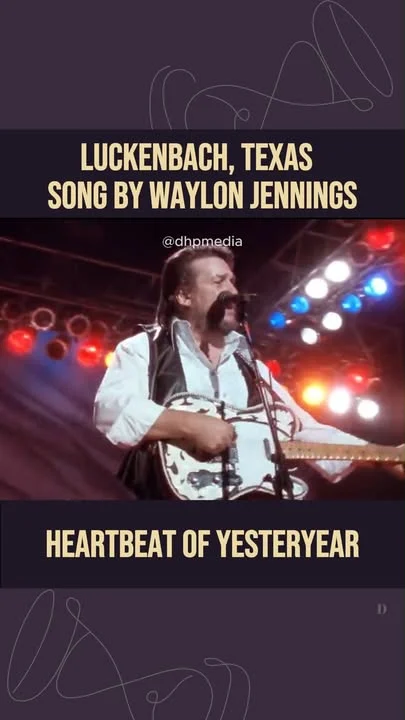
The first notes of an acoustic guitar hum softly, as if the strings themselves are sighing with relief. Then that voice—gritty, weathered, yet tender—begins to sing about leaving behind the noise and returning to what truly matters. For millions of listeners, Waylon Jennings’ “Luckenbach Texas (Back to the Basics of Love)” is more than a song. It’s an invitation to step off the treadmill of modern life and find solace in a tiny Texas hamlet where love and good company are all you need. Released in 1977, this track has become a timeless anthem, embodying the very soul of the outlaw country movement Jennings helped pioneer.
The story of this beloved track begins with the album that carried it into the world. Ol’ Waylon, released in 1977, arrived at a critical moment in country music history. Nashville’s polished production and commercial formulas were dominating the airwaves, but Jennings and his fellow outlaws were pushing back with raw, unfiltered sound. Ol’ Waylon was a declaration of independence. It mixed traditional country storytelling with a rock-infused edge, steering clear of slick studio tricks in favor of honest, straight-from-the-heart performances. The album became an instant commercial success and is widely regarded as one of Jennings’ most influential works. Within its grooves, “Luckenbach Texas” found its perfect home, capturing the essence of a movement that valued authenticity above all else.
From the moment the song begins, the listener is wrapped in a gentle acoustic guitar melody. The arrangement remains sparse and intentional—a steady bass line, a restrained drum beat, and the soft presence of a piano that adds depth without stealing the spotlight. This deliberate minimalism allows Jennings’ voice to take center stage. His delivery is both gritty and vulnerable, as though he’s sharing a personal confession with an old friend. The harmonies that rise in the chorus create a sense of community, echoing the togetherness that the lyrics celebrate.
We don’t need much to be happy—just love, music, and good company.
That simple truth runs through every line of the song. Jennings sings of a life unburdened by fame, money, or materialism. He contrasts the artificiality of the modern world with the honest comfort found in a small Texas town. Luckenbach becomes more than a place on a map; it transforms into a state of mind. It’s a refuge where people can connect with one another in a way that feels genuine and fulfilling. The song is both an invitation to slow down and a declaration that real happiness lies in the basics of love and human connection.
The legacy of “Luckenbach Texas” has only grown stronger with time. It remains one of Jennings’ signature songs and a cornerstone of the country music canon. The track’s ability to resonate across generations speaks to its universal theme: the longing for a simpler, more meaningful life. It has been covered by numerous artists and continues to be a touchstone for fans who appreciate the true spirit of outlaw country—an embrace of individuality, authenticity, and gentle rebellion against the mainstream.
For those who find themselves drawn to this song’s honest charm, a few other tracks carry a similar spirit. “Mammas Don’t Let Your Babies Grow Up to Be Cowboys” by Waylon Jennings and Willie Nelson shares the same laid-back vibe and timeless message about life’s complexities. Willie Nelson’s “On the Road Again” captures the joy of freedom and simplicity. Merle Haggard’s “If We Make It Through December” offers a poignant reflection on life’s struggles and simple joys. And Hank Williams’ “Jambalaya (On the Bayou)” brings an upbeat celebration of tradition and connection to the land. Together, these songs form a playlist that celebrates the heart of country music at its most genuine.
Decades after its release, “Luckenbach Texas (Back to the Basics of Love)” continues to transport listeners to a place where life slows down and love matters most. Waylon Jennings crafted more than a hit—he created a lasting reminder that the best things in life are often the simplest. In a world that grows more complicated by the day, that message has never felt more necessary.