
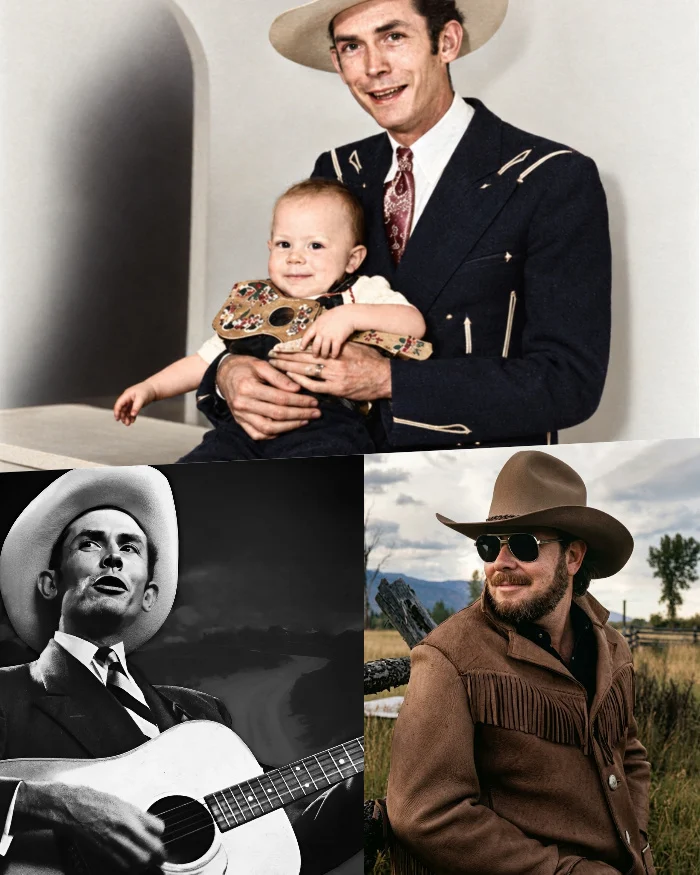
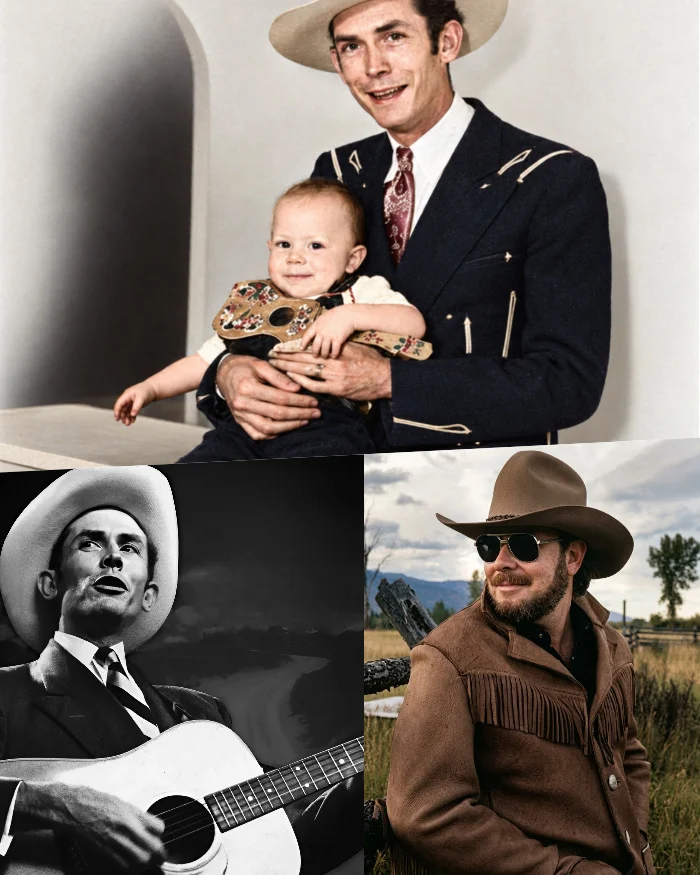
The porch was cold. The winter air bit through the coat of a broken man. Hank Williams knelt beside his three-year-old son and held him like a goodbye he could not fully say. That tiny embrace on a Nashville doorstep became the last living memory Hank Jr. carried of his father.
In mid-December 1952, Hank pulled up to his former home on Franklin Road. His divorce from Audrey Sheppard had been settled months earlier, and the house still carried the strain of a marriage ending in public. He came back between tour dates for one reason. He wanted to see his children.
At twenty-nine, Hank looked far older than his years. Spina bifida occulta had left him with relentless spinal pain. Muscle deterioration, prescription sedatives, and alcohol had worn him down. He moved slowly up the porch steps and crouched to meet Randall Hank Williams, the boy his family called Bocephus.
His thin hands gripped the child’s shoulders. He pulled the boy against his worn wool coat. He rested his chin near the boy’s hair, breathing hard, and pressed a kiss to his forehead. Then he spoke in a low voice.
Always be a brave young man.
Before leaving, Hank paused at the car door. He watched the children play in the yard for a moment, then drove away alone into the southern winter. Neither father nor son knew that the porch kiss would become a final chapter.
Two weeks later, in the early morning hours of New Year’s Day 1953, Hank died in the back seat of a rented powder-blue Cadillac near Oak Hill, West Virginia. He was heading to a show in Canton, Ohio. He was twenty-nine, and country music lost one of its most powerful voices.
For Hank Jr., the memory stayed small and enormous at the same time. A brief hug. A worn coat. A father’s quiet request. His mother later placed him on stage before he had reached ten years old. In miniature Western suits, he held a guitar and tried to sound like the man he barely remembered.
That burden shaped a lifetime. Decades later, by the mid-1970s, Hank Jr. pushed away from Nashville’s strict traditional mold. He fused southern themes with loud electric southern rock and became an outlaw country giant. The boy who heard his father’s final words carried them into every song, every rebellion, and every scar.