
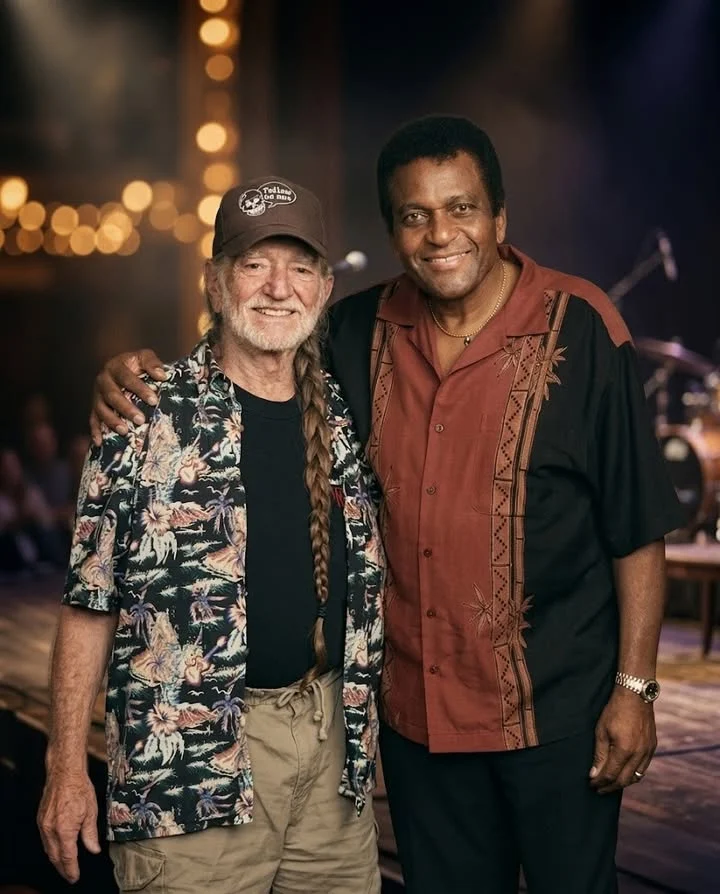
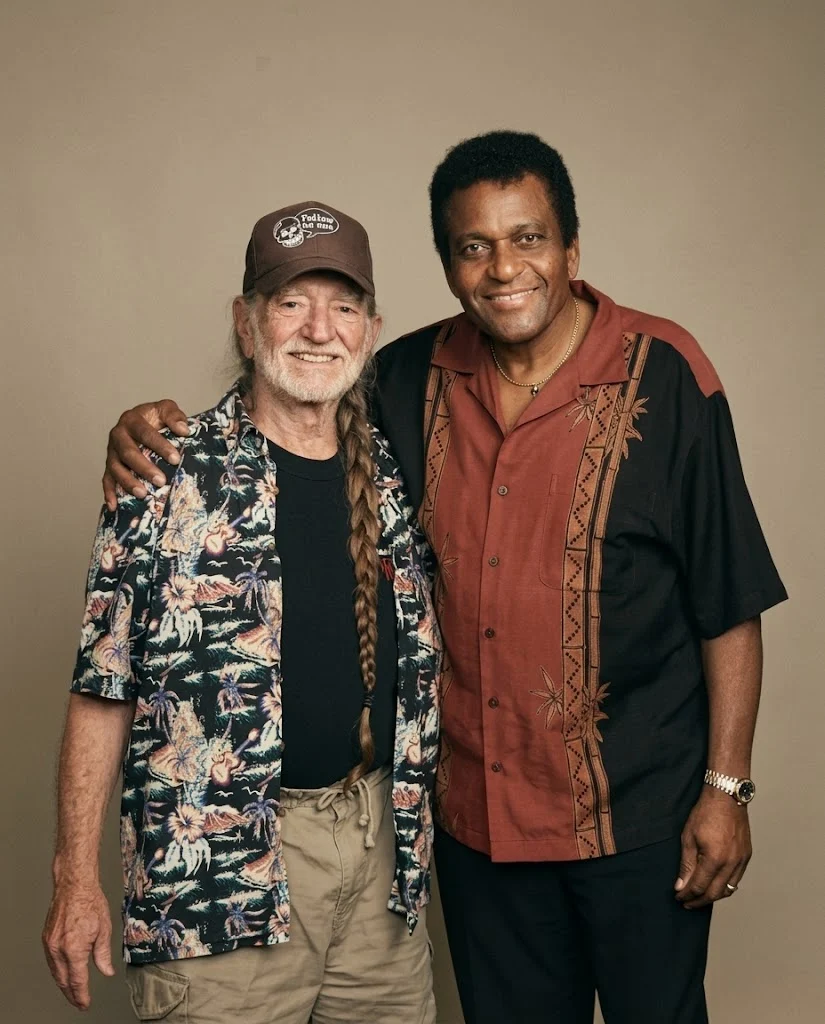
The lights burned bright and the crowd fell silent.
Charley Pride stood alone at the microphone in a conservative Texas town, and the air felt dangerous.
His smooth baritone had already won listeners across the American South in the mid-1960s.
His record label had sent his music to radio stations without a photograph, so many fans had never imagined the voice belonged to a Black man.
That illusion vanished the moment he stepped onstage.
Applause stopped.
Folded arms replaced cheers.
The silence carried a real threat, and one wrong move could end his career before it truly began.
Willie Nelson watched from the wings.
He was already an established and rebellious force in Texas country music.
He understood the mood of the room, and he understood what Pride needed.
Nelson did not seize the microphone.
He did not offer a long speech about equality or civil rights.
He walked straight to Pride and kissed him square on the mouth in front of hundreds of stunned spectators.
It looked like a casual greeting.
It acted like a rescue.
The message was plain.
This man is my brother, and if you accept me, you must respect him.
The tension broke into nervous laughter and relief.
Pride finally had room to breathe.
He leaned into the microphone and let his unmistakable voice do the rest.
The crowd warmed, and a permanent Country Music Hall of Fame career began to rise from that fragile moment.
Nelson had used his own standing to shield one of country music’s most important voices when Pride was most vulnerable.
Their bond grew deeper behind closed doors.
The two men traveled the grueling touring circuits of the deep South, where racism and risk could follow every show.
Years later, on a private tour bus, Pride playfully returned the exact gesture and kissed Nelson.
That shared laugh sealed a brotherhood that outlasted the bitter politics of their era.
Nelson later fixed the friendship into the permanent record of country music.
In his 1971 road classic Me and Paul, dedicated to his closest confidant and drummer Paul English, Nelson made sure Pride belonged in the story.
He sang about playing a show in Laredo, Texas, alongside Charley Pride.
By naming him, Nelson placed the baritone in the center of the country outlaw mythos.
Pride was never a novelty.
He was never an outcast.
Charley Pride forced Nashville to listen through sheer talent.
Yet the hardest door he ever faced opened in a quiet Texas dance hall.
He did not have to push it alone.
A rebellious songwriter walked out, embraced him, and showed the room where country music was heading.