
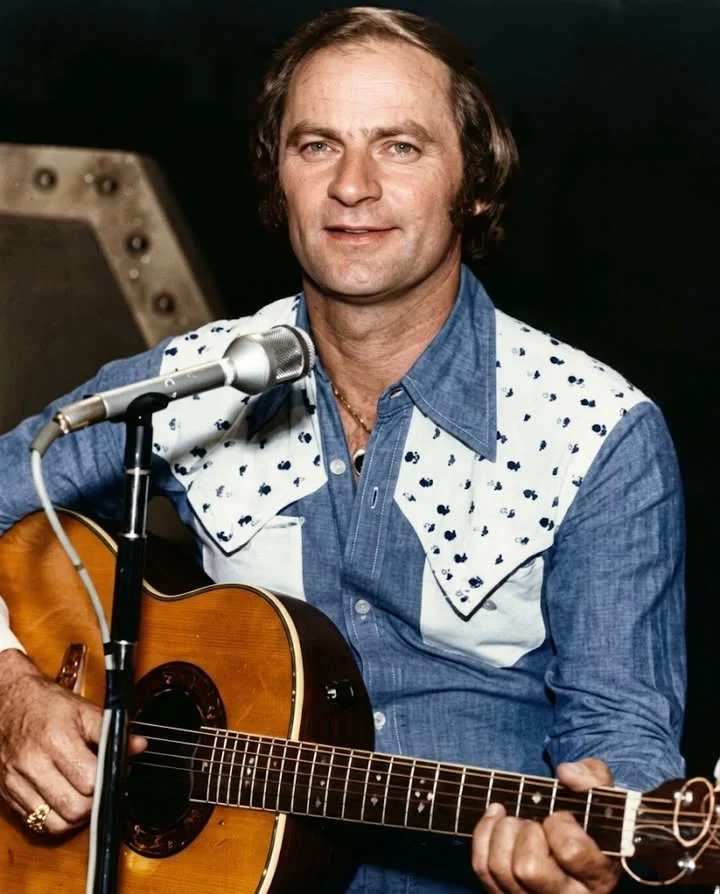
Long before Nashville called him The Voice, Vern Gosdin nearly let the dream die in a glass shop in Atlanta.
He had been a welder in California, a farm boy from Alabama, a gospel singer beside his mother’s worn piano, and a brother chasing harmony with Rex. Then the music stopped.
Born in August 1934 in Woodland, Alabama, Gosdin grew up among nine children on rocky soil that asked for sweat before it gave anything back. Music was not a luxury there. It was the brief relief that made hardship feel bearable.
His legendary baritone took shape beside his mother’s piano, where gospel songs taught him how to carry sorrow without shouting it. Years later, he and Rex stood before a microphone at WVOK radio in Birmingham, and the foundation was already deep.
In 1953, the Gosdin brothers left the farm. They moved to Chicago, then to California, chasing a wider horizon. The West Coast did not hand them a stage. Gosdin worked as a welder and sold glass among cold steel and flying sparks, keeping his ambition alive through exhaustion.
That blue collar grit became his sound. In the 1960s, The Gosdin Brothers rose through West Coast bluegrass and the growing country rock scene, even sharing studio and stage time with The Byrds around 1966.
But the dream stalled. As the 1960s faded, Gosdin did something rare for a future legend. He quit.
By the early 1970s, he had moved to Atlanta, opened a glass business, and traded the microphone for a quieter life. For years, one of the most natural country voices in America was selling glass instead of singing heartbreak.
Then Emmylou Harris found his song Hangin’ On and recorded it. Her interest pulled Gosdin back toward the microphone, and in late 1976 he traveled to Nashville to work with producer Gary S. Paxton.
Those sessions became the turning point. With Harris providing harmony, Gosdin released his own version of Hangin’ On and the hit Yesterday’s Gone in 1977. The Atlanta glass salesman became a chart topping traditionalist almost overnight.
When Nashville began leaning toward slick pop production, Gosdin offered something raw. His voice carried Alabama dirt, California steel, failure, faith, and the ache of a man who had learned that pain could be sung.
George Jones and Tammy Wynette heard that purity. They were not hearing a singer chasing radio fame. They were hearing The Voice, a title earned by out hurting others on a track.
He never needed to pretend to know heartbreak. He just opened his mouth, and the truth poured out.
Throughout the 1980s, he delivered definitive country anthems, from Set ‘Em Up Joe to the CMA award winning Chiseled in Stone. Each song sounded like a man alone at a dim honky tonk table, telling the hard news with grace.
Vern Gosdin’s legacy was not built under bright lights alone. It was forged in dust, sparks, silence, and return. The welder became The Voice because every note carried the weight of a real life.