
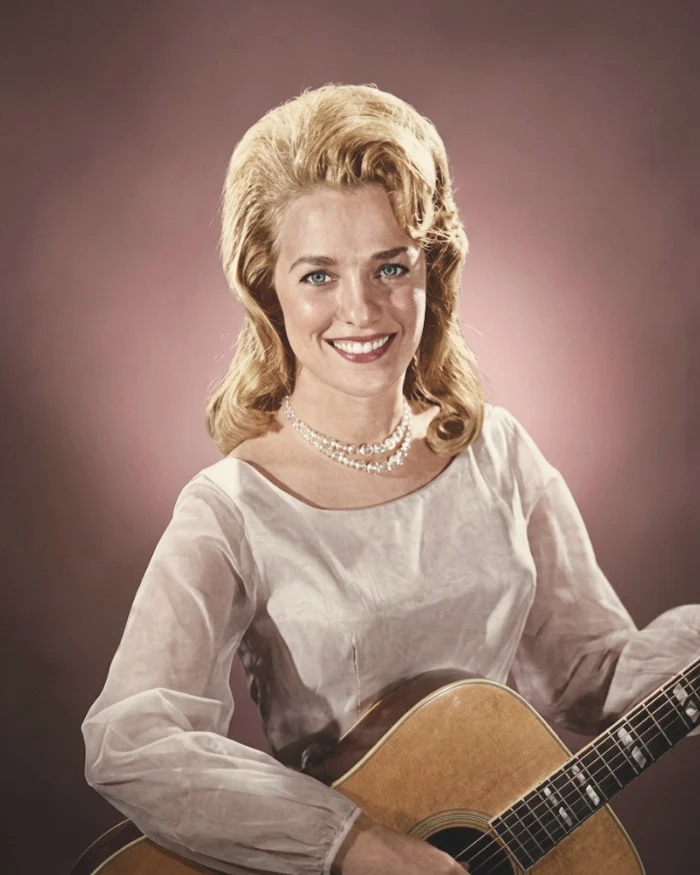
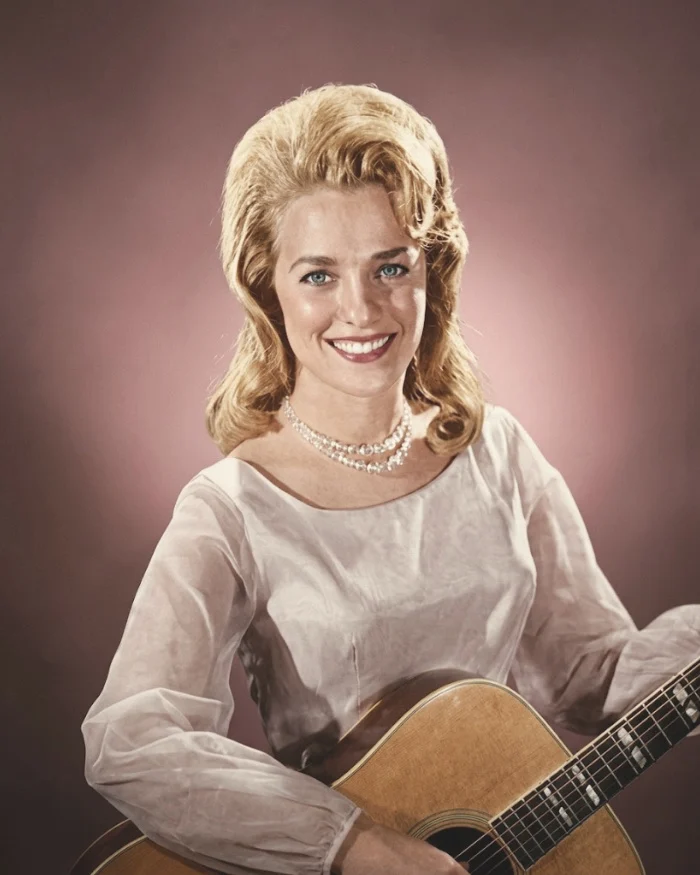
Seven dollars bought a battered guitar. It also bought Connie Smith a way through terror, silence, and a recovery that nearly took her leg.
In 1959, she was eighteen and trapped in a recovery bed after a lawnmower accident cut deeply into her leg. The wound nearly forced an amputation. Months of stillness followed. Her world shrank to the claustrophobic walls of her room. She feared a life in a wheelchair, yet she hid the fear from her overwhelmed family and endured physical agony and profound isolation in silence.
Desperate for any distraction from the heavy quiet, she spent her entire savings on the scratched acoustic guitar from her uncle. With her leg bandaged and her mobility gone, she held the guitar against her chest and taught herself clumsy chords. The bruised wood became her sanctuary. It gave her a place to release tears and frustration she could not say aloud.
What began as a seven-dollar coping mechanism slowly became a lifeline. As her body healed, the crude chords unlocked a fierce natural talent. The accident had grounded her, but the cheap guitar gave her wings and forged the aching unmatched vocal power that would make her a country music legend.
Four years later, that same voice carried her onto a stage near Columbus, Ohio. In August 1963, Constance June Meador, an Ohio housewife and young mother in her early twenties, stepped into a talent contest at Frontier Ranch country music park. She had not planned a professional career. She had grown up in a working-class family of fifteen children, where noise and motion had shaped her days. Her injury had forced stillness, and the guitar had become the vessel for her untrained vocal power.
When she entered the talent contest, she brought that raw aching delivery to the microphone. Bill Anderson, an established Nashville hitmaker who was already writing hits and performing regularly, sat in the audience as a guest judge. He was struck immediately by the piercing clarity and emotional weight of her voice. He heard something a studio could not manufacture.
The sound on the small Ohio stage carried the ache of the long recovery and the strength she had hidden.
Anderson did not just offer polite encouragement. He took an active role in her future and helped secure demo recordings. By early 1964, his manager Hubert Long presented the tapes directly to legendary producer Chet Atkins at RCA Victor in Nashville.
Atkins, the chief architect of the Nashville Sound, heard exactly what Anderson had heard at the Ohio park. On June 24, 1964, the major label formally offered the young singer, now going by Connie Smith, a recording contract.
The transition from a small-town talent contest to the center of the country music industry happened with stunning speed. On July 16, 1964, Smith walked into an RCA studio for her very first recording session. She cut four tracks that day. Three of them had been written specifically for her by the man who had discovered her at Frontier Ranch.
Among those Anderson compositions was Once a Day, a song that perfectly fit the vulnerable heartbreak-heavy tone Smith had unknowingly developed during her long recovery.
The Nashville establishment immediately recognized her arrival. Just two days after completing her first studio session, Smith stepped into the wooden circle at the Ryman Auditorium to make her debut on the Grand Ole Opry.
When RCA released Once a Day to radio in late summer, it did not just chart. It completely took over. By November 1964, the song had become a country music sensation, turning the girl from the recovery bed into a legend.